


|
|
|
|
|
BIBLIOGRAPHYKA ////////// PREHISTORIKA
 |
ANCIENT HUNTERS
and their modern Representatives
by
W. J. SOLLAS
PREFACE
The substance of this work, at least in its main outlines, was first set
forth in a course of three lectures delivered before the royal Institution in
1900, and subsequently published as a series of articles contributed, at the
request of the Editor, Dr. N. H. Alcock, to Science
Progress.
My original intention was simply to gather these together and to
republish them in book-form with adequate illustration. But in the meanwhile
the rapid progress of discovery had rendered necessary so many changes in the
text that I took advantage of the opportunity to introduce a good deal of
additional matter, and to enlarge the short summaries treating of recent
hunting races, especially the Australians and Bushmen.
The manuscript as delivered to
the printers in 1910 contained an account of our knowledge as it existed up to
the end of the previous year; since then, however, many important discoveries
have been made known; to render an account of them all was impossible, but by
the kind indulgence of Messrs. Macmillan, I have been able to incorporate such
as are of more than usual interest, particularly to myself. This must be my
apology to those Authors whose recent work finds 110 mention. I especially
regret that -1 been unable to refer to Mr. Marett’s account of his explorations
in Jersey, and the important conclusions to which they lead on the oscillations
of land and sea.
My thanks are due to a number of friends who have assisted me in my
studies. In France, our great teacher in these matters, I am indebted first to
M. Cartailhac, the Nestor of prehistoric Archaeology, through whose kindness I
enjoyed, in company with my friend Mr. Marett, an unrivalled opportunity of
studying the painted caves of Ariege and the Hautes Pyrenees, and next to Prof.
Breuil and M. Peyrony, who made us acquainted with those of Dordogne, to Prof.
Boule, who introduced me to the fossil man of La Chapelle-aux-Saints, and to M.
Commont, who initiated me into the mysteries of the Mousterian industry. In
Germany I learnt much from Dr. R. R, Schmidt, who guided my studies of the Paleolithic
deposits of Würtemberg; in Belgium from M. Rutot, whose kindness and
information are both inexhaustible, as well as from Professors Fraipont and Max
Lohest, the discoverers and expounders of the skeletons from Spy. In England my
old friend the Rev. Magens Mello guided me through the caves of Creswell Crag;
Dr. Sturge made me at home among the treasures of his great collection,
probably one of the finest collections of flint implements in the world; Prof.
Tylor, Prof. Haddon, Mr. H. Balfour and Mr. Montgomery Bell, have assisted me
in the most efficacious manner, by frank discussion, and the late Mr. Pengelly
many years ago led me with humorous and illuminating discourse through the
recesses of the famous Kent’s Hole, near Torquay.
I am also under great obligations to those generous friends and
colleagues who have given me permission to borrow illustrations from their
published works; in every case acknowledgement has been made of the source, but
I desire in addition to express my especial thanks to Professor Boule and the
publishers of L’Anthropologie, who
have allowed me to ransack this thesaurus and to carry away from it some of my
richest spoils; to M. Commont, whose figures of Mousterian implements are all
from his own collection; to the Smithsonian Institution for the use of many
illustrations published by the Bureau of American Ethnology, and to the “Commission
for Ledelson af de geologiske og geographiske Undersogelser i Gronland,” for
the use of illustrations published in the Meddelelser
om Gronland.
I have also to thank my assistant Mr. C. J. Bayzand for the skilful
manner in which he has prepared the illustrations for publication; many of them
have been redrawn by him.
I believe this is the first time that a general survey has been
attempted—at least in the English tongue—of the vast store of facts which have
rewarded the labours of investigators into the early history of Man during the
past half-century. It is difficult to over-estimate their importance; they
afford a new picture of the mode of life and intellectual status of our
primitive predecessors, differing in many of its details from that which
suggested itself to the imagination of earlier investigators.
In reviewing the successive Paleolithic industries as they occur in
Europe, I find little evidence of indigenous evolution, but much that suggests
the influence of migrating races; if this is a heresy it is at least
respectable and is now rapidly gaining adherents. In a collateral branch of
enquiry it has been powerfully advocated by Graebner and it received the
support of Dr. Rivers in his recent important Address to the British
Association at Portsmouth.
No allusion has been made to the belief so strongly held by Piette that
the Aurignacians had learnt to bridle the horse, because the evidence seemed
insufficient to establish so startling a conclusion; now, however, we have
reason to believe that the Magdalenians drove behind a reindeer harnessed to a
sledge, Piette’s view acquires a fresh interest, and deserves renewed
investigation.
In every branch of Natural Science progress is now so rapid that few
accepted conclusions can be regarded as more than provisional; and this is
especially true of prehistoric Archaeology. General views, whatever other
interest they may have, are chiefly useful as suggesting the way to fresh
enquiry. If the brief summary presented in the present work should have happily
that effect, it will have exceeded my anticipations in accomplishing its aim.
W. J. SOLLAS.
University College, Oxford.
September, 1911.
CONTENTS
CHAPTER I THE GREAT ICE AGE
CHAPTER II THE ANTIQUITY OF MAN
CHAPTER III EOLITHS
CHAPTER IV EXTINCT HUNTERS. THE TASMANIANS
CHAPTER V THE MOST ANCIENT HUNTERS
CHAPTER VI MIDDLE PALAEOLITHIC
CHAPTER VII THE AUSTRALIAN ABORIGINES
CHAPTER VIII THE AURIGNACIAN AGE
CHAPTER IX THE BUSHMEN
CHAPTER X THE SOLUTRIAN AGE
CHAPTER XI MAGDALEXIAX MAN
CHAPTER XII THE ESKIMO
CHAPTER XIII THE AZILIANS
CHAPTER XIV CHRONOLOGY
ANCIENT HUNTERS AND THEIR MODERN REPRESENTATIVES
CHAPTER I
THE GREAT ICE AGE
The changes which have affected the face of the earth since the dawn of
recorded history are comparatively few and unimportant. In some regions, as in
the British Isles, great tracts of forest and marsh have been replaced by
cultivated land, and some few species of wild animals, such as wolves and
bears, have been exterminated; but, so far as we can judge, the climate has
remained the same, and no movements have permanently disturbed the level of the
sea. The recent period seems to have been one of geological repose, affording a
peaceful and stable arena for the great drama of human existence. The historian
consequently may pursue his researches untroubled by disturbances of the
environment, accepting the world as it now is, as that which, so far as he is
concerned, has always been. But directly we extend our inquiries into
antecedent periods, and endeavour to recall the story of our species from the
unwritten past, we are conscious of a new regime : not constancy, but change
seems to dominate the environment. The climate loses its stability; it swings
slowly to and fro between extremes of heat and cold, of moisture and dryness,
in long oscillations several times repeated. Harmoniously with these,
successive assemblages of living forms—southern, temperate, northern—faunas of
the forest, the tundra, and the steppe—make their appearance in the temperate
European zone, disappear to reappear, and then finally vanish, either
altogether or into remote regions of the earth.
Even the land itself ceases to maintain its solid firmness, but subsides
over larger or smaller areas beneath the waters of the encroaching sea, or in
some places rises to greater altitudes, and even shares in the increasing
growth of mountain chains.
No doubt, in a retrospective glance, we are liable to a deceptive effect
of perspective, and events widely separated in fact appear unduly crowded
together by foreshortening. We are not, however, altogether without the means
of making an appropriate correction for this illusion. The geological scale of
time, though far from exact, is sufficiently so for the purpose, and, judged by
this standard, the duration of the latest epoch of terrestrial history, known
as the Pleistocene, cannot have exceeded some three or four hundred thousands
of years. It corresponds with the chief period of human development, and
includes four complete oscillations of climate; one of them being of much
longer duration than the rest.
The Great Ice Age.—Of the many
changing elements which contribute to the geology of the Pleistocene epoch,
climate is one of the most important, and to this, therefore, in the first
place, we will turn our attention. The recent existence of a great Ice age was
first divined by Schimper, the poet-naturalist, whose enthusiasm fired the
imagination and stimulated the researches of the indefatigable Agassiz.
As a result of his investigations, Agassiz announced his belief that the
earth had passed at no distant date through a period of extreme cold, when ice
and snow enmantled a large part of its surface. Attempts, persisting even down
to the present day, have been made to overturn or belittle this conclusion, but
with very imperfect success, and it now stands more assured than ever. As the
number of observers increases scarcely a year passes which does not bring some
important discovery to bear additional testimony to its truth.
The evidence 0n which Agassiz based his views was derived, in the first
instance, from a study of the Swiss glaciers and of the effects associated with
their existence. The contemporaries of Agassiz—Forbes and Tyndall— and
subsequent generations of scientific explorers have pursued their researches in
the same region; and this land of lofty peaks, which has furnished inspiration
to so many great discoverers in other branches of science, is thus
pre-eminently classic ground for the glacialist. Let us then commence our
studies in the Alps, and, as a preliminary to further investigation, make
ourselves acquainted with phenomena now alien to our land
The Gorner Grat. —
When Agassiz began
his researches, glaciers were but little known, even to the travelled
Englishman; now a crowd of summer visitors makes holiday upon them. It matters
little to which of the many glacier systems we direct our attention; perhaps
one of the best known is that which contributes to the astonishing panorama
unfolded before us from the Gorner Grat. Dominating the scene is an
array of majestic snowy peaks. On the extreme left stands the mighty complex
mass of Monte Rosa, then the Bretthorn; in front of us the Matterhorn rises in
its superb and isolated grandeur; farther to the right come the Dente Blanche, the Gabelhorn, the Rothhorn; and last, the shapely Weisshorn, which from some
points of view, but not here, offers the most complete realization of the ideal
of mountain beauty.
Below lies a wide valley, filled deep with a mass of slowly flowing ice,
fed by many tributaries pouring down from the broad snow-fields which sweep
around and between the mountain fastnesses. Two main streams—the Grenz and the
Gorner glaciers—unite 011 almost equal terms, and flow together as the Boden
glacier, which comes to an end at the upper margin of the Hinter Wald, above
Zermatt, where it melts away into the hurrying Visp.
Suppose now that by some magic wand we could wave away all these streams
of ice, and dismantle the mountains of their snowy robes, leaving the rocks
exposed and bare. A strange and wonderful landscape would then stand revealed;
the valleys, as far up as the ice had filled them, would be modelled in smooth
and round and flowing outlines, in striking contrast to the rugged forms of the
frost-splintered mountain summits. Angular fragments of rock, some of them very
large, the remnants of the lateral moraine, would lie scattered over the valley
sides, marking the line where the glacier had lapped against its banks; and a
heap of debris, confusedly piled together, would stretch across the valley in a
broken crescentic mound, like the ruins of a great natural dam. This is the
terminal moraine, and marks the end of the vanished glacier. Behind it we might
see a basin-like depression, in which the glacier had sunk itself by abrasion (Fig. 1); and within this, rising from its
surface, elongated hummocks, or drumlins, of boulder clay. These radiate from
the centre of the basin outwards, streaming like a swarm of fishes swimming
against a current. They record the streamlines of the once flowing ice.
When we have razed 0n the desolate scene long enough to distinguish its
principal features, we will descend from our eyrie and examine them more in
detail. The smoothness of rounded outline which we have already remarked is
found to be due to the abrasive action of the glacier, which has ground away all
the asperities of its bed; crags and jutting rocks have been worn down into
rounded bosses (roches moutonnées) (Fig. 2), the smooth surfaces of which are
striated by grooves and scratches all running in the same direction as that
once taken by the glacier in its flow.
The drumlins consist of a tough clay, crowded with stones of all sorts
and sizes, but bearing very remarkable features by which they are readily distinguished.
Originally angular fragments, they are now subangular, their sharp edges and
corners having been ground away and rounded off by the ice; their flattened
faces are smoothed and polished, and covered with scratches which run in
parallel groups, generally in the direction of the longest axis of the stone,
but occasionally crossing it (Fig. 3). The whole assemblage of scratched stones
and clay is known as till or boulder clay.
Such, then, are the signs which would be left behind on the
disappearance of the ice.
It requires no magic wand to bring about the transformation we have
imagined; an amelioration of climate will suffice. Even at the present time
the Boden glacier, like so many other great glaciers in Switzerland, is
diminishing in bulk ; its surface, instead of bulging up,
Effects of Refrigeration. — Let us now suppose that the climate, instead
of ameliorating, grows gradually more severe. The Boden glacier will be more
richly replenished by its tributaries; it will bulge upwards and downwards, and
descend farther into the valley of the Visp; if the mean annual temperature
falls low enough—say, 5° C. below the present—it will extend downwards till it
reaches the valley of the Rhone All the glaciers which lie in valleys tributary
to the Rhone will similarly enlarge, as will the glacier of the Rhone itself.
The Rhone Valley.—If, bearing this possibility in mind, we walk down the valley of the Visp, we shall discover on ever side signs of an ancient extension of the ice, and on the most stupendous scale. The swollen Visp glacier evidently soon became confluent with that which filled the Sasstal, and their united volume then entered the glacier of the Rhone. This, which now ends close to the Furca, had then already attained there a thickness of some 5.000 ft., and overflowed the Grimsal pass (Fig. 4). Farther down, where the Sasser-Arisp glacier entered, it was even thicker. Filling the valley, it pursued its course past the bend at Martigny, and emerged from the Alps to overwhelm, in a great fanshaped expansion, all the region now occupied by the lakes of Geneva and Neuchatel; it rose against the flanks of the Jura to a height which shows it to have possessed, even at this distance from its source, a thickness of over 3,000 ft. But it did not terminate here ; it surmounted the Jura, and debouched 011 the plains of France (Fig. 4).
There it deposited its
terminal moraine,
Switzerland in the Ice Age.—As might have been expected, this increase
in volume was not confined to the glaciers of the Rhone valley. All the
glaciers of Switzerland were affected in a corresponding degree; and the whole
of this territory, now dotted over with numberless farms and villages and with
great towns like Zurich and Geneva, was buried beneath a continuous sheet of
snow and ice.
The Ice Sheet of Northern Europe.—It is not
necessary to visit Switzerland to become familiar with the signs left by
the ancient ice of the Glacial epoch; they surround us 0n every hand at home,
and are amongst the commonest features of the mountainous parts of our
land. Smoothed and striated surfaces, boulder clay and superficial morainic
material,
testify to the passage of the ice, indicate its direction, afford
evidence of its thickness, and mark its boundaries.
The Ice Sheet of North America.—At the same time a large part of North America was overwhelmed (Fig. 7). The great terminal moraine which marks the southern boundary of the ice can be traced with occasional interruptions from Nantucket, through Long Island past New York, towards the western extremity of Lake Erie, then along a sinuous course in the same direction as the Ohio, down to its confluence with the Mississippi; then it follows the Missouri as far as Kansas City, and beyond runs approximately parallel to that river, but south of it, through Nebraska, Dakota and Montana, and Washington, where it meets the coast north of Columbia river. Within this boundary nearly the half of North America was buried beneath a thick sheet of ice, flowing more or less radiately outwards from a central region situated m and about the region of Hudson Bay. The coexistence of two continental ice-caps, one on each side of the Atlantic Ocean, is a sufficiently impressive fact, and that the Oeean itself enjoyed no immunity from the rigours of the time is shown by the discovery of boulders, which appear to have been carried by ice, in close proximity to the Azores (about lat. 38° N.). A review of the evidence may fairly lead us to conclude that a general lowering of the temperature, probably to the extent of about 5° C., affected the whole of that part of the Northern hemisphere which lies outside the Tropic of Cancer.
Ancient Glaciation in the Southern Hemisphere.— A similar fall of
temperature seems to have affected the Southern hemisphere. If we turn to our
antipodes we discover obvious signs of the former existence of glaciers in the
Kosciusko plateau or Muniong range of New South Wales (lat. 36° 22' S., height
7,328 ft.). The snow-fields 0n the watershed gave birth to glaciers which
flowed down the valleys on each side; to the west to a level of at most 6,300 ft.,
to the east of 5,800 or perhaps 5,500 ft. The largest of these glaciers was
only a few hundred feet in thickness and three miles in length. The facts
observed in the Kosciusko plateau indicate a former lowering of the snow-line
to the extent of 2,200 to 2,700 ft.
Ancient Glaciation in the Tropics.—If the temperate regions of both
hemispheres experienced a lowering of temperature at all approaching 5° C. the
tropics themselves could scarcely remain unaffected, and we might expect to
find some signs of a colder climate even in the torrid zone. Though these signs
are to be sought in regions which are difficult of access and rarely
The Whole World was Affected by the Glacial Climate.—Thus, to whatever
region we turn, our inquiries elicit the same facts. Alike in Northern Europe
and Southern Australia, in the Peruvian Andes or the isolated cones of Central
Africa, the evidence points to a considerable lowering of temperature in
comparatively recent times, corresponding with the last glacial epoch. Thus the
Great Ice Age clearly deserves its name; it affected the whole of our planet,
and can scarcely have failed to influence in a high degree the history of its
inhabitants.
Oscillations of Climate.—Of late years investigations bearing, if
possible, even more immediately 011 our subject, have been directed to the
succession of events, or the inner history, of the Glacial epoch.
River Terraces.—The accompanying illustration (Plate 2), which I owe to
the kindness of Prof. Penck, represents one side of the valley of the Steyr. On
close examination it will be seen to display a number of parallel terraces,
almost horizontal, and running with great regularity in the same direction as
the valley. The lowest of these terraces forms a broad field through which
runs the poplar-bordered road from Steyr to Sierning. It descends by a steep
slope, about 50 ft. in height, to the river. Nearly 70 ft. above it, the
surface of the second terrace, is seen; one of the characteristic
farmhouses of Upper Austria stands upon this. Immediately behind it follows the
third terrace (m), and above this again the highest terrace, which forms a
plateau of considerable extent. Such terraces are not confined to the valley of
the Steyr; they are common in many of the great valleys of the Eastern Alps, of
the Western Alps also; they occur very generally over Europe, and indeed in
all the glaciated regions of the globe.
These terraces can be traced down the valley of the Steyr into the
valley of the Enns, and then onwards towards the Danube; two of them, indeed,
the uppermost and lowermost, actually reach the bank of this stream. They can
also be traced upwards towards the mountains, extending with considerable
interruptions, over a course of forty or fifty miles. The pits, wliicli are dug
into them here and there, afford an insight into their structure and composition.
Entering one of these, we observe beds very much resembling gravel, very
coarse, and cleanly washed, made up of pebbles varying from about 2 in. to 6
in. in diameter. On the whole they are rather evenly stratified, though
sometimes they form oblique layers (false bedding), and include occasionally
lenticular patches of sand or loam. To these deposits the Germans give the name
of shotter (schotter), a term we shall find it convenient to adopt. The shotter
have evidently been deposited by swiftly running water; they mark the course of
a rapid river.
A question of capital interest now presents itself; what are the relations, if any, between the terrace and the moraine? The answer to this has been given by Penck, who has shown that the river terrace loses itself in the moraine; the two meet and interdigitate with each other. Where the glacier gave birth to a river, there the moraine passes into a terrace. As there are four terraces, so there are four moraines, one to each each terrace. A consideration of these facts leads to very important consequences. In attempting an explanation let us begin with the first or highest terrace. To account for the formation of the thick sheet of shotter it represents, we must assume the existence of a river so heavily overburdened with detritus, that it had little or no power to erode; it could carry away the material of the moraine, round the angular fragments into wellworn pebbles, and distribute them far and wide over its valley floor, but it could not deepen its channel. Its energy was restricted to building up a sheet of shotter, over a hundred feet in thickness, which stretched from side to side of the river valley. This sheet of shotter represents the first stage in the formation of the terrace (a, Fig. 9). Of the sheet so formed only the first terrace, a mere remnant, a narrow selvage, now exists, lining the side of the valley ; the river which previously deposited it has since carried the greater part of it away. It seems natural to assume that the river had acquired a higher degree of activity, probably as a consequence of increased volume and velocity ; and its enhanced power is still further shown by the fact that after removing the shotter it was able to wear its way down into the harder rocks beneath, and has actually deepened its valley. Thus the terrace was cut out during a period of erosion which followed upon a period of deposition (b, Fig. 9). The second terrace involves a similar succession of events ; it points to a return to the earlier conditions, when the river, powerless to erode, spread out a second sheet of shotter over the newly excavated valley floor (c, Fig. 9); then came renewed activity, and the second terrace was carved out. The same is true of the third and fourth terraces, and thus we have repeated, time after time, an alternation of periods of deposition and periods of erosion. Such are the immediate inferences from the facts.
We must now take a step further, and attempt to account for this alternation of processes.
The interdigitation of the terrace with its
moraine shows that the terrace, or rather the sheet of shotter from which it
was carved out, was deposited during an interval when the glacier was
comparatively stationary, i.e. during an interval in which it built up its
terminal moraine. But when a glacier is stationary the amount of water
discharged from it is comparatively small, the annual discharge is indeed
precisely equal to the annual snowfall by which the glacier is replenished.
When the glacier is advancing the discharge is even less. Under these
circumstances the resulting river would be scarcely larger than the
corresponding river which now represents it, and its power to erode was at a
minimum.
If now we are to endow this river with
greater volume and velocity we must assume that the glacier commenced a
retreat, or in other words that more ice was melted away from it than was made
good by the annual snowfall ; and this retreat must have continued for no
inconsiderable period—it must have lasted at least as long as was necessary for
the sweeping away of the previously deposited shotter and the deepening of the
valley.
Thus, if this reasoning be valid, we are led
to greatly enlarge our conception of the glacial epoch: it was evidently 110
unbroken reign of ice, it was not a single episode, but a repeated alternation
of contrasted episodes. There were periods of predominant snowfall, when the
ice attained its maximum development, and the rivers were impoverished; and
alternating with these were periods of predominant rainfall, when the
accumulated ice of centuries melted away, and, adding its volume to the general
drainage, gave birth to swollen streams far surpassing in magnitude those with
which we are familiar in the existing Alps.
The great ebb and flow of temperature was at
least four times repeated; four times have the glaciers enlarged their bounds,
and four times have they been driven back into their mountain home.
Hypothesis.—Such
then is the hypothesis which arises from our contemplation of the river
terraces; there is much that is attractive about it, and it has the additional
advantage of completely explaining the facts, so far as they are known. Yet we
must not omit to point out that its author, Prof. Penck, admits it was
suggested by the writings of Prof. James Geikie, who in turn was inspired by
the theory of Adhemar, as advocated by Croll. At the present day, however,
there are few who accept the theory of Adhemar, and consequently the
explanation is discredited at its source.
Must we for that reason reject it? By no
means : we shall not condemn the prisoner at the bar on account of his
pedigree, or because he has been convicted of a previous offence. At the same
time, in making an unprejudiced inquiry into the case, we shall be more than
usually exacting in our demand for proofs.
We will therefore inquire whether there is any independent evidence in favour of these supposed interglacial or genial periods. It would seem that there is.
Hötting Breccia.—Every one, at least every geologist, who has visited Innsbruck, that delightful starting-place for the mountains, is familiar with the peculiar red stone which is so much used there for building. It comes from some neighbouring quarries situated on the northern slope of the Inn valley, near the village of Hotting. By walking down to the promenade along the side of the river vwe shall obtain a good general view (Fig. 10).
The
breccia is seen, at the height of about 500 ft. above the bottom of the valley,
as an almost horizontal band, several hundred feet in thickness, and very
conspicuous owing to the contrast of its reddish colour with the dark blue rock
beneath : its course can be plainly traced by the heaps of waste stone thrown
out
Thus the breccia is older than the last
glacial episode, and younger than the last but one, and may provision
Taken by itself the evidence we have so far
offered is not sufficient to establish so important a conclusion,
but fortunately it does not stand alone. The Hotting breccia is
fossiliferous, and has yielded a number of leaves and other remains of plants :
these fossils are indeed fairly common, and the visitor who should fail to find
at least a few examples would be singularly unfortunate. No less than forty-two
species have been identified ; they include among others the fir
(Pinus
Three of the most important plants we have
reserved for special mention : they are a new species of buckthorn,
The region round Hötting thus furnishes us
with evidence of revolutions of climate on the grandest scale; the lower
boulder clay, representing the third
It is fortunate for our argument that the
advancing
In the light of these facts the imaginary
sequence of events suggested by the river terraces acquires a greater
appearance of reality, so much so that we may now make use of these features in
our subsequeni inquiries.
The four terraces are ruled, as it were,
across the last page of terrestrial history; they are datum lines, which
enable us to divide the Pleistocene or Quaternary epoch into seven ages, the
first, second, third, and fourth glacial ages, with their three intervening
genial ages. We are thus provided with a chronological scale to le which we
can refer the more important events in the uff early history of the human race.
|
THE ANTIQUITY OF MAN
The dawn of the human race is supposed to belong to a past more remote than the beginning of the Great Ice age ; yet of the existence of man antecedent to that epoch not a vestige of evidence, forcible enough to compel universal belief, has up to the present time been discovered. Even Pithecanthropus, that singular ape-like form, which makes the nearest approach to the genus Homo, although referred by its discoverer to the Pliocene,1 has since been asserted 011 good authority2 to belong more probably to the Quaternary epoch.3
Thus a problem presents itself at the very outset of our investigation, and as a first step towards its discussion we may commence with an account of the just-mentioned Pithecanthropus.
1 Eugene Dubois, “ Einige van Nederlandschen Kant verkregen uitkomsten met betrekking tot de kennis der Kendeng-Fauna (Fauna van Trinil),” Tijdsclirift v. h. K. Nederl Aardrijk. Genoot, 1907, ser. 2, vol. xxiv. p. 449. _
2 W. Volz, “ Das geologische Alter der Pithecanthropus-Schichten bei Trinil, Ost Java,” Neues Jahrbnch f. Mineral., etc., Festband znr Feier des 100 Jahrujen Bestehens, Stuttgart, 1907, p. 256 ; Branca, “ Arorlaufiger Bericht,” etc., Sitzber. d. k. P reussische.n Ak. d. IUi'.s.s. Berlin, 1908, p. 261 ; K. Martin, “Das Alter der Schicliten von Sonde und Trinil auf Java,” K.'Ak. v. Wetenschaften te Amsterdam, 1908, p. 7.
3 The age of Pithecanthropus is not yet decided. J. Elbert thinks it lies between the Upper Pliocene and Lower Pleistocene (Dubois, “ Alter-bestitnnmng der Kendengschichten, ein Wort der Entgegnung,” Central-blatt fur Min. Geol. and Pal., 1909, No. 17, p. 513). Investigations are still in progress ; for the present we may adopt Elbert’s view.
20
Pithecanthropus erectus.—On the south Hank of the Kendengs, a range of low hills which traverse the eastern extremity of Java (Fig. 14), lies a gently undulating series of freshwater and volcanic deposits formed of consolidated clay, sand, and volcanic lapilli, altogether considerably over 1,000 feet in thickness. They rest on a marine bed of coral limestone
about 7 ft. thick, and below this is a bed of clay containing marine shells, all of which are preserved with their valves closed, a sign of sudden death, resulting probably from a volcanic eruption. Such an eruption might have heralded the birth of Lavu-Kukusan, a great twin volcano, more than 10,000 feet
in height, and not yet completely extinct, which rises, south of the Kendeugs, out of the gently undulating freshwater series.
The river Bengawan, which flows round a great part of the volcano, has cut its way down into the freshwater deposits to a depth of 50 ft., exposing a fine section just at the point where the river touches the Kendeng hills, near the village of Trinil (Fig. 15). A bed of lapilli at the base is especially rich in Mammalian remains. Vast quantities of bones have been exhumed,
|
Fig. 15.—1, Argillaceous marl (marine); 2, coral limestone; 3, argillaceous marl and sandstone ; 4, conglomerate ; o, clay; 6, chief bone-bearing bed ; 7, tuff and conglomerate ; 8, tuff; 9, tuff of lighter colour tint than 8; 10, white tuff; 11, tuff and conglomerate, u, Riverbed; b, bluish-black clay ; c, confused mass of beds. The remains of Pithecanthropus were found in the bone-bearing layer (6), where it begins to disappear below bed 7 on the right of the little anticline. (After Branca.) |
affording us. now that their affinities have been determined (E. Dubois, loc. cit.), a vivid picture of the life of the time. Various kinds of deer are richly represented : they include the “ Sambar,” still living in India, the “ Kidang,” still living in Java, and a new species, Cervus lyrioceros. There is also an antelope, Tetraceros Kroesenii, allied to an existing Indian form. Next come buffaloes (two species), rhinoceros (two species), a tapir, similar to a living Sumatran form, pigs (two species), hippopotamus, the extinct Stegodon, and a true elephant.
Among the Carnivora, the most interesting species is Felis Groeneveldtii, said to combine in itself the characters of the lion and the tiger.
There were monkeys, such as Semnopithecus and Macacus.
The Edentata were represented by a large Pangolin, which attained a length of 8 ft.
In addition to the Mammalia, some birds have been found, such as parrots and marabouts ; reptiles also, crocodiles, gavials, and freshwater tortoises ; a number of freshwater fish, all belonging to existing species ; and a shark, Carcharias gangeticus, which points to the proximity of the sea.
Amidst these remains, Dr. Eugene Dubois, who had left Holland for Java with the avowed intention of finding the “missing link,” discovered in September 1891 a molar tooth (m3 right side), the wisdom tooth of Pithecanthropus erectus; a month later, between three and four feet away from the tooth, the cranial vault or the skull-cap was found lying in the same bed, and on the same horizon (Fig. 16). Work was then suspended on account of the rainy season, but was resumed in May of the following year, and in August the thighbone of the left leg was found lying 50 ft. away from the spot where the first tooth was obtained, but still on the same horizon, and finally, in October, another molar tooth (m2 left side), lying 10 ft. away from the skull-cap.
After raising a monument to the memory of this supposed ancestral man,1 Dr. Dubois returned to Europe, bringing his spoils with him.
The Dutch Government continued the excavations at Trinil after Dr. Dubois’ departure, but beyond an additional grinding tooth [p.m.) nothing of importance was found. Recently, however, the district has been visited by several investigators. Prof. Klaatscli ex-
1 It stands on the edge of a cliff, overlooking the last resting-spot of Pithecanthropus (previous to his removal), and has served as a useful guide to subsequent investigators.
plored the neighbourhood in search of implements such as might have been made by Pithecanthropus, but he was unable to examine the bed from which it had been obtained, as this was submerged to a depth of 3 ft. by the swollen waters of the Bengawan. Prof. Volz of Breslau (loc. cit.) has made a special geological study of the district. But the most important of recent expeditions is that conducted by Madame Selenka, which left Berlin in 190G.1 The naturalist who assisted her, M. Carthaus, is said to have found that many of the bones of the animals already mentioned have been split longitudinally, as though to extract the marrow ; some have been polished and fashioned into weapons, and others, as well as fragments of wood, have been burnt by fire. Indeed, it is asserted that a hearth had been discovered, with ashes, and fritted fragments of clay and sand.2
A complete description of the remains of Pithecanthropus has been published by Dr. Dubois,8 and
1 “Die Selenka-Expedition nach Trinil,'’ Globus, vol. xciii. p. 58, KM>8. J. Elbert, “ Ueber prahistorische Funde aus dein Kendengsehichten Ostjavas,” MUth. Korrexp.-Blatt Dcutsch. Ges. f. Anthr. 1908, xxxix. p. 120-130; M. Blanckenhorii, “ Vorlage eines fossilen Menschenzahn von den Selenka-Trinil-Expedition,” Zeits. f. Ethn. 1910, xlii. p. 337. For an interesting summary see “The Age of Pithecanthropus,’' by J. Deniker, L’Anthropologie, 1908, tom. xix. p. 260.
2 Elbert, who is responsible for these statements, now admits that lie was mistaken—the black colour of certain bones and sediments is not due, as'was supposed, to charcoal, but to manganese and iron oxides ; the bones were not broken by men, and the hearths are depressions hollowed out by whirling water. J. Elbert, “ Prahistorische Funde aus dem Kendeng-schichten Ostjavas,” Mitth. Korresp.-Blatt. Deutscli. Gas. f. Anthr, 1!)0!>, xl. p. 33.
3 E. Dubois, “ Pithecanthropus erectus, eine menschenahnliche Ueber-gangsform aus Java,” Batavia, 1894, 4to, p. 44; and ki Pilhecanthrojms erectus, transitional form between Man and the Apes,” Sri. Trans. II. Dublin Sac. 1898, vol. vi. pp. 1-18. See also G. Schwalbe, "Studien iiber Pithecanthropus erectus,” Zeits. f. Morph, u. Anthrop. 189!), vol. i. pp. 16-240, and M. Schlosser, “Die neuste Literatur iil>er die ausgest-orbenen Anthropomorphen,” Zool. Anzeitjer, 1!)00, xxiii. p. 289. An account of the literature is given by H. Klaatsch, Zool (Jcntralblutt, 18!)!), vi. p. 217.
they have been studied by almost all the leading anatomists in Europe. All are agreed that they indicate an animal bearing a close resemblance to men and apes, but beyond this opinions are 110 longer in harmony : some regard Pithecanthropus as an ape with certain human characters, others as a man with evident simian characters ; others again, and in particular Dr. Dubois himself, regard it as a connecting-link, standing midway between man and the higher apes. The suggestion has even been made that the remains are those of a microcephalic idiot, or again of a monster begotten of human and simian parents.
Disregarding those opinions which have little of probability to recommend them, let us review the question in broad outline.
That which distinguishes man from all the beasts of the field is the power and complexity of his mind,1 and whether the brain be a dream of the mind or the mind a dream of the brain, the two are certaiuly associated in a manner as close as it is inexplicable. Thus the chief interest in the Trinil fossil attaches to the skull-cap or brain-pan (Fig. 16). As regards both its general form, and all those niceties of modelling which require the trained eye of an anatomist for /their appreciation, this is certainly more simian than human. Prof. J. D. Cunningham recognises many features which remind him of the gibbon ; Prof. Schwalbe sees more resemblance to the chimpanzee ; and, tfiough neither of these authorities is inclined to push his comparisons too far, yet they are both agreed in asserting that the affinities indicated by the form of the skull-cap are 011
1 In these days of triumphant athleticism this sounds like a startling paradox : even in our Universities the power to kick a football through a goal or to row a boat to victory would almost certainly be considered a criterion of at least equal value.
the side of the anthropoid ape rather than man. The forehead of Pithecanthropus is even more receding than that of the chimpanzee, the occiput scarcely less so, and the altitudinal index, i.e. the ratio of the height of the skull-cap to its length, is almost the same in both. The value of this index in Pithecanthropus is 34‘2 : in the
|
Fig. 1G.—Pithecanthropus erectus, Dubois, a. The skull eap seen from above ; b, in profile ; c, in sagittal section ; <I, e, the first found molar tooth, seen from the side and from above ; f g, the femur, seen from in front and in profile. (After Dubois, x J, except d, e, which are x J.) |
lowest known human cranium it rises to 40‘4, while in the average European it is 110 less than 52.1 ' Owing to the absence of the anatomical features which serve as fixed points of referenge in the com-
1 Less importance is now to be attached to these numbers, since it has been shown that the base-line from which the measurements are made is not trustwoithy. See Sollas “ On the Cranial and Facial Characters of the Nea^dertal Race,” Phil. Trans. 1907, ser. B, vol. 199, p. 294.
D 2
parativc study of skulls, it is impossible to assign tlie calotte of Pithecanthropus to its precise position in the organic scale, but a rough approximation, sufficient for all important purposes, can be made, such as is shown in the accompanying diagram (Fig. 17). This represents the skull of a chimpanzee (cranial capacity about 500 c.c.), of a low typev of Australian (cranial capacity 1,190 c.c.) and an average European (cranial capacity
|
pIG 17._The skull of a chimpanzee (c, broken line), an Australian (a, broken and dotted line), a European (e, thin, continuous line), and of Pithecanthropus (p, thick, continuous line) compared in profile ( x £). |
1,425 c.c.) drawn in profile and superposed on a common base drawn from the root of the nose to the front of the occipital foramen ; the profile of the Pithecanthropus calotte is inserted in what is supposed to be the most probable position.
The matrix with which the skull-cap was filled when it was first brought over to Europe has since been carefully removed, so as to expose the interior, thus rendering it possible to obtain a plaster cast which represents approximately the form of the brain.
Next to mind, speech is the distinctive faculty of man ; some thinkers have even given this the first place.
But the power of speech resides in a particular fold of the brain, the lower frontal lobe, oceup)Ting the region known as Broca’s area. Fortunately this region can be identified in the case just alluded to ; its area has been measured, and is said to be twice as great as in the anthropoid apes, but only half as large as in man.14 Thus in this one respect Pithecanthropus may be truly regarded as a middle term. If further we are justified in arguing from organ to function, then we may fairly conclude that this primitive precursor of the human race had already acquired the rudiments of vocal speech.
AYe have left the most important character to the last : this is the size of the skull-cap, or rather its capacity for containing brains. According to the latest measurements of Dr. Dubois the cranial cavity has a volume of 850 cubic centimetres. AYe must not omit, to point out, however, that this can only be taken as an approximate estimate : the skull is far too incomplete for exact measurement.
The cranial capacity of the higher apes is not known to exceed 600 c.c., and that of a healthy human being never falls, so far as existing observations extend, below 880 c.c. ;15 the mean of these two numbers is 740, and this should be the capacity in cubic centimetres of a form standing midway between the lowest man and the highest ape ; but, as we have seen, this limit is already exceeded in Pithecanthropus, even to the extent of
110 c.c*., and thus, judged by a character which is generally regarded as of the highest importance, Pithecanthropus must be included within the limits of the human family. In the long ancestral series which extends upwards from the apes to man he has mounted far more than half-way, and only a few steps of the long ascent remain to separate him from the species Homo sapiens, essential man.
The facts may be most clearly shown by a diagram (Fig. 18). The curve for the Tyrolese skulls, chosen to
represent the highest existing races, is a fairly good one, being based on 557 examples.1 It is remarkable for the wide range of capacity which it displays, extending from a minimum of 900 c.c. to a maximum of 1,900 c.c. The curve for the Australian skulls is based on all the published material available; this is comparatively small, though large compared with that relating to the gorilla, which is altogether inadequate.
If Pithecanthropus is an average example of its kind it must have been accompanied by associates of greater
1 F. Tappeiner, loc. cit.
and less capacity, and by assuming a range of variation intermediate between that presented by the Australian native women and the gorilla, we obtain the curve given in the diagram. It overlaps the curves for all the human skulls, but is separated from that for the gorilla by a considerable hiatus (100 c.c.).
We have now passed in brief review the chief features of the skull-cap : as to the molar teeth, they are large and coarse, such as are appropriate to the skull ; the premolar has not yet been described.
Especial interest attaches to the femur or thigh bone (Fig. 1G) : it is distinctly human,16 and belongs without doubt to an animal which walked erect. But with the erect attitude is correlated the differentiation of the extremities into hands and feet, one of the most important of human characteristics.
As we have seen, the femur and skull-cap were not found close together, but separated by an interval of 50 feet; there is thus no absolute proof that they belonged to the same animal, though in view of the extraordinary rarity both of human and simian fossil remains it would be very astonishing if they had not. This is very generally admitted, and thus the animal they represent has been fittingly designated Pithecanthropus e rectus—the ape-man, who walked erect. Attempts have been made to portray him in the flesh, but these exercises of the imagination are of no scientific value. Judging from the length of the femur (45'5 mm.) his stature is supposed to have been 1700 mm., or about the same as that of an average Englishman.
Homo heiclelberfjensis.—Only last year, 1909, fifteen years after the publication of Dr. Dubois’ memoir on Pithecanthropus, a fresh discovery was made which adds another link to the chain of human descent.
We owe this to Dr. Schoetensack,1 who found at Mauer, 10 kilometres south-east of Heidelberg, the beautifully-preserved lower jaw of a primitive man, representing, according to its discoverer, a new species, which he has named Homo heidelberr/ensis. It was extracted from a bed of fiuviatile sand (Mauer sands), exposed in a sand-pit, at a depth of 24 metres (say about 80 feet) from the surface (Fig. 19), and it is evidently of great antiquity.
Overlying the Mauer sands are beds of younger and older loss,2 as shown in the following table ;—
Younger loss . . 5'74 metres (over 18 feet).
Older ,, . . 5'18 ,, (about 17 ,, ).
Mauer sands . . 15’62 ,, ( ,, 50 ,, ).
The jaw of the Heidelberg man is not the only fossil which has been dug out of the Mauer sands ; a number of others has been obtained, sufficient to give us a fair idea of the contemporary life, and to suggest, with some approach to the truth, the geological age of the deposit.
The fauna includes an elephant (.Elephas antiquus), belonging to a species which was more closely allied to the existing; African than to the existing Indian
O G
form. It roamed the plains of Europe in numerous herds, and continued to exist into times considerably later than the Mauer sands. There was a rhinoceros, R. etruscus, a species which is found elsewhere in
1 0. Schoetensack, “Der Unterkiefer des Homo Heidelbergensis aus deni Sanden von Manor, bei Heidelberg,” Leipzig, 1908. 4to.
2 For an account of the loss see chapter v.
Upper Pliocene deposits, as in the Yal d’Arno, Italy, the Forest Led at Cromer, and the Siwalik hills of India. Two species of bears are represented (Ursns cu'vernensis, Croizet, and U. deuingeri, Reichenau);
|
Fic. 19.—Position in which the mandible was found, JUauer, near Heidelberg. |
the lion, FeJis ieo var. spelea, a species not distinct from the existing African lion, which survived up to historic times in Southern Europe; a dog (Canis neschersensis, Croizet) which is almost identical with the existing wolf of the Pyrenees ; a boar (Sus scrofu., cf. prisca) ; several deer (Cervus latifrons, C. elaphus, var. C. co/preolus); a bison ; the beaver [Castor fiber) ; and the horse. The horse is represented by a number of teeth, which are said not to be identical with those of the existing species (Equus caballus), but intermediate between it and the Pliocene Equus stenonis.
Some of the species of this fauna suggest an Upper Palaeolithic horizon, but Elephas antiquus would seem to take us back at least to the Lower Palaeolithic, while Ursus arvernensis and Rhinoceros etruscus suggest a still earlier date. In the opinion of geologists who are best acquainted with the district, the sands of Mauer were deposited during one of the genial episodes of the Great Ice Age ; and the most recent investigations have been supposed to show that they must be referred to the first of these episodes.17 Considering, however, that we know very little about the fauna of the second genial episode, there seems some reason for a suspension of judgement, more especially as the earlier observers were of opinion that it was to this, and not the first, episode that the Mauer sands should be assigned. M. Rutot had no hesitation in including them in his Mafflian period, which is early Pleistocene.18
Let us now turn to the jaw itself (Fig. 20). It presents a combination of characters which are truly remarkable. The dentition is completely human, the teeth forming a close, regular series uninterrupted by a gap (diastema), with the crowns, so far as we can judge from their worn condition, all rising to a common level ; the canines are no more projecting than the other teeth, and we may add, as an equally important fact, that the incisors are of a comparatively small size, no larger than the
|
B. Fig. 20.—A, Mandible seen from the side ; B, mandible seen from above. |
average of existing men. In the Anthropoid apes these teeth are distinguished by their relatively large dimensions. The dentition is in some respects less simian than that which may be sometimes observed in existing primitive races, such, for instance, as the Australians (Fig. 21).
The front teeth are not “ projecting,” but set squarely in the jaw; they are curved, however, especially the roots, in accordance with the generally rounded contour of the front end of the jaw—precisely recalling, in this respect, the curvature of the teeth in the upper jaw of the Neandertal race as represented by the Gibraltar skull to which we shall refer later. They show considerable signs of wear, much more so than the
|
back teeth (molars and premolars); and since the dentition is complete, the wisdom teeth having been “cut,” this shows that the front teeth probably played an even more important part than in the primitive hunting races of our own times. An additional inference may be drawn from this fact. In the apes the third molar is cut before the permanent canine, or at latest simultaneously with it: hence, as Dr. F. SifFre1 points out, if the jaw had belonged to an ape the third molar should have been as much worn as the canine ; the fact that it is not furnishes, therefore, 1 F. Siffre, “Apropos de la niaudibule Homo Heidelbergensis,” Bull. $oc. Anthrop., Paris, 1909, ser. 5, vol. x. p. 89, |
additional confirmation of the human character of the dentition.
If the characters of the dentition are purely human, the same cannot be said of the jaw itself, which offers a startling contrast. Dr. Schoetensack scarcely exaggerates when he remarks that, if the jaw had been found without the teeth it might have been assigned, by some anatomists at least, to an ape. Its massive body and broad ascending branches at once distinguish it, even to the uninstructed eye, from that of existing men ; it stands, indeed, almost midway between that of Homo sapiens and that of an anthropoid ape, such as the chimpanzee.
The differences between a human and a simian jaw are most salient at the anterior extremity. In existing men the profile of this part of the lower jaw is usually, though not always, a more or less sigmoidal curve, concave above, just below the teeth, and convex below where it follows the chin (Pig. 22). The chin is a characteristic human feature. A line drawn from the upper to the lower extremity of the curve is more or less vertical, varying a few degrees on one side or other of a perpendicular let fall from the upper extremity when the general alveolar surface of the jaw is placed horizontally.
In the mandible of the apes there is 110 inflexion below the incisors and there is no chin ; the profile is a simple rapidly retreating curve.
It has long been known, from observations on the jaws of Spy and Krapina, that the chin was very much reduced or even altogether absent in the Neandertal race ; in the Heidelberg jaw, however, not only is this the case, but the profile has retained the simple rounded outline which is met with in the apes, differing chiefly by its more gradually retreating slope (Fig. 22).
The inner face of the anterior extremity of the jaw also presents several interesting peculiarities. In modern races this surface slopes steeply downwards from the back of the incisors and exhibits no marked subdivision into different regions. In the anthropoids its slope is far less steep, and the upper portion corre-
|
Fig. ‘22.—Projections of the Mauer jaw (thick continuous line), the jaw of an Australian aborigine (thin continuous line), and the jaw of a chimpanzee (broken line), superposed on the alveolar line. (xf about.) |
sponding to the lingual basin can generally be distinguished from the remainder, either by its gentler inclination or by presenting a concave instead of a convex outline in profile. In regard to this character also the Heidelberg jaw occupies an intermediate position, a somewhat sudden increase in inclination marking the termination of the lingual region (Fig. 23). The interval between the higher races and the Heidelberg jaw in respect to this character is filled, however, by an almost infinite series of gradations.
A second important peculiarity is presented by the lower part of the inner surface, about two-thirds of the way down. In existing races of men two pairs of muscles are attached in this region, the genio-glossal above and the genio-hyoid below; each muscle of the pair is symmetrically placed on each side of the middle line and close to it; in some cases the place of attachment is marked by a roughened oval area, but usually, in modern races, by
|
Fig. 23.—Sagittal section through the symphysis of the lower jaw of Maner (thick line), an Australian aborigine (thin line), and a chimpanzce (broken line). (Natural size.) |
a spine (spina mentalis interna), or spines. Great importance was given to this spine by de Mortillet, who regarded it as essential to speech, a view which, though it lias been refuted by Topinard, frequently recurs in the works of later writers. It is not infrequently absent from the jaw of the Bushmen, a people no whit less talkative than the rest of mankind, and capable of conversing in English or other languages widely different from their own.
In the apes this spine is absent, and in its place we find a depression or pit. This simian character is now admitted, after much controversy, to occur in several primitive lower jaws of ancient date, but in none of them is it so conspicuous as in the Heidelberg example (Fig. 23).
Thus we perceive that in all the characters which distinguish the anterior extremity of the lower jaw, Homo heiclelbergensis stands midway between man and the" anthropoid, apes.
In its robustness and general characters it is equally primitive. The extraordinary breadth of the ascending ramus is a remarkable feature, implying great muscular development and a large zygomatic arch.
The jaw as seen from below is represented in outline in Fio-. 24, and similar outlines of the lower jaw of an © 7 ‘ Australian native and of an orang, as well as of a young gorilla, are added for comparison. The jaw of the young gorilla is especially interesting, since it possesses a rudimentary chin, which it loses with growth.
Briefly summarising our results, we find that the earliest known remains of human or semi-human beings occur in two deposits—the Trinil beds of Java and the Mauer Sands of Heidelberg—which are possibly of not very different age, and not far removed from the dawn of the Pleistocene epoch.
Of Pithecanthropus we have the fragmentary skullcap, but no jaw, of the Heidelberg man we have only the lower jaw. Direct comparison is therefore impossible ; the upper wisdom tooth of Pithecanthropus presents some very remarkable characters; and it is considerably larger than the corresponding tooth in the lower jaw of Homo heidelbercjensis.
Even if these two relics should prove to occupy almost the same position in time, they are still widely separated in space ; nearly half the circumference of the globe intervenes between them. In geology, time is
Fl(!'nmi fTlle -Alal,er j’™'- the jaw of an orang, of an Australian aborigine,
hSlmv ^Tg ? ( !"en ,n. ,mlcr fronl above downwards) seen from eiow, the aheolai plane being m all cases horizontal. ( x h about.)
equivalent to space, being represented in the strati-graphical series by a vertical line, and in geographical
E
distribution by a horizontal line, the distance which intervenes between remote races measuring the time required for their differentiation from a common stock or their migration from a common centre. It is worth noticing that the lower form (Pithecanthropus) occurs in that hemisphere where the most primitive of known races of men (the Australians and Tasmanians) continued to hold exclusive possession of a large isolated territory into comparatively recent times, while the higher form, Homo heiclelbergensis, lived in Europe, which has nurtured for a very long period the most highly endowed races of the world.
But this Heidelberg man, the oldest known European, belongs to none of the existing races of mankind, and
O O
differs so much from them all, that he is rightly referred to a different species. In most of the characters by which this species differs from modern men, it approaches the higher apes, and it marks perhaps the highest level reached by human evolution in early Pleistocene days. No doubt it was preceded by still more primitive ancestral forms, and one of these, surviving in Java after its fellows had become extinct elsewhere, is possibly represented by Pithecanthropus erectus. With this we step outside the genus Homo and enter a world of creatures so ambiguous that the most distinguished
O O
naturalists when presented with the fragmentary remains of one of them cannot agree whether it should be classed with apes or men.
From this it would appear possible that man, not only in the narrower specific sense but also in the broader generic sense—Homo—is a product of the Pleistocene epoch—the latest child of time, born and cradled amongst those great revolutions of climate which have
G O
again and again so profoundly disturbed the equilibrium of the organic world. Some thinkers deeply impressed with this reflection have gone so far as to suggest that these changes of the environment provided not only the opportunity but also the cause of his appearance.
Let us now turn to the apes. As man when traced k backwards into the past approaches these animals, so they, when traced forwards towards the present, might be expected to show some signs of approach to man.
Indications of a progressive evolution among the apes themselves have 110 doubt been discovered.
The earliest known members of the Primates, the great order to which both man and apes belong, are lowly forms possessing some affinities with the Lemurs, and they occur in the early Eocene deposits.19 Later on true apes, both of the old world and the new world type, make their appearance in the Upper Oligocene beds of the Fayum, i.e. in similar deposits to those in which Dr. Andrews^liscovered the pygmy ancestor of the elephants. The remains of these apes, chiefly teeth, have been briefly described by Dr. Schlosser2; they include three species, one of them, a little monkey named Propliopithecus, is said to be a precursor of Pliopithecus, and therefore of the human apes.
Still later, in the Middle Miocene of Europe, apes are again met with, and two of them, Dryopithecus, and the
Pliopithecus just mentioned, are rather primitive forms of true Anthropoids.
From a femur found at one locality and a humerus at another, Schlosser concludes*that the arm of Dryopithecus was shorter than the leg, and that the excessive length of the arm which now distinguishes the higher apes from man had not at this stage been acquired. It is a recent character, not dating further back than the Pliocene epoch. Pliopithecus in some of its characters recalls the gibbon ; it is regarded by Schlosser as a gigantic descendant of Propliopithecus.
The Pliocene has furnished the remains of a chimpanzee and other man-like apes, but not of man, who, as we have seen, is first met with in Pleistocene deposits.
The positive evidence afforded by fossils thus reveals the successive appearance in time, first of the lemurs, then of the lower apes, next of the higher or man-like apes, and finally of man himself. This is precisely the order which on other and independent grounds we might expect: it is the order of affiliation by descent, as inferred from the facts of embryology and anatomy.
Since the evidence is thus harmonious, it might seem unnecessary to proceed further ; but it may be urged, and indeed justly urged, that the assumed non-existence of man in times preceding the Pleistocene depends in the main 011 negative evidence, and that this evidenee is without convincing force. To render it valid we should be able to prove that if man had existed in Pliocene times, some traces of his remains would certainly have been found in corresponding deposits, and this is beyond our power; we must indeed frankly admit that the preservation of such remains, presupposing their existence, and their discovery also, would be purely a matter of accident. Thus the way is left open for those who assert that Europe was inhabited by some species of man in times long antecedent to the Pleistocene, far back indeed 'in the Tertiary era.
The evidence on which this belief is based will be considered in the next chapter.
For recent literature see :—M. Schlosser, “ Die neuste Literatur fiber die ausgestorben Anthropomorphen,” Zool. l'JOO, xxiii. p. 289, and W. J. Sollas, Quart. Jonrn. Geol. Soc. 15)10, lxvi. p. liv.
2 M. fcJchlosscr, Zool. A nz. March 1, 1910, p. 5U0.
EOLITHS
Let us now turn our attention to another class of facts. The operations of the mind 110 doubt find their noblest expression in the language of speech, yet they are also eloquent in the achievements of the hand. The works of man’s hands are his embodied thought, they endure after his bodily framework has passed into decay, and thus throw a welcome light 011 the earliest stages of his unwritten history.
It was, indeed, by the discovery.of stone implements in the valley of the Somme, more than fifty years ago, that Boucher de Perthes was able to announce for the first time that a race of men using rudely chipped flint weapons existed in Europe at a time when the extinct mammoth and the reindeer roamed its plains.
Stimulated by this discovery and a number of others equally surprising which followed in its train, many investigators have since endeavoured to find traces of man’s handiwork in still more remote periods. Some have thought they have succeeded in this quest, and thereware many who at the present day share their views, regarding as deliberately shaped tools certain
objects—so-called “eoliths”20—which to other observers appear to be nothing more than naturally broken bits of flint.
We will cast a brief glance over the history of these supposed discoveries.
Thcnay.—The first investigator in this field was the Abbe Bourgeois,21 who in 1867 discovered a number of broken flints in beds of Upper Oligocene age near Thenay, a village situated south of Orleans in the department of Loir-et-Cher. AI. Bourgeois was of opinion that they had been shaped by man, and he observed a peculiar crackling of the surface which he attributed to the action of fire. Distinguished investigators, d’Omalius, d’flalloy, de Quatrefages, and G. de Mortillet, not to mention others, shared the opinion that they showed evidence of intelligent design; equally distinguished authorities, Virchow, Desor, and Fraas, maintained the contrary. De Mortillet believed that they had been made not by man himself, but by a semi-human precursor which he named Homosimius bourgcoisii.
Otta.—Fragments of quartzite and flint were next found by Carlo Ribeiro22 in lacustrine beds of Upper
Miocene age at Otta, a village not far from Madrid. These have been attributed by G. de Mortillet to another species of Homosimius : H. Ribeiri.
Puy Courny.—The Upper Miocene of Puy Courny, near d’Aurillac, in the department of Cantal, Auvergne, has also furnished numerous flints of supposed human workmanship. They were discovered by J. B. Rames 1 in 1877, and from that time to this the locality has
|
Fin. 25.—An “ eolith ” from I’uy Courny. (After Mayet, L’Anthr., nat. size.) proved a battle-field for contending opinions, the combatants on each side being equally confident in the strength of their cause. In this case there is no doubt as to the palaeontological horizon from which the flints have been obtained: it is unquestionably Upper Miocene, and has furnished remains of extinct mammals, such as Dinotharium giganteum, Kaup; Mastodon longirostris, Kaup; Rhinoceros Schleier-machen, Kaup ; Ilipparion gracile, Kaup. The sole point in dispute is whether the flints have or have not been fashioned by man or a precursor of man. The accompanying illustration (Fig. 25) represents one of these supposed artefacts. 1 J. B. Rames, “ Geologie du Puy Courny,” in Materiauxpour t’hiduire naturelle et primitive de I’homme, 1884, pp. 399-403. |
The veteran anthropologist de Quatrefages asserts that if these forms had been met with in Pleistocene deposits no one would have doubted their artificial nature. Prof. Verworn,1 after a close examination of the flints obtained in his excavations, concludes that 24 per cent, show “indubitable signs” of workmanship, and in the adjacent locality of Puy de Boudieu even 30 per cent. ; about half are classed as “doubtful,” and only 15 to 20 per cent, as of inorganic origin. Like Prof. A. Rutot, who thinks he can recognise the special purposes for which these fragments were used, classifying them into hammers, anvils, scrapers, burins, missiles, Prof. Verworn regards them as proof of a fairly well differentiated culture, and he concludes that at the close of the Miocene epoch the valleys of the Cantal were peopled by beings who were already familiar with “ the art of splitting flints by blows and the formation of implements by comparatively fine marginal chipping under the action of skilfully produced rebounds.” G. de .Mortillet, while agreeing as to the artificial character of these forms, attributes them to the hypothetical Homosimius, and distinguishes a new species—H. Ramesii.
On the other hand, M. Marcellin Bonle is unable to perceive any signs of intelligent workmanship, and the latest investigator of Puy Courny, Dr. Lucien Mayet,2 concludes that natural agents, such as variations of temperature, torrential rushes of water, subsidence of the deposits, and no doubt others of which we are ignorant, have played the principal part in the formation of the “ eoliths ” of Cantal.
1 Max Verworn, “Dio archreolithische Kultiu1 in den Hipparions schichte von Aurillac, Cantal,’’ Abh. d. K. Ges. d. JF-ias. (/ottinyen, 1!)05, IS.F., vol. iv. no. 4, 50 pages, 5 pis.
2 L. Mayet, “La Question de l’homme Tertiare,” L'Anthr. 1!)00, vol. xvii. pj>. 041-068.
Burma,—In 1894 Mr. Fritz Noetling1 recorded the occurrence of curiously shaped flints in beds of Lower Pliocene age near Yenang-yung in Burma : he suggested that they may have been chipped into shape by man. Prof. T. Rupert Jones,2 after an examination of the only specimen which has yet been figured, asserts that “there can be no doubt as to the artificial dressing of this flake.” Mr. R. D. Oldham3 has shown, however, that the flakes were found lying on an exposed surface, and that it is very doubtful, therefore, whether they are of the age attributed to them.
East Runton.—In the late Pliocene or early Pleistocene deposit, known as the Forest Bed of Norfolk, some flints were found by Mr. \Y. J. L. Abbott4 in 1897, and
mm (ft» ."i. „,
(4)
Fig. 26.—Asserted implements from Cromer Forest Bed.»f(After Abbott, x f.)
these present many features suggestive of human workmanship (Fig. 26). Sir John Evans, after examining them, expressed himself with great reserve. The specimen “No. 4” he wrote, “may or may not be artificial, and
1 F. Noetling, “ On the Occurrence of Chipped (?) Flints in the Upper Miocene of Burma,” Bee. Geol. Surv. India, 1894, xxvii. pp. 101-3, pi.
2 T. Rupert Jones, “Miocene Man in India,” Nat. Sci. 1894, v. p. 345.
3 R. D. Oldham, “The Alleged Miocene Man in Burma,” Nat. Sci., 1895, vii. p. 201.
4 W. J. L. Abbott, “Worked Flints from the Cromer Forest Bed,” Nat. Sci. 1897, x. p. 89.
the same may be saicl of No. 3, with even more probability of its having been made by man.”
BonceUes.—Last of all, M. E. de Munck1 and M. A. Rutot2 have discovered abundant chipped flint flakes (Fig. 27), which they regard as representing an
|
Fig. 27. — “Eoliths” from the Oligocene of Boncelles. a,a , scraper with well-marked notch ; b, awl with oblique point; c,c', flake with bulb of percussion and a point between two notches retouched over the .same face. (After Rutot. x about £.) |
“ eolithic industry,” in pebble beds of supposed Middle Oligocene age.
The interest aroused by the facts as described by M. Rutot has led many excellent observers to visit the locality, and lately a party consisting of M. Bonnet, M. Braclit, and Prof. Vcrworn, have devoted several days to its investigation. The result of their inquiry is published by Prof. Verworn,3 who, although himself
1 E. de Munck, “ Les alluvions a eolithes de la terrace superieure de la vallee de l’Ourthe,” Bull. Soc. Beige de geol. xxi. 1907. Pr.-verb.
2 A. Rutot, “Un grave Probleme,” Bull. Soc. Beige de geol. xx. 1907. Mem., also “ Une industrie c'olithique anterieurea l’Oligocene superieure ou aquitanien,” Gomjr. prclri.storique de France, 1908, 4e sess. Chambery, pp. 90 104, 1910.
3 Max Verworn, Archiv f. Anthr., N.F., xi. Korre.ytondenz-Blatt Dmtsch. ges. Anthr. p. 1910. See alse R. Bonnet and G. Steinmann, “Die ‘ Eolithen ’ des oligozjins in Belgien,” 8.B. iViederrhein ges. f. Nahir.-u. Heilkunde zu Bonn, Naturw. Milth. 1900. This memoir contains a short bibliography on the subject of eoliths.
an ardent champion of the human origin of eoliths in general, is persuaded that in this instance all the characters which have been supposed to indicate intentional flaking can be better explained by the action of pressure due to the weight of super-incumbent strata.
This conclusion is in complete harmony with that which is suggested by general considerations and especially by what we know of the general course of animal evolution. Thus the ancestral horse of this % epoch (Middle Oligocene) was the three-toed Mesohippus, a small animal only eighteen inches in height; the ancestral elephant was the pygmy Mceritherium, about the size of a pig and more closely approaching that animal in some points of its anatomy than its highly specialised descendant; and the highest known ape was the little Propliopithecus of Schlosser.
The whole tribe of mammals, pushing out new forms in all directions, advancing in a steady stream of evolution, had still far to go before they attained their existing characters, and there is no reason to suppose that the human line of descent was in advance of the rest. It would be indeed strange if man alone of existing mammals had at this early date already come into existence ; as we look back we lose sight of him at a period even less remote than the close of the Pliocene, and discover instead first Homo Ileidelberg-enses and then Pithecanthropus ; but the Middle Oligocene is seven or eight times still further removed from us in time and might fairly be expected to yield some primitive form such as Propliopithecus, but not man. That the common ancestor of the higher apes and man was a tool-using animal seems scarcely probable.
We have now reached the end of this summary, and cannot claim to have discovered any decisive evidence for the existence of man in times previous to the Great lee ao-e.
O
The subject abounds in difficulties naturally inherent to it. The finished flint implement, which we shall ' meet with later in Pleistocene deposits (Fig. 47), is a work of art—every touch tells of intelligent design ; but it was not achieved, we may feel sure, by a sudden inspiration : if we adopt the uniformitarian tenets of the day we shall be led to suppose that it was a product of slow growth, the issue of a long series of preceding stages. The first implements to be used by a creature of dawning intellect would be those that lie ready to hand ; a pebble seems specially designed for a missile, yet it will also serve admirably for a hammer, and a broken flint is by no means a bad knife.
But broken flints are not always to be found when wanted ; in that case they may be made at will by the simple process of striking one against another ; and when this momentous experiment has been made the equally momentous discovery follows that the resulting fragments possess an edge of almost unrivalled keenness. The' first step has now been taken, the stimulus of discovery soon leads to others ; directly the tyro takes to hammering flints he begins to perceive with what tractable material he has to deal, he learns its habits and tricks of fracturing, and so passes on to shape it into forms which he has already framed in his mind as suitable to meet his ends. These will bear every evidence of design; the pebble which he flung from his hand preserves no record of its flight ; but between these two lie many intermediate stages which might puzzle the wisest to decide whether they have been formed by accident or intent. Nature graduates nicely
into art, and we have 110 criterion at present to tell us where one ends and the other begins.
That some implements belonging to the more advanced of the intermediate stages might bear clear evidence of design is obvious enough, and it is these which some observers think they have discovered in Tertiary deposits. Others, however, regard the supposed implements as mere simulacra such as Nature seems not seldom to provide for the trial of her admirers. The one school regards the existence of man in the Tertiary era as a necessary postulate of the evolutional hypothesis, the other regards it as in the highest degree improbable on this or any other hypothesis.
Hence it happens that anthropologists are divided into two opposing, almost hostile camps.
Let us now pass in brief review the arguments which have been used on each side.
It may be remarked at the outset that those who advocate the human origin of many “ eolithic ” forms too often seem to confuse the possibility with the probability that a particular stone may have been used by man. For instance, the Andaman islanders obtain sharply pointed fragments of Hint by heating the stone in a fire and then plunging it into water; they make use of these fragments for drilling holes in bits of shell which then serve as a sort of beads ; the drills are soon blunted by use, and are then thrown 011 to the kitchen midden, where along with other refuse they accumulate in thousands.23 This fact is cited as evidence of the human workmanship of the flints of Tlienay.24
But the Hints of the Andaman islanders carry very little proof of their origin in themselves ; our knowledge of them is founded partly 011 direct observation of the process by which they were made, and partly 011 their association with other signs of human occupation in the rubbish heaps of the village. If they occurred without this collateral evidence, strewn through a mass of inorganically-shaped flints, we should in all probability be unable to establish their true nature. But it is a curious perversion of reasoning which would argue that since certain fragments of stone, devoid of any sign by which they could be recognised as of human workmanship, have nevertheless been made and used by man, therefore certain other fragments, equally devoid of such signs, must also have been used by man.
A second example of the same kind of argument is afforded by Prof. Engerrand,25 who writes : “ One of the most striking confirmations of the theory advocated by M. Rutot is the discovery of primitive tribes which are still in the stage of simply using stones. Such are the Seri Indians, inhabitants of the islands of Tiburon and Sonora, described by McGee.
“ The arms of the Seri are stones collected from the beach, and serve without preparation as the hammers which they use in everyday life. They carry these stones in their fights and employ them in combats man to man.”
It is true that some of these stones after long use as hammers do become bruised in a very suggestive manner, but it is extremely doubtful whether the marks they acquire would be sufficient to identify them if they were found isolated among the pebbles of ancient deposits. Certainly no Tertiary “ eoliths ” have yet been found which bear indisputable marks of such usage.
It may also be pointed out that this interesting people, though evidently degenerate, are not so primitive as is asserted. They are in possession of no less advanced a weapon than the bow and arrow, and their arrows, though now sometimes tipped with iron obtained from the white man, were occasionally provided in past times with stone points, notched on both sides and flaked, so that a tyro would have no difficulty in recognising them as genuine arrow heads.
Another argument, frequently employed by the advocates of the “ eolith ” school, is that we know of no other way of accounting for the forms of these Hints ; but this is always a very dangerous logic : we are not yet so intimately familiar with all the processes of nature as to be able to proceed by a method of exclusion. •
Indeed, it may be alleged that forms very similar to those in dispute are almost certainly produced by river and torrent action, as well as by pressure beneath the soil or by the action of the frost.
It is possible to pick out of almost any gravel pit containing angular material any number of chipped forms, and among them some which are difficult to distinguish from supposed “eoliths”: but these make very little impression 011 the true believer, for he has always two resources open to him—either the natural form may be distinguished from the artificial by some slight difference in detail, which is only perceptible to a gifted eye, or it may be boldly claimed as a true artefact.
But we can go farther, since the last few years have afforded us direct evidence of the chance production of eolithic forms.
The observations of Air. Warren may be first cited.1 These show that the Hints of a newly mended road are often broken by cartwheels into forms which closely resemble “ eoliths.” A small pebble lying against a larger fragment determines the formation of an incision
O o
or notch, and the surface of this is broken up into facets which recall secondary Halving ; in this way the simulacrum of a hollow scraper is produced. Two adjacent pebbles may produce a double notch with an intervening projection looking like a boring point. The pressure of the cartwheel is represented in nature by superincumbent beds, glaciers, or soil creep. That “ eoliths ” have been formed in this way is also asserted by M. Commont, who figures examples which have been produced by the natural pressure of the soil.'2
Prof. Verworn, while applying a similar explanation to the “ eoliths ” of the Oligocene of Boncelles, makes an exception in favour of the Miocene “ eoliths ” of Auvergne, because, as he asserts, many of these now occur in isolation embedded in volcanic tuff. We do not know, however, their previous history ; they do not occupy the place where they were first formed and may have been transported by natural agencies from their original home.
We may next turn to some observations made within the last few years at Guerville.3 At this spot, some two kilometres south-east of Mantes, 011 the right bank of
1 S. Hazzledine Warren. “ On the Origin of Eolithic Flints by Natural Causes,. &c.” Journ. Anthr. Inst. 1905, vol. xxxv. N.S. viii. pp. 337-3U4, Plate. See also Max Yenvorn. luc. rit.
2 M. Commont, “ A propos .d’Folithes,” Conyr. prehist rriipie de Fr. 10U0, p. 71). , _ . _
3 M. Boule, “ L’origine des Kolithes,” L'Anthr., 1005, xvi. pp. 257-2G7 ; H. Obermaier, “ Zur Eolithen frage,” Arch. f. Anthr. 190f», xxxii. pp. i 5- SO.
F
tlie Seine, is a cement works from which every form of “ eolith ” is said to be produced in great numbers daily as a by-product. The cement is made by intimately mixing chalk and clay ; but the chalk contains a number of Hint nodules, some of which find, their way into the mill. This is a circular basin in which the chalk and clay are stirred together along with water by a revolving rake, five metres in diameter, moving with a velocity at its outer edge of four metres per second, or the same velocity as the Rhone in flood. The flints are thus exposed to a succession of violent impacts during a space of twenty-six hours, the time required to secure adequate mixture. When the operation is ended the mud is drawn off, and the flints remain at the bottom of the vat. Some have been converted into true pebbles ; others, according to M. Marcellin Boule, present all the characteristic features of “ eoliths ”—the same bulbs of percussion, pointed ends, curvilinear notches, and edges broken by “retouches.” They are “of extraordinary perfection, and appear to be the result of fine workmanship.” Some of the specimens in M. Boule’s collection, which he was kind enough to show me, are even more deceptively similar to true artefacts than would be judged from the published illustrations.
It has been objected that it is the iron-rake which is chiefly responsible for these forms ; but this seems to be special pleading; in torrent action pebbles would obviously play the part of the rake.
The leading exponent of the view which attributes “ eoliths ” to human agency is M. Rutot, who, steadfastly pursuing the comparative method, endeavours to trace the resemblances between * these doubtful forms and those which are generally admitted to be of palaeolithic workmanship.
It is impossible not to admire the courage and perspicacity which M. Rutot brings to his task, but proof must depend 011 the degree of similarity which he is able to discover, and further, a likeness which will produce conviction in one mind will fail to do so in another. I am myself deeply indebted to M. Rutot for the kindness and patience with which he unfolded his evidence before me in several lengthy demonstrations. These had at least the effect of dispelling all doubt from my mind as to the serious nature of the problem proposed for solution.
We are now in a position to make an impartial survey of the facts. We have seen that the order of succession in time of fossil remains of the Mammalia and especially of apes and men suggests that man, in the strictest sense, Homo sapiens, is a creature of Pleistocene time ; that other human species might perhaps have already come into existence in the Pliocene, but scarcely in the Miocene, and still less in the Oligo-cenc epoch.
No direct evidence has yet been obtained to invalidate this suggestion. Tertiary -c eoliths” judged entirely 011 their merits, apart from all considerations of theory, do not exhibit such unequivocal marks of design as to compel universal belief in their artefact origin ; while recent observations have shown that they may be readily produced by natural forces, such as earth pressure or torrent action.
Note Added in the Press.
This chapter was written as a disquisition into the nature of “ eoliths ” at a time when it was possible to defend the view of those who interpreted them as
f ‘2
artefacts. Investigation has since advanced so rapidly that I fear it must now he regarded as the story of an exploded hypothesis. It was found possible to incorporate the observations of Prof. Verworn and others on Boncelles in the body of the text, but at the last moment, as these pages are being passed for press, a fresh discovery of “ eoliths ” is announced. These were found by the Abbe Breuil1 in Lower Eocene sands (Thanetien) at Belle-Assize, Clermont (Oise). XL Breuil
|
Fig. 2S.—Associated fragments of flints from theThanet sands of Belle-Assize (Oise) produced by flaking in -situ. (After Breuil. x about |.) |
shows in the most convincing manner that they all owe their formation to one and the same process, i.e. to movements of the strata while settling under pressure of the soil. The flint nodules crowded together in a single layer are thus squeezed forcibly one against the other, and flaking is the inevitable result. As this process has been active during a very long period so the eoliths have been produced at very different dates, some are ancient and these are distinguished by a dense patina, others are recent and the fractured surfaces of
1 L’Abbe H. Breuil, “ Sur la presence d’eolithes a la base de l’Eoeene
these are perfectly fresh, without even incipient patina-tion. In many cases the flakes are still to be found in connexion with the parent nodule, lying apposed to the surface from which they have been detached (Fig. 27). They display just the same forms as other Tertiary “ eoliths,” ranging from the obviously purposeless to those which simulate design and bear bulbs of percussion and marginal retouches. Amono- the most arti-
O O
ficial looking are a few which present an astonishing degree of resemblance to special forms of genuine
|
a u' b b' Fig. 29.—Naturally-formed flint-flakes simulating artefacts from the Thanet sands of Belle-Assize. aa’ resembles Azilio-Tavdenoisian flakes ; bb' resembles the small burins of Les Eyzies. (After Breuil, UAnthr. Nat. size.) |
implements; attention may be directed to two in particular, which are compared by the Abbe Breuil, the one [a, Fig. 29) to Azilio-Tardenoisian flakes, and the other (b, Fig. 29) to the small burins of Les Eyzies ; in their resemblance to artificial forms these simulacra far transcend any “ eoliths ” which have been found 011 other horizons of the Tertiary series. On the important question of man’s first arrival 011 this planet we may for the present possess our minds in peace, not a trace of unquestionable evidence of his existence having been found in strata admittedly older than the Pleistocene.
To commence a chapter 011 Pleistocene man by an account of a recent race might well seem a wilful anachronism ; the Tasmanians, however, though recent, were at the same time a Palaeolithic or even, it has been asserted, an “eolithic” race; and they thus afford us an opportunity of interpreting the past by the present —a saving procedure in a subject where fantasy is only too likely to play a leading part. We will therefore first direct our attention to the habits and mode of life of this isolated people, the most unprogressive in the world, which in the mictcQe of the nineteenth century was still living in the dawn of the Paheolitliic-epaclL_ As regards clothing, the Tasmanians dispensed with it. They habitually went about in a state of nakedness, except in winter, when the skins of kangaroos were sometimes worn. To protect themselves from rain they daubed themselves over with a mixture of grease and ochre. Yet they were not without their refinements : the women adorned themselves with chaplets of flowers or bright berries, and with fillets of wallaby or kangaroo skin, worn sometimes under the knee, sometimes around the wrist or ankle; the men, especially when young, were also careful of their personal appearance—a fully dressed young man wore a necklace of spiral shells
and a number of kangaroos’ teetli fastened in his woolly hair.
They paid great attention to their hair; it was cut a lock at a time with the aid of two stones, one placed underneath as a chopping-block, the other being used as a chopper. A sort of pomatum made of fat and ochre was used as a dressing.
The Tasmanians had no houses, nor any fixed abode ; they wandered perpetually from place to place in search of food, and their only protection from wind and weather,
|
in a climate sometimes bitingly cold, was a rude screen made by fixing up strips of bark against wooden stakes.1 Their implements were few and simple, made of wood or stone ; their weapons, whether for the chase or war, were of wood. Of these the spear was the most important ; it was fashioned out of the shoots of the “ ti ” tree, which are distinguished for their straightness. To convert one of these into a spear was an operation demanding considerable skill and care : the stick was first warmed over a fire to render it limber, and if not 1 There is reason to suppose that they sometimes made use of cave shelters. See H. Ling Roth, “Cave Shelters and the Aborigines of Tasmania,” Nature, 18'J'J, LX. p. 545. |
quite straight was corrected by bending with both hands while held firmly between the teeth. Thus the human jaw was the earliest “ arrow-straightener.” The end was hardened by charring in the fire, and sharpened by scraping with a notched flake of stone. With a similar implement the bark was removed and the surface rendered round and smooth. When finished it was a formidable weapon ; a good spear balanced in the hand as nicely as a fishing-rod; it could be hurled for a distance of sixty yards with sufficient force to pass through the body of a man. The aim of the Tasmanian was good up to forty yards. To keep the spears in good condition, when not in use, they were tied up against the trunk of a tree, selected for its straightness.
The only other weapon was the club or waddy, about two feet in length, notched or roughened at one end to give a grip, and sometimes knobbed at the other; the shaft was scraped smooth in the same manner as the spear. . Its range was over forty yards.
The stone implements, which served a variety of purposes, were made by striking off chips from one flake with another: in this occupation a man would sit absorbed for hours at a time. Flint is not known in Tasmania, and a fine-grained sandstone or “plithanite” served as a substitute; it is not so tractable as Hint, however, and this may partly account for the inferior finish of much of the Tasmanian workmanship.
A double interest attaches to the notched stone (Fig. 31, 2 and 3) or “ spoke-shave,” used for scraping the spear. The spear itself is perishable, for wood soon decays, and no wooden implements are known to have survived the Palaeolithic period ; but the stone spoke-shave, which implies the spear, and in its smaller forms the arrow, may endure for an indefinite time.
5 5 a
Fio. 31.—Some Tasmanian stone implements. 1, la, a bouchcr, somewhat resembling a Levallois flake ; 2, 2^, a notched scraper ; 3, another form of notched scrapcr ; 4, 5, 5a, simple scrapers. (Drawn from specimens in the collection of Frof. Tylor. ( x h, except 1, Ire, which is x ^.)
Many excellent examples of such implements are known under the name of hollow scrapers or “ racloirs en eoches” both from Palaeolithic and Neolithic deposits.
A large rough tool, delusively similar to the head
of an axe, was made by striking off with a single blow a thick flake from a larger block of stone, and dressing the side opposite the surface of fracture by several blows directed more or less parallel to its length (Fig. 31, 1). This is not unlike the ancient Palaeolithic implement which the French call a “coup de poing” and the Germans a “Beil” (axe) or “Faust Keil” (fist wedge). In English it has no name, though it was at one time very inappropriately spoken of as a celt, a term never used now in this sense. Anthropologists are generally agreed that the Palaeolithic “ coup de poing” was not provided with a haft, but was held directly in the hand; and that it was not used simply as a “ chopper ”: it is extremely gratifying therefore to find that the Tasmanians had no notion of hafting their homologue, or rather analogue,
O O ' o '
of the “ coup de poing,” and that it served a variety of purposes, among others as an aid in climbing trees. It was the women who were the great climbers: provided with a grass rope, which was looped round the tree and held firmly in the left hand, they would cut a notch with the chipped stone1 and hitch the great toe into it; then adjusting the rope they would cut another notch as high, it is said, as they could reach ; again hitch themselves up, and so on till they attained the requisite height—sometimes as much as 200 feet. In this way they pursued the “opossum” up the smooth trunk of the gum-tree. Many stories are told of their expertness : on one occasion a party of lively girls chased by sailors made a sudden and mysterious disappearance; on looking round a number of laughing faces were descried among the branches of
1 Prof. Tylor describes this as a quoit-like stone, 4 to 6 in. across, and chipped about two-thirds round the edge : Journ. Anthr. Inst. 1893, vol. xxiii. p. 142. " the trees, into which the girls had swarmed in the twinkling of an eye.
There is great inconvenience in having no special name for this kind of implement—greater perhaps than attaches to the introduction of a new word ; I propose therefore to use “boucher” as an equivalent of the “ coup de poing,” thus honouring the memory of Boucher de Perthes, who was the first to compel the attention of the scientific world to these relics of the past. This kind of nomenclature has already been introduced by physicists, as for instance in the terms volt, joule, watt, and others. Its great recommendation lies in its complete independence of all hypothesis.
Another implement was an anvil, formed of a plate of stone chipped all round into a circle, about 7 in. in diameter L'5 in. thick in the middle, and 1 in. thick at the edge. On this the women broke the bones left after a meal to extract the marrow, using another stone, about G in. in diameter, as a hammer. XL Hutot has described several such anvils (enclumes), but of a ruder make, from early Palaeolithic deposits.
One of the commonest tools was the scraper, a flake of about 2 inches in diameter, carefully dressed by chipping on one side only to a somewhat blunt edge (Fig. 31, 4 and 5). The edge was not serrated, and great skill was required to keep the line of flaking straight : it was used for flaying animals caught in the chase, and as well, no doubt, for other purposes. To test its powers Prof. Tylor sent a specimen to the slaughterhouse requesting the butcher to try his skill in flaying with it. The notion was rather scornfully received, but on trial the flake was found to be admirably adapted to the task, removing the skin without damaging it by accidental cuts.
The country seems to have afforded the Tasmanians a fair amount of game. Kangaroos, wallaby, opossums, bandicoots, the kangaroo rat, and the wombat were all excellent eating, especially as cooked by the natives. The animals were roasted whole in the skin and cut up with stone knives; the ashes of the wood fire were sometimes used as a seasoning in default of salt. Cooking by boiling was unknown to this primitive people, and when introduced to their notice they expressed their disapproval of a method which produced such unpalatable results.
They hunted several kinds of birds, such as the emu, now extinct in Tasmania, black swans, mutton birds, and penguins. The eggs of birds were collected by the women and children. Snakes and lizards were put under contribution, as well as grubs extracted from hollow trees, and said by Europeans to be dainty morsels, with a nutty flavour reminiscent of almonds.
Fish the Tasmanians did not eat, simply because they were ignorant of the art of fishing, nets and fish-hooks being unknown to them ; but cray-fish and shell-fish were an important article of diet. The women obtained the shell-fish by diving, using a wooden chisel, made smooth by scraping with a shell, to displace those, such as the limpets, which live adherent to the rocks.
The shell-fish were roasted; and the empty shells, thrown away near the hearths, grew into enormous mounds or kitchen-middens, which still afford interesting material to the anthropologist. Most of the shells found in these belong to genera which are universally eaten by mankind, such as oysters, mussels, cockles, limpets, periwinkles (Turbo and Purpura), and ear-sliells (Haliotis). The periwinkles were broken by a stone hammer 011 a stone anvil, and these implements, as well us stone knives, are also found in the kitchen middens.
Several kinds of plants furnished them with vegetable food—the young shoots of ferns, roots of bulrush, the ripe fruit of the kangaroo apple (Solanum laciniatwn), a fungus with a truffle-like growth, and sea-wrack.
O O
These were cooked by broiling.
Water was their usual but not their only drink, for they well understood the virtues of fermented liquor. A species of gum-tree (Eucalyptus resiniferci) yields when tapped a slightly sweet juice, resembling treacle ; this they allowed to collect in a hole at the bottom of the trunk, where it underwent a natural fermentation, and furnished a kind of coarse wine.
Fire was obtained either by the simple plan of rubbing the pointed end of a stick to and fro in a groove cut in another piece of wood or by the drill method, i.e. by rotating one stick in a hole sunk in another.26 Each family kindled its own fire at its own hearth, the hearths being separated by intervals of fourteen to twenty yards.
The following statement of Backhouse is of interest in connexion with the discovery of marked stones in some European caves. He writes: “ One day we noticed a woman arranging stones; they were flat, oval, about two inches wide, and marked in various directions with black 'and red lines. These we learned represented absent friends, and one larger than the rest a corpulent woman 011 Flinders Island, known as Mother Brown.” This description recalls the painted stones found by E. Piette 27 in the cave of Mas d’Azil, Ariege, on an horizon (Azilian) which is supposed to mark the transition from the Palaeolithic to the Neolithic a^e. These also are “ flat, oval, and about two inches wide,” and “ they are marked in various directions with red and black lines,” or rather bands (Fig. 32), but on not a few of them more complex characters occur which in a few instances simulate some of the capital letters of the Roman alphabet. The resemblance is
|
Fig. 32. indeed so startling that on the one hand doubts have |
been expressed of their genuineness (A. de Mortillet), and on the other theories have been propounded attributing to them some connexion with Phoenician script (E. Piette). There can be no doubt as to their genuineness. M. Car tail liac 1 has confirmed the original
O O
observations of Piette, and M. Boule and L. Capitan have found additional examples in another locality ; but their meaning remains obscure, M. Hoernes remarks that they offer one of the darkest problems of prehistoric times. I am tempted to think that some light is thrown on this problem by the Tasmanian stones,2 but here we
1 L’Anthr. 1891, ii. p. 147.
2 Science Progress, Jan., 1909, p. 504. M. Salomon Reinach has since made a similar suggestion, L’Anthr. 1909, xx. p. 605. Mr. A. B. Cook has compared the painted pebbles of Mas-d’Azil with the Australian “churinga,” L’Anthr. 1905, xiv. G55. The Tasmanian stones may also have been “churinga,” but in Australia such objects are “taboo” to the women.
have to lament one of our many lost opportunities, the Tasmanians have disappeared, and these stones with them ; not a single specimen., not even a drawing, is preserved in any of our museums.
It is said that rude attempts were sometimes made to represent natural objects by drawings. Very poor sketches of cattle, kangaroo, and dogs done in charcoal are mentioned; but cattle and doe's suom^t the
possibility of European influence. The fact that large pieces of bark have been found with crudely marked
characters like the gashes the natives cut in their arms is of more importance. These are not unlike some of the marks incised on Palaeolithic- arrowheads.
The Tasmanians are said to have been unacquainted with boats or canoes, but they possessed a useful substitute, half-float, half-boat, which recalls in a striking manner the “ balsa ” of California or the rafts made of papyrus or of the leaf stalks of the ambatch tree which are still to be met with on the Xile and Lake Nyanza. Similar rafts are said to have been used by some Melanesian islanders.
The Tasmanian raft (Fig. 33) was made of the bark of more than one kind of tree, but usually it would seem some species of Eucalyptus. The bark having been removed was rolled up into something like a
colossal cigar, pointed at each end. Three such rolls were required, a larger one to form the bottom and two smaller ones to form the sides of the raft. They were firmly lashed together, side by side; a tough coarse grass serving for cord. The completed raft was not unlike in general form a shallow boat, being broadest in the middle and tapering away to a pointed extremity at each end. It was of considerable size, attaining sometimes a length of between 9 and 10 feet,
o o
with a breadth of about 3 feet, a height of 1 \ foot, and a depth inside of 8 to 9 inches. It would carry comfortably three or four persons, and at a pinch as many as five or six. In shallow water it was punted with poles, and the same poles, devoid of any blade-like expansion at the end, were used as paddles on the open sea. Nevertheless the Tasmanians were able to make their rafts travel at a fair pace through the water, £< as fast as an ordinary English whale-boat” ; it must have been hard work, and they seem to have thought so, “after every stroke they uttered a deep ‘ugh’ like a London paviour.” A fire, carried on a hearth of earth or ashes, was kept burning at one end of the raft.
ITow far the Tasmanians ventured out to sea in these frail craft is unknown ; they certainly visited Maat-suyker island, “ which lies 3 miles from the mainland in the stormy wTaters of the South Sea,” and they were observed to make frequent crossings to Maria Island off the east coast during calm weather. The rafts have been known to live in very rough seas, and an old whaler asserted that he had seen one of them go across to Witch Island, near Port Davey, in the midst of a storm. The natives on the north coast of Tasmania are said not to have made use of rafts.1
1 H. Lino- Roth, The Aborigines of Tasmania, Halifax, England, 18'J‘J.
The “ balsa ” of the Seri Indians (Fig. 34) in Sonora (California) closely resembles the Tasmanian raft, differing mainly in the substitution of bundles of reeds for rolls of bark; but it attained a much greater size, being sometimes as much as 30 feet in length. With only one passenger aboard it rose too high out of the water, “ rode better with two, carried three without difficulty, even in a fairly heavy sea, and would safely bear four adults .... in moderate water.” European observers who have seen this craft afloat have admired “ its grace-
O
|
Fig. 34.—Raft or “balsa55 of Seri Indians. (After McGee.) |
ful movements and its perfect adaptation to variable seas and loads” curving “to fit the weight .... and to meet the impact of swells and breakers.”
The Seri Indians are in the habit of crossing in their balsa from the mainland to the outlying islands, and occasionally even complete the passage across the gulf to the opposite shore of Lower California.1
The facts we have thus briefly summarised include almost all that I can discover bearing directly on our subject. For the sake of completeness it may be as well to give some account of the bodily characters of this interesting people, and a few words as to their history.
The Tasmanians were of medium stature, the average height of the men being 1661 mm., with a range of from 1548 to 1732 mm. ; the average height of the
O O
women was 1503 mm., with a range of from 1295 to 1630 mm. The colour of the skin was almost black,
1 W. J. McGeo, The Seri Indians, op. cit. pp. 215-221.
inclining to brown. The eyes were small and deep-set, beneath strong overhanging brows ; the nose short and broad, with widely distended nostrils ; the mouth big ; and the teeth larger, it is said, than those of any other existing race.
The hair was black and grew in close corkscrew ringlets. The men had hair on their face—whiskers, moustache, and beard, and on the borders of the whiskers it assumed the form of tufted pellets like peppercorns. (Plate I.)
It is a commonplace amongst biologists that characters of apparently the most trivial significance are precisely those which are of the greatest value as a means to classification, and it is on the degree of curliness or twist in the hair that the most fundamental subdivision of the human race is based. We thus recognise three groups: one in which the hair is without any twist— that is, perfectly straight—the Lissotrichi; another in which it is twisted to an extreme, as in the Negro or Bushman—the Ulotrichi; and a third in which the hair is only twisted enough to be wavy, as in many Europeans—the Cymotrichi. The Tasmanian is ulotrichous, like the Negro and most other races with very dark skins.
The bony framework, being more resistant to decay than the rest of the body, is more likely to be preserved in the fossil state, and has therefore a certain amount of importance in our study. We shall restrict our description, however, to the skull, as more is to be learnt from this than from any other portion of the skeleton.
The skull of the Tasmanian is of a characteristic form, so that a practised eye can readily distinguish it from that of other races. Looked upon directly from above (Fig. 35), its outline is oval or more or less pentagonal; its greatest breadth lies considerably behind the middle line. The crown rises into a low keel, bordered by a groove-like depression on each side ; the sides of the skull are rounded and swell into large
parietal bosses (Fig. 36). _ _
It is neither long nor short (mesaticephalic), and the ratio of its breadth to its length (cephalic index) is 73-9, as determined from measurement of twenty-six examples. The cranial capacity is the lowest yet met with among recent races, measuring 011 the average 1199 e.c. ; in the men the average rises to 1306 e.c., in the women it falls to 1093 c.c.
The face is remarkably short,and presents a peculiarly brutal appearance ; the brow-ridges and glabella are strongly marked, „ rr -ii, f
_ S J ’ 1< 10. 3;^. — I asmaman skull, seen from
and there is a deep above. (x about After H. Ling
1 1 n 1 Roth.)
notch at the root 01 the
nose. The jaws project, but not to the extreme degree which is characteristic of the Negro, nor even so much as in some Australians. The lower jaw is small, disproportionately so when compared with the teeth, which, as already observed, are very large. I11 consequence of this misfit the natives suffered grievously from abnormalities of dentition.
I11 endeavouring to discover the people to whom the Tasmanians were most closely related, we shall naturally
restrict our inquiries to the Ulotrichi. for, as we have seen, the Tasmanians belonged to this group. Huxley
thought they showed some resembance to the inhabitants of New Caledonia and the Andaman Islands, but Flower was disposed to bring them into closer connexion with the Papuans or Melanesians. The leading anthropologists in France do not accept either of these views. Topinard states that there is no close alliance between the New Caledonians and the Tasmanians, while Quatrefages and Hamy remark that “ from whatever point of view we look at it, the Tasmanian race presents special characters, so that it is quite imjjossible to discover any well-defined affinities with any other existing race,” and this probably represents the prevailing opinion of the present day.1
|
Flo. 36.—Tasmanian skull “ en face” ami in profile. ( x about 3. After H. Ling Roth.) |
The Tasmanians appear to have been an autochthonous people, native to the soil, the surviving descendants of a primitive race, elsewhere extinct or merged into a preponderant alien population. Frequenting the coast, and yet destitute of sea-going craft capable of making long voyages, it is scarcely likely that they reached Tasmania from any of the remote Pacific islands ; and it is far more probable, as our foremost authorities now maintain, that they crossed over from Australia.
The primitive ancestors of the race may have been widely distributed over the Old World : displaced almost everywhere by superior races, they at length became confined to Australia and Tasmania, and from Australia they were finally driven and partly perhaps absorbed or exterminated by the existing aborigines of that continent, who were prevented from following them into Tasmania, because by that time Bass Strait was wide enough to offer au insuperable barrier to their advance.
A notion exists that the uatives entered Australia and Tasmania by dry land, at a time antecedent to the formation of Torres Strait and Bass Strait, but the well-
1 Sir Win. Turner, “The Aborigines of Tasmania,” Tmns. Roy. Sue. Edin. l‘J08, vol. xlvi. pt. 2, p. 3G5, in particular pp. 385-31)4, 19io, vol. xlvii., pt. 3, p. 411.
known distinction between tlie Australian and Oriental faunas presents some difficulty to tliis view. It would appear that man must have possessed some special means by which he could enter Australia unaccompanied by other animals. The rafts of the Tasmanians thus acquire an unexpected importance ; they were capable, as we have seen, of making voyages across channels at least 3 miles in width. It is true that much wider channels than this now break up the road from New Guinea to Tasmania ; but there seems to have been a time, probably geologically recent, when these channels did not exist and the Australian cordillera stretched as a continuous mountain chain from the one great island to the other. It was only by repeated subsidence that it became broken down, in the region of Torres Strait on the north and Bass Strait 011 the south. Subsidence has also probably enlarged the seas between the islands of the East Indies. Thus at some past epoch the channels which afterwards confined the Australians and the Tasmanians to their respective lands may have been sufficiently narrow to have been crossed by rafts and yet wide enough to bar the way to the rest of the Oriental fauna.
When the more civilised nations of the north had succeeded in subjugating the sea to their enterprise, even the Ocean itself failed in its protection to the unfortunate Tasmanians, and with the arrival of English colonists their doom was sealed. Only in rare instances can a race of hunters contrive to co-exist with an agricultural people. When the hunting ground of a tribe is restricted owing to its partial occupation by the new arrivals, the tribe affected is compelled to infringe 011 the boundaries of its neighbours : this is to break the most sacred “ law of the Jungle,” and inevitably leads to war : the pressure 011 one boundary is propagated to the next, the ancient state of equilibrium is profoundly disturbed, and inter-tribal feuds become increasingly frequent. A bitter feeling is naturally aroused against the original offenders, the alien colonists : misunderstandings of all kinds inevitably arise, leading too often to bloodshed, and ending in a general conflict between natives and colonists, in which the former, already weakened by disagreements among themselves, must soon succumb. So it was in Tasmania.
The estimates which have been given of the number of the population at the time Europeans first became acquainted with the country differ widely : the highest is 20,000, but this is probably far in excess of the truth. After the war of 1825 to 1831 there remained scarcely 200. These wretched survivors were gathered together into a settlement, and from 1834 onwards every effort was made for their welfare, but “ the white man’s civilisation proved scarcely less fatal than the white man’s bullet,” and in 1877, with the death of Truganini, the last survivor, the race became extinct.
It is a sad story, and we can only hope that the replacement of a people with a cranial capacity of only about 1200 c.c. by one with a capacity one-third greater may prove ultimately of advantage in the evolution of mankind.
The world certainly needs all the brains it can get: at the same time it is not very flattering to our own powers of intelligence to find that we allowed this supremely interesting people, the last representatives of one of the earliest stages of human culture, to perish without having made any serious effort to ascertain all that could be known about it. What we do know is very little indeed: a book of about three hundred pages contains almost every scrap of trustworthy information.1
If any other nation than our own had shown the same disregard for a human document of such priceless value, we should be very outspoken in our censure. Even now, in this twentieth century, it cannot be said that the British Government takes such an intelligent interest in the numerous primitive peoples which it has taken into its charge as we have a right to expect, at least from a State having any regard for the advancement of learning.
The first to call attention to the resemblance between the stone implements of the Tasmanians and those of Palaeolithic man was Prof. E. B. Tylor.2 Subsequently Mr. R. M. Johnston3 compared them with the “ eoliths” figured by Ribiero already alluded to. Prof. Tylor4 has repeatedly returned to the subject; and in 1905 when he exhibited specimens before the Archaeological Institute, he made the following statement: “ I am now able to select and exhibit to the Institute from among the flint implements and flakes from the cave of Le Moustier, in Dordogne, specimens corresponding in make with such curious exactness to those of the Tasmanian natives, that were it not for the different stone they are chipped from, it would be hardly possible to distinguish them.” 5
Since then Prof. Tylor has been led to believe that an
1 H. Ling Roth, The Aborigines of Tasmania, Halifax, England, 1899.
2 E. B. Tylor, The Early History of Mankind, London, 1865, p. 195.
3 R. M. Johnston, Systematic Account of the Geoloyi/ of Tasmania, 1888, p. 334.
4 E. B. Tylor in Preface to H. Ling Roth, The Aborigines of Tasmania, 1st Edition, 1890 ; 2nd Edition 1899. On the Tasmanians as Representatives of Palaeolithic Man, Journ. Anthr. Inst. 1S93, xxiii. pp. 141-152,
2 pis. On the Survival of Palaeolithic Conditions in Australia and Tasmania, Journ. Anthr. Inst. 1898, xxviii. p.199. On Stone Implements from Tasmania, Journ. Anthr. Inst. 1900, xxx. p. 257.
5 Journ. Anthr. Inst. 1895, vol. xxiv. p. 336.
even closer resemblance can be traced between the so-called plateau implements and the Tasmanian. A similar view has also recommended itself to At. Rutot and Dr. II. Klaatsch.28 If this could be established it would invest the Tasmanian implements with peculiar interest.
The plateau “ implements ” are so called because they are found in gravels capping the high plateaux of Kent and elsewhere. They were,first discovered by Air. B. Harrison, of Ightham, who brought them before the notice of Sir Joseph Prestwich; and this observer, famous for the caution and sagacity of his judgement, expressed in unqualified terms his conviction that they showed signs of the handiwork of man.29 Sir John Evans, a fellow-worker with Prestwich,and equally distinguished for his acumen and insight, was unable, however, to share this opinion, and at present the question is involved in the raging vortex of the “ eolith ” controversy.
The plateau gravels are 110 doubt very ancient ; they lie at a higher level than any of the existing river terraces, and cannot be referred to any of the existing river systems. Prestwich spoke of them as glacial or pre-glacial; At. Rutot assigns them to the Pliocene.
The question as regards the “implements” is an extremely difficult one. A great number of the Tasmanian forms are so rude and uncouth that, taken alone, we should have little reason to suspect that they had been chipped by man ; some, 011 the other hand, show signs of skilful working, and leave us in 110 doubt. It is 011 these last that our judgement should be based in a study of the Tasmanian art. As to the rest, “ noscitur a sociisThey are distinguished by two very definite characters. In the first place their fundamental form is that of a flake which has been split off from a larger fragment. They never commence their existence as fragments already existing in a natural state. And next, the finer dressing of the stone is always confined to one face ; if a boucher, there is one face obtained by a single blow which detached it from the parent mass, and an opposite face with secondary flaking ; if a scraper, the marginal dressing is produced by the removal of chips always struck off’ in the same direction, as in some Neolithic scrapers.
If we judge the Tasmanian implements by the best examples, we should in fairness extend the same treatment to the plateau “ implements.” The best of these do indeed show some superficial resemblance to the Tasmanian, especially in general form, and this is particularly true of the hollow scrapers. In connexion with these we may cite the following statement made by Prestwich when speaking of the plateau implements. lie says : “A very common form is a scraper in the shape of a crook, sometimes single, sometimes double, such as might have been used for scraping round surfaces like bones or sticks” The part we have placed in italics shows remarkable insight.
But the comparison is scarcely sustained when we enter into a minute investigation. To begin with, the fundamental form of the plateau “implement” is rarely—so far as I know, never—artificial. On the hypothesis that these fragments were used by man, we must suppose that, to begin with, he simply selected such bits of flints, lying scattered about, as he thought would serve his ends, and then merely improved their existing edges by additional chipping. This supposed chipping, though often confined to one side of the fragment, has not the closeness nor regularity that distinguishes the best Tasmaniau scrapers, which, as already remarked, sometimes suggest Neolithic rather than Palaeolithic workmanship. The confused and clumsy' chipping of the plateau hollow-scraper ” does not produce an efficient edge, and it seems hard to believe that a being with sufficient intelligence to conceive the idea of a spoke-shave should not have succeeded in making’ a better one.
Mr. Henry Balfour, one of the first to study Tasmanian implements and to recognise their Paleolithic affinities, regards them as representing a separate industry. At the same time he is willing to admit that, in the doubtful event of the plateau flints proving to be true implements, it is to these rather than to Palaeolithic types that he would refer them. While agreeing with Mr. Balfour 011 the existence of special features characteristic of the Tasmanian implements— possibly due to the peculiar character of the stone from which they were made—I am still inclined to think that Dr. Tylor made a closer approach to the truth in his earlier than in his later comparisons. Some resemblance to Mousterian implements may indeed be recognised, but scarcely any to the irregularly broken flints of the Kent plateau.
The real value of what little we know about the Tasmanians lies in the analogies it provides and the guidance it affords in our study of the earliest relics of Paheolithic man.
If, suddenly transported to the beginning of the Palaeolithic epoch, we could survey the face of the earth as it then appeared, we might be surprised at first by its strange and unfamiliar aspect; but on closer inspection, as we traced one by one its leading ♦ features and identified the several continents and seas, we should perceive that the general plan remained the same and that the details alone were changed.
These details, however, were neither few nor unimportant. The whole continent of Europe had enlarged its bounds, and the Atlantic broke against a shore lying far to the west of the British Isles, along a line where soundings now show a depth of 100 fathoms.' It looks as though the ocean had sunk GOO feet. The Irish Sea, the English Channel, and the German Ocean, thus deserted, formed wide valley plains, watered by many noble rivers (Fig. 37)./ Tlie Rhine, with its tributaries the Elbe and the Thames, swept in wide meanders to the north till it opened into the sea not far south of the Faeroe Isles; the Seine, gathering the waters of the south of England and north of France in its How, continued its course through the fertile plains of the English Channel till it entered the Atlantic
|
a h c. |
lit!. 3/. The Pleistocene (ieography of Europe, a. during the period of reatest elevation ; b. at the close of the third glacial episode ; c. at the lose of the fourth glacial episode. The diagrams b and c represent M. Kutot s views. (After Rutot.)
O QfQ
a hundred miles west of the farthest point of Brittany or Cornwall; and the deepest parts of the Irish Sea formed great fresh-water lakes stocked with ancestral
O
salmon.
In the south we might look in vain for the Adriatic, and in place of the Mediterranean we should discover two restricted inland seas, separated by a broad isthmus, which extended from Northern Africa, through Sicily, into Southern Europe.
On the extreme east, Asia was probably united with America, across Bering Strait, by a tract of land which extended an unknown distance to the south, perhaps completing the arc of the Aleutian Islands, now represented On the map by a mere dotted line,
On the extreme west and north an ancient bridge, afterwards to break up into Iceland and the Faeroes, was possibly still standing, and united Europe with Greenland and the east of North America; but this is an open question, to which we shall refer later.
In some places, on the other hand, the sea penetrated farther into the land, as where the Arctic Ocean covered all the region of the gulf of the Obi.
A traveller starting in this ancient world from the banks of the Thames could have made his way over the watershed formed by the Straits of Dover into France, and so through Italy and across Sicily into Africa, which would have then lain open to him from end to end. If instead of entering Africa he had turned to the left, he could have reached India by devious paths; the Malay peninsula, and the East Indies, united here and there by land-connexions, would have taken him, with the help of a frail canoe, into Australia, whence he might have wandered into Tasmania.
|
Fig. 3S.—Elephants and Hippopotami at a Tropical Watering-place (Africa). (After Wolf.) |
If lie had wished to visit North America he would have had, perhaps, a choice of routes, either by the Icelandic bridge or the Alaskan isthmus.
Even before leaving England he would see strange sights by the way: great herds of elephants of an ancient kind (Elephas antiquus), the mightier predecessors, perhaps ancestors, of the mighty African elephant would perhaps come trampling across his path ; he might witness, not without awe, the infuriated rush of the soft-nosed rhinoceros (Rhinoceros Merckii), which bore a horn sometimes as much as
|
Fig. 39.—The Sabre-toothed Tiger, Machairodus veogams. Attention maybe called to the widely open mouth. In adaptation to the great length of the tusks, and to permit it to get out of their way, the lower jaw was provided with a peculiar articulation, so that it could move backwards through nearly a right angle. (From Osborn, after C. R. Knight.) |
three feet in length ; disporting itself in the rivers was that shy behemoth the hippopotamus (Fig. 38), the mother animal swimming with her young upon her back; sometimes he might catch sight of the great sabre-toothed tiger, Maehairodus (Fig. 39), making its stealthy spring, or hanging, with its great overgrown canines, on to the flanks of a strayed elephant. If he waited by the water places he would be able to watch herds of bison, wild horses, and various kinds of deer, the Irish elk among them, as they came to drink.
A delightfully warm climate might tempt the traveller to make his bed in the open, but, in any case, he would do well to beware before accepting the shelter of a cavern, for there he might encounter the terrible cave-bear, larger than any existing species, or an animal even still more terrible, no other than man himself.
Unfortunately, we have no time-machine by which to revisit these scenes; we must content ourselves by laboriously piecing together the evidence, still more laboriously, obtained, which lies sparsely scattered in the gravel of river terraces or in the debris of ancient eaves, which is fragmentary at the best and consequently too often full of apparent contradictions. He who attempts to construct a consistent story will sometimes wonder whether he may not be weaving a rope of sand. Classifications are made only to be unmade, and as finer and finer subdivisions are proposed, so our difficulties seem only to increase. This is the darkness which precedes the dawn. Already indeed minute attention to details, not omitting the apparently most insignificant, is producing its effect: the darkness begins to break, and amidst much that is confused, certain facts stand out in broad outline.
Man as we first meet with him is a hunter, not by choice but from necessity, winning a precarious existence from the chase of wild beasts and the collection of grubs, eggs, and other edible products, especially those afforded by wild plants. Nature as he knew her was as yet untamed, though he had already wrested two great powers from the inanimate world, the first that of transforming energy into fire, and the next that of concentrating its power by means of an edge given to a stone.
Many thousands of years, attended only by a gradual
H
advance, were to elapse before lie achieved any epoch-making victory which could compare with these, and then he made two great strides, which led him to the mastery of the organic world. He discovered that wild plants could be grown at will, and that herds of wild animals could be tamed and kept in a state of captivity. From hunter he became shepherd and farmer, abandoned his roaming hand-to-mouth mode of life, and, assured of ample means of subsistence, became attached to the soil ; settled communities thus arose, organised societies became possible, and all the advantages which accrue from the subdivision of labour.
This triumph preceded by a long interval the discovery of metals, and some of the stone implements of the primitive agricultural stage are in 110 respect superior to their predecessors. O11 the other hand, many attain a perfection which leaves 110 room for improvement. A complete mastery over stone had been acquired ; it was chipped by an admirable technique into implements which are distinguished as much by their artistic beauty as by their perfect adaptation to the ends for which they were designed. Such implements were well worthy of the additional labour which was often bestowed upon them, as when they were smoothed by grinding 011 sandstone and finally polished so as to give increased hardness as well as beauty to the surface.
It is these polished implements which have afforded a distinctive mark to the period, so that it is often spoken of as the polished stone age ; and the Stone Age as a whole is divided, not according to its most fundamental differences into a hunting and an agricultural stage, but according to the nature of its weapons into the earlier flaked and the later polished stone ages.
The newer and older stone ages thus recognised have been conveniently named by Sir John Lubbock (now Lord Avebury)1 the PalreoHthic and the Neolithic periods.
The presence of polished stone implements, though distinctive of the Neolithic period, is not essential. When stone implements are discovered their place in our classification is determined on a variety of evidence,, first and foremost 011 their position in the stratified series, next on the species of animals associated with them, and finally 011 the nature and fashion of the implements themselves.
Our knowledge of the Ancient Hunters or Palaeolithic men has made extraordinary progress during the past two decades, especially in France, which has afforded a fertile field of discovery to a brilliant band of investigators. The remains of successive hunting races are found in the deposits of eaves, river gravels and other sediments, which are spoken of collectively as the Palaeolithic series.
The Paleolithic series may be provisionally divided into three groups—an upper, a middle, and a -lower. This proceeding will at all events provide us with useful general terms. - These, groups may be further subdivided into stages as follows : j
Magdalenian stage Upper Palreolithic'i Solutrian ,,
{ Aurignacian ^ ^ H " * Middle ,, - Mousterian Aeheulean Chellean Strepyan
Lower
_ Mesvinian ,,
Sir John Lubbock, Prehistoric Times, London, 18(>r>, p. CO.
H 2
After our first glimpses of Pleistocene man, as represented by the lower jaw of Ilomo Heidelbergensis, a long interval supervenes, during which we lose sight not only of man, but of the organic world, and when once more we discover signs of his existence, these are exclusively the works of his hand. Our knowledge of man during; the whole of the Lower Palaeolithic epoch is based entirely on chipped stone implements.
The order in which the Lower Palaeolithic stages succeed each other in time has been determined by a variety of observations extending over a long period, but most fully by the study of the sections at St. Acheul on the Somme and of that at Helin near Spiennes in Belgium.
The valley of the Somme is classic ground, it was there that Boucher de Perthes1 made his famous discoveries, and that Gaudry, Prestwich 2 and Evans3 found confirmation of the truth of those discoveries ; G. de Mortillet has investigated it, and most recently it has been studied, particularly at St. Acheul, by M. Commont. St. Acheul now takes precedence of all other localities and we will therefore commence our account with it, making a special use of the information a,Horded by M. Commont.4
The river Somme flows through a broad valley which it has eroded in the Chalk. The rate of erosion was
1 Boucher de Perthes, “ De l’industrie des antiquites Celtiques et Anti-diluviennes,” Paris, 1847.
2 J. Prestwich, On the Occurrence of Flint-implements, associated with remains of Animals of Extinct Species in Beds of a Late Geological Period in France at Aniiens and Abbeville, and in England at Horne,” Phil. Trans. 1860, pp. *277-317. (This contains a note by Sir John Evans, p. 298.)
3 John Evans, " On the Flint-lmplements in the Drift, being an Account of their Discovery on the Continent and in England,’’Arclueo-logia, 1860, XXXVIII. pp. 280-307.
4 V. Commont, “Les Industries de l’ancien Saint-Acheul,” L’Anthr. Vol. XIX. pp. 527-572, 1908.
|
Chalk |
Fin. 4U.—A section across the valley of the Somme, near St. Acheul, showing the steps of erosion and terrace deposits. (After Commont, JJAnthr.) |
not uniform, but accelerated at three successive intervals, so that the sides of the valley do not present a uniform slope, but are cutout in three successive steps, an upper, middle and lower (Fig. 40).
Deposits of gravel, sand, and other sediment rest on these steps, forming terraces, which are far less accentuated than the steps they conceal; they contribute comparatively little to the relief of the land.
.Superficial soil Brick earth = weathered — ergeron
Ergeron = Recent loss —
|
Terre-a-pipe-- Sable aigre- Gravel- |
— Neolithic — Upper Palajolithic Mousteriaii ? — Moiisterian — Upper Acheulean — Lower Acheulean — Chellejan _ Strepyan | |
|
Fig. 41.—Palaeolithic deposits at St. Acheul. | ||
Gravel — Ergeron Gravel
Limon fendille = altered aneient loss Pockets of gravel -
The existence of the steps and the structure of the terraces have been revealed by numerous artificial excavations, brick pits, drainage works, and so forth.
It is in the deposits of the middle terrace that the Lower Palajolithic implements occur. A generalised section based on observations in numerous excavations is given in Fig. 41. At the base lies a gravel containing relics of the Strepyan industry, it is succeeded by coarse fluviatile sands (sable aigre) with Chellean implements, then comes a sandy marl (terre-a-pipe or sables gras) and next coarse gravels (shotter) lying in
pockets and containing early forms of Aclienlean workmanship ; over this is a red sandy clay (limon fendille) with later Aclienlean forms, and occasionally intercalated near its base is a loose sand with concretions like “ hiss piippehen ” which is supposed to represent the older loss, a layer of gravel again succeeds and contains Mousterian flints, then clayey sand and once more a layer of gravel; this is covered by yellow sandy clay (ergeron) which represents perhaps the younger loss and contains Aurignacian implements. The “ ergeron ” passes upwards into brick earth, which is probably a product of its alteration by weathering, and then comes the vegetable soil, with Neolithic implements, which completes the series.
A complete interpretation of the features of the valley is not easy.
The explanation previously given of the terraces of the Eastern Alps is excluded in this case, because the basin of the Somme lies completely outside the regions covered by the great ice-sheets, and consequently was not directly affected by the waxing and waning of the ice. We return, therefore, to a very old-fashioned view, dating almost from the time when river terraces first began to be studied, which attributes the periodic acceleration of the rivers and the consequent erosion of the valley steps to successive elevations of the land. The land continued to rise till the valley had been excavated to its maximum depth. This may have been attained during the Chellean age or even earlier, for Chellean implements are found in deposits underlying the alluvium of the existing river. It is possible that these are remanie, i.e., derived from the middle terrace ; but M. Uommont assures me that they are not.
From the steps we pass to the terraces. English geologists, following Prestwich, generally regard the gravel of each terrace as scarcely separable in origin from the step on which it lies. It is supposed indeed that the gravel at the base of each terrace may be the remains of the very same gravel as that which the river employed in eroding the step, and the overlying layers are attributed to floods, which occurred before the river had cut its way much deeper down. As a general explanation this is probably on the whole correct, but when implements belonging to the same age are found in deposits below the existing level of the river and at the same time in those of the middle terrace, 20 metres higher up, we are led to suspect that other causes may have intervened, such, for instance, as a subsidence of the land, and a consequent deposition of material over areas previously subjected to denudation.
We will not stay to discuss ’this question, as another and more formidable awaits us. How, for instance, are we to account for the layers of loam known as “ ergeron ” and “ limon fendille,” which spread like a mantle over the valley sides, extending from below the level of the existing stream to heights of 100 metres or even more above it.
There is no dearth of explanations ; the difficulty is to choose between them. M. Rutot supposes that1 the water liberated by the melting of the great glaciers could not find an immediate outlet to the sea, but was ponded up to form an extensive lake which covered to a depth of over 100 metres a great part of northern Europe and the south of England. Each genial episode was accompanied by its floods and its lake, and it is the sediments left behind by the last two of these episodes
1 A. llutot, “ Les deux grandes Provinces Quaternaires de la France,” which now form the “ ergeron ” and the “ limon feudille.” The northern barrier of the earlier lake was formed by the southern margin of the Scandinavian ice, which extended across the site of the North Sea (Fig. 37, 6) ; but a barrier 011 the west is also necessary andM. Rutot supplies this by freezing up the mouth of the lake ; evidently an inadequate device. The mouth must have existed before it could be frozen up, and its existence implies a barrier, such as could only be produced by an elevation of the land. If the continental platform which supports the British isles (Fig. 37, a) were tilted as it rose above the sea so as to reverse the slope of the English Channel a lake might very well be produced. There is nothing theoretically impossible in this conception. We know that great movements of the earth’s crust affected a great part of northern Europe during the Pleistocene period, and we have every reason to believe that they were not uniform.
The movements of Scandinavia have been followed step by step in a series of remarkable investigations, of which the latest and most important are those by Baron de Geer and Prof. Brogger.1 It would be beyond our province to enter into these in detail, suffice it to say that at the close of the maximum extension of the ice the peninsula rose to a much greater altitude than at present, but as the ice melted away it began to sink, step by step, till at length when the ice had almost completely disappeared it stood 240 metres below its present level.2
1 G. de Geer, Om Skundinaciens Geoyntjiskn, Jjtvechlmy efter Istiden, Stockholm, 1S96, p. 107. W. C. Brogger, <hn de senglncmle og posUjlnciale nivdfomndringar i Kristianiufeltet, Christiania, 1900-1901, p. 091. _
2 It may be noticed in passing that the changes in climate which accompanied the retreat of the ice have also been traced in detail ; the temperature rose from -8° or -9 C. at the commencement to +20 C. at the close.
Since the subsidence the peninsula has again risen, so that it now stands 240 metres higher than when it had just been relieved of its burden of ice.
The west of Holland, on the other hand, sank during the glacial epoch to a depth of 190 metres, as is shown by a boring at Amsterdam, which proved the existence of glacial deposits down to that depth. From this depression Holland has never recovered.30
The British isles shared in the movements of the continental platform 31; at the close of the great glaciation they rose to greater heights than at present and apparently to a greater height on the west than the east, a fact, if it be so, in harmony with M. Rutot’s hypothesis. The great objection to this hypothesis, however, is that it is not sufficiently supported by direct evidence. No freshwater fossils, such as the sediments of a lake should afford, are to be found in the “ ergeron ” and “limon fendille,” though marsh-loving shells, such as Succinea, are present, and in no inconsiderable numbers.
The majority of geologists are led, therefore, to explain the facts in a less heroic fashion ; they regard the “ ergeron ” and the “ limon fendille ” as loss, and this, as is generally admitted, is of subaerial origin, though different opinions are held as to the precise manner of its formation. Much of it, as was first shown by Richthofen, is an reolian deposit, laid down by the winds, but part is a pluvial deposit, washed by the rain down the valley slopes. According to Gosselet, De Lapparent and Commont the loss of the Somme has
been formed by the rain,1 as indeed M. Rntot himself is ready to admit,2 though he still maintains the lacustrine origin of the corresponding deposits in Belgium.
If, as the general trend of the evidence seems to show, wc may accept a pluvial origin for the “ ergeron ” and “ limon fendille,” we must at the same time admit that they have been formed under exceptional climatic conditions, characterised in particular by heavy rainfall.
|
o Fie;. 42.—1. Section from Terry's Lodge (marked 770 feet, but should be 700 feet) near Ightham across the valley of the Thames. Distance about 1‘2 miles. 2. Part of the above section on a larger scalc. Distance about 3 miles. I. First terrace with Acheulean implements. II. Second terrace, also with Acheulean implements. III. Third terrace or Crayford brick-earths. IV. Fourth terrace extending below the buried river channel In both sections the vertical scale is six times the horizontal (after Hinton and Kennard.) ■ |
The sections at St. Acheul carry us down as far as the Strepyan stage only ; to discover the relative position of the Mesvinian we must visit the remarkable section at Helin, near Spiennes, so well described by M. Rutot.
The general features are here much the same as at St. Achenl. The Lys flows through a broad valley, 1G0 metres deep, excavated in five successive steps, each surmounted by its terrace, and it is in the fourth terrace that the Lower Palaeolithic stages are preserved.
1 J. Gosselet, Esquisse yeulwjique du Nord dc In Fnnicc, Lille, 1880, p. 381 : A. de Lapparent, Trnite de Groloijie, Palis, 1008, p. 1(>03 ; V. Coinmont, “Les Industries dc l’ancicn Saint-Acheul.” L’Anthr. 100S, XIX. pp. 527-572.
2 A. Rutot, u Les di'couvertes de jNI. le Prof. V. Coinmont dans les environs d’Amiens,” Hull. Sue. Belje dr Gcol. 1010, XXIV. pp. 13-33, in particular p. 32. .
The floor of the ancient valley lies below the present channel of the Lys and this to the extent of over 30
|
Fig. 43.—Section across the valley of the Lys, Belgium. I. Miocene ; II. Pliocene ; III. Reutelian ; IV. Mesvinian ; V. Chellean ; open vertical lines, brick earth ; close vertical lines, ergeron ; a, b, part of the section shown in greater detail in Fig. 44. (After Rutot.) |
metres (Fig. 43). We may here recall the fact that the same is true of the ancient valley of the Thames,
|
— Lower Aclieulean — Chellean — Strepyan — Mesvinian |
Soil -
Brick earth
Ergeron —
Gravel Limon fendille —
Gravel -
Glaise -
Gravel -
River sand —
<Iravel -
Gravel -
Sand and glaise -
Chalk —
Fie. 44.—Section at Helin [a h f, Fig. 43) through the fourth terrace.
the bottom of which lies more than 23 metres below the surface of the existing river at Tilbury.
The section at Helin (Fig. 44) is excavated in the
middle terrace. The Upper Acheulean is not represented, but the Lower Acheulean occurs in its proper place above the Chellean, the Strepyan similarly beneath it ; but the section continues below the Strepyan, which is underlain first by fluviatile sands and then by gravel, in which Mesvinian implements occur. Below this, again, we have first a sandy clay (glaise) and then another bed of gravel resting 011 the Chalk and containing fragments of flint, which J\I. Rutot regards as representing another industrial stage, the MafHian. In other sections another supposed industry, the Reutelian, is said to occur. The Mafflian and Ihe .JfeiitelianJiolong. however, to the nebulous region of “ eoliths/’ and will not be further referred to.
The Mesvinian Stage.
When I visited Belgium some three or four years ago the Mesvinian, now accepted as the oldest of the Palaeolithic horizons, was under a cloud ; it was associated with eoliths and judged by its companions. I owe my introduction to it to my friend M. Rutot, who carefully guided me over the section at Helin and afterwards demonstrated the characters of the supposed implements in his laboratory. The logic of his method and the excellence of his examples ought even at that time to have convinced me, but it was not till some years later, after I had made a closer study of the implements, that I became fully persuaded of their artefact character. I have now before me several flakes, taken with my own hand from the Mesvinian gravel, which all present essentially the same shape and characters. One side is formed by a single conchoidal surface, the other by two or three faces which run parallel with each other and with the opposite face, in the direction of the length of the specimen. If these Hakes had been formed by random blows, such as occur when pebbles are hurried along by a river, we should find cones of percussion scattered at random over the surface ; but, as a matter of fact, no such cones are anywhere to be seen, even with the assistance of a strong lens, except at the butt end. There we perceive indications of four, or sometimes five, cones of percussion ;1 one of them belongs to the bulb
1 When a flint is struck by the corner of a hammer a conical fracture or a system of such fractures surrounds the point of impact. This is the cone of percussion. When the blow is sufficiently hard, one of the conical fractures develops into an undulating surface (conchoidal fracture) and a flake springs oft’, carrying with it more or less of the cone of percussion. If the flake takes with it the greater part of the
Fm. 45.—Mode of fracture of flint. (1) Cone of percussion ; (2) cone of percussion, end view at the base for flake ; (3) cone of percussion, lateral view, and undnlating surface of fracture proceeding from it; (4) bulb of percussion surrounded by concentric ripples, which are crossed by radiate stria?.
cone, its surface next the cone rises into a gently swelling prominence [Fig. 45 (3)]. This, including the cone, is the “bulb” of percussion. If the flake leaves the cone behind in the mother flint, then the bulb of percussion remains with the cone, and a corresponding hollow occurs on the flake. This is what is meant by a negative bulb 'of percussion. The mode of fracture of a flint is a very interesting study. Many little points of detail are worthy of attention besides those just mentioned. Frequently the gentle undulations of the conchoidal surface are accompanied by numerous finer sharper concentric ripples. Rectilinear strife radiate from 'the centre of the cone, often extending a comparatively long way from it : these appear to be torn out of the stone [Fig. 45 (4)].
of percussion, which corresponds with the single conchoidal surface 011 one side, two with negative bulbs of percussion which are associated with the faces of the opposite side. The remaining cones have not penetrated very deeply into the stone, but they each record a blow, which must have been struck in approximately the same direction as those which resulted in flaking. But four or five blows delivered in the same direction over a very restricted area of the Hake and nowhere else can scarcely be attributed to chance; and when we find the same phenomenon repeated in a great number of flakes, all having much the same form, we begin to feel it points directly to intent. Such flakes were shaped bv an intelligent being; they are the earliest known implements used by Palaeolithic man.
This is also the opinion of Dr. Obermaier,1 one of the most decided opponents of the “ eolith ” school, who assigns the Mesvinian to an horizon immediately below the Chellean and speaks of it as “ fruh-Chellean.” In the light of our present knowledge this nomenclature can scarcely be maintained ; the Strepyan intervenes between the Chellean and Mesvinian, the Mesvinian implements are ruder than the Chellean, and the characteristic boucher is lacking. The artefact nature of the Mesvinian flints had been remarked upon even earlier by M. Boule,2 who was impressed by their resemblance to the more primitive examples of Mousterian implements.
Finally, Prof. Cartailhac, whose judgement inspires universal confidence, informed me, when he visited our
1 H. Obennaier, “Die Steingerate ties franzosichen Altpalaolith-ikums,” Mitth. d. priihinturischen Korn. d. K. A!:. TFins. JVicn, 11)08, Bd. ii. jSTo. 1, pp. 41-125.
2 M. Boule, “ La Quaternaire du Xord de la France,” L’Anthr.. 1892, tom. iii. pp. 431, 432.
collections at Oxford, that he regards the Mesvinian as the earliest known stage of human industiy.
The Mesvinian implements are mostly simple flakes of flint or brown chert, roughly shaped and irregularly chipped at the margin. They are scrapers and rude knives for the greater part; a few are excavated 011 one side by a round notch (notched scrapers). Some larger specimens seem to have been anvils, and M. Rutot regards some as hammer stones.
The absence of any forms which could have served as weapons is worthy of note ; weapons of some kind Mesvinian man must have possessed, whether for war or the chase. We are thus reminded of the Tasmanians, and may fairly assume the existence of wooden spears, and perhaps throwing sticks.
The Strepyan Stage.
The distinctive character of the Strepyan industry, according to M. Rutot, is that all the implements retain a considerable part of the original crust of the flint nodule from which they have been fashioned. This, however, is only a question of degree, for many of the Chellean and Acheulean bouchers present the same peculiarity.
Coarse examples of side scrapers (racloirs), end scrapers (grattoirs), and notched scrapers (lames a encoche), are not uncommon, as well as primitive forms
of the boucher (Fig. 46).
Some very remarkable forms, closely resembling a dagger, have been described by M. Rutot. One of these has been shaped out of an elongated flint nodule, such as commonly occurs in the neighbouring chalk ; one end has been cleverly chipped into a rude blade, the
other has been left unworked to serve as a haft. The black Hint exposed 011 the worked surface is in striking contrast to opaque dead white crust of the haft and presents an astonishingly fresh appearance, without any sign of patination. I11 some eases a natural swelling
|
2 Fig. 4G.—Strepyan implements. 1. A boueher ; 2. A coarse knife, from the Lower ({ravel of St. Acheul. (After Commont, L'Anfhrojwloyie. x^.) |
of the nodule occurs just below the blade and has been fancifully compared to a guard. By many investigators these dao’o'ers are regarded as forgeries.
uu. o o
The Chellean Stage.
The distinctive Chellean implement is the boueher. It is not unlike in size and form two hands apposed palm to palm (Fig. 47), but it may attain a length of ten inches, or, in rare exceptions, may not exceed two or three inches. Most commonly it is somewhat almond-
shaped, sometimes it is more triangular, and rarely oblong with rounded ends. Not uncommonly it retains a part of the surface of the original nodule or pebble from which it has been shaped.
It has been dressed by coarse flaking on both sides, and the flaking of opposite sides meets along the edge
in a wavy line, so that this edge, which was used for cutting or scraping, is characterised by its irregularity.
|
Fig. 47.—A Chellean boucher, seen “ en face” and from the side ; found at Chellcs. (After ChoiKjiiet. x J.) |
At St. Acheul some of the bouchersare distinguished by a thick butt end and a much thinner, elongated, distal end. These are known to the workmen as “ herons.” Other more ovate forms are known as “ limandes ” (Fig- 48).
As we have already seen, the boucher was used in all probability without the intervention of a hel^e. At the same time, too much stress should not be laid on its analogy with the Tasmanian implement, for that was used in a very different environment, destitute of ferocious carnivora and of colossal animals like the elephant. It has been urged, however, that the Chellean boucher was too thick to be comfortably hafted, and that when secured in its place, as we must assume by cord or animal sinews, it would be almost concealed in its wrappings, and present a very clumsy appearance. It would have been a deadly weapon all the same.
M. Commont, however, not only repudiates all notion of a haft, but asserts that the boucher could not have been used for striking heavy blows, for if so it would show signs uf violent use, but such is never the case ; the chipping which has been produced by wear is 011 a very small scale. That the boucher was intended to fit the hand is plainly shown, according to the same distinguished observer, by its workmanship ; a flake has
|
Fig. 48.—(1) A Chellean boucher ; (2) a “limande” seen from the side and in front. From St. Aclieul. (After Commont, L'Antliropoloyie. x|.) |
been struck off on one side to make a place foi the thumb and 011 the other for the fingers.
The finest examples of the boucher are made of flint; with less tractable material, such as quartzite, the result is extremely crude.
The boucher has been said to occur unaccompanied by other implements; and according to G. de Mortillet this is the ease at the famous locality of Ohelles on the banks of the Seine (Seine-etAIarne), where abundant
1 2
examples of the boucher have been found without, it is said, any admixture of other forms. Hence it has been supposed that the boucher was the one and only implement of Chellean man.1 This, however, can no longer be maintained ; even at Chelles itself rough forms of other implements have been found, and at several other localities, notably at St. Acheul and in Belgium, well-defined end-scrapers, thick side-scrapers (Fig. 49),
Fig. 49. — 1. Chellean scraper ; 2. the same, showing liow it was held in the hand. From St. Achcul. (After Commont, L’Anthropoloyie. x|.)
/
and notched scrapers, little pointed forms for piercing, and coarse knives are common associates of the boucher. M. Rutot describes in addition a dagger (Fig. 50), recalling that of Strepy, but dressed all over, haft as well as blade, and of superior workmanship ; he also mentions Hint lance-heads and arrow heads.2
1 “ L’outillage de l’homme Chellean etait bien simple, il ne composait que d’un seul instrument en pierre, le coup de poing,” G. de Mortillet, Bull. Soc. d'Anthr. Paris, 1887. 3 ser., X. p. 173.
2 A. Rutot, Le Prehistorique dans VEurope Centrale, 1004, p. 157, Engerrand, Six lemons de prehistoire, Brussels, 1905. H. Obermaier discredits both these and the daggers : Mitth. d. prahistonxrhen Kom. d. Ti. Ak. Wiss. JVien, Bd. ii. 1908 ; so does M. Dechelette, Manuel d’Arrhco-loqie prehisiorique, 1908, p. 05. The late Sir John Evans and G. de Mortillet also expressed their disbelief in the genuineness of the daggers.
The Chellean implements occur most commonly in river gravels, though some examples are known from caves, as in the famous Kent’s hole, near Torquay, which has yielded rough bouchers (Fig. 51) from the lowest layer along with teeth of the cave-bear.
As regards the geographical distribution of the Chellean industry, the characteristic boucher is found in all the continents of the world except Australia. It is spread over the whole of France, all that part of England which lay south of the region of most persistent glaciation, and it is found in the river gravels of Belgium (Fig. 52).
It was in England, as we may note in passing, that the boucher first attracted attention. Bagford and Hearne figured a boucher of Acheulean type in 1715.32 Frere 2 wrote a memoir on those he had discovered at Hoxne in Suffolk, which is Fi«. 50.—Flint remarkable for its insight and exactitude. i'Se, fB°e'i- '
The boucher is rare in the north of Italy, but becomes abundant as we go south. A few examples have been found in Portugal, and great numbers in Spain, as at San Isidro, near Madrid.
It has been traced from end to end of Africa, from Egypt through the Congo, Rhodesia, and the Transvaal to the Cape ; and from west to east of southern Asia, from Arabia, Palestine, the valleys of the Tigris and Euphrates, to the Narbadda valley in Hindustan—
|
Fig. 51. —Various flint implements from Kent’s Hole. 1. A boucher ; ‘2. an Acheulean “amancle”; 3. a Solutrian-point; 4. a Magdalenian flake. (After Sir John Evans, x except (4), which is natural size.) |
where it is represented J>y quartzite implements which occur in company with extinct species of elephant (E. namadicus, which appears to be identical with
E. antiquus, and Stcgodon in sign is) and two species of hippopotamus—and, again, still more to the east in Cochin China and Malacca.
In North America it occurs in some parts of Canada and the United States, where it is associated with two
species of extinct elephants (E. Columbi and E. Jncksoni) allied to E. antu/mis, but apparently of later date. It is said to occur in South America also.
Thus, if we except Australia, Tasmania, and Oceania, the distribution of the Chellean industry is world-wide, It is necessary to proceed with great caution in drawing inferences from this fact.
In the first place, the Chellean industry cannot be identified with Chellean man; that is, we have 110 reason to assume that even at this early date the human family was homogeneous, not yet differentiated into divergent races. General considerations would indeed suggest the contrary.
I11 the next place, we cannot identify the Chellean industry with a Chellean epoch. The Chellean industry probably originated at some particular centre and then travelled in a slowly enlarging wave over the entire world ; it is even possible that fresh industries had already arisen while this wave was in progress, and that these were similarly propagated, so that after a sufficient interval of time all the various Palaeolithic industries might have existed simultaneously in different parts of the earth.
It may be pointed out in illustration that at the time we were living in an age of iron1 we found the Fijians and many other races still using implements of polished stone, and the Tasmanians, Paleolithic, or still ruder implements.
The duration of each of the several epochs may be defined on the one hand by its first appearance, and on the other by the first appearance of that next succeeding it. Thus with the advent of the Acheulean in any locality, the Chellean epoch may be regarded as closed; nevertheless the Chellean industry may have continued to exist elsewhere, a fact which may be expressed by the statement that the Chellean industry survived into Acheulean or even later times. Thus the industries overlap the epochs.
The Chellean Fauna.—This will naturally have differed in different parts of the world, and even in
1 The present age is sometimes distinguished as the Age of Steel.
Europe geographical provinces may have been defined. According to French observers, the fauna which accompanies the bouchers at Chelles is distinguished by the presence of Elephas antiquus and the absence of the mammoth (E. primiyenius). As an almost inseparable companion of E. antiquus we find also the soft-nosed rhinoceros (R. Merckii), and among other distinctive animals we may mention the hippopotamus. These are all southern forms indicative of a warm climate.
In Belgium and England the case appears to be different, since, in addition to the animals just mentioned, the fauna of the succeeding Acheulean stage, in particular the mammoth and the woolly rhinoceros (R. tichorhinus), also occur, their bones lying intermingled,
I11 Italy, 011 the other hand, the fauna of the mammoth is unknown, at all events south of Piedmont, but the fauna of E. antiquus, 011 the other hand, is both richly represented and very persistent, surviving into the Mousterian stage.
In the northern countries where both faunas occur it has been suggested that their intermixture may be due to “ remaniement,” i.e. to the destruction of an earlier deposit and its redistribution, along with its contained fossils, in a later deposit. Prof. Boyd Dawkins has attributed it to seasonal migrations.
Attention may be called to the fact that the horse which is represented at Chelles itself, is said to be allied to Eqitus stenonis* It would seem, therefore, that the existence of a horse allied to E. stenonis ill the sands of Mauer can 110 longer be cited in favour of the Pliocene age of the Heidelberg jaw.
1 (Jhoquet, “ Materiaux pour l’histuiro de l'homme,” 1881, p. 331.
The Acheulean Stage.
The Acheulean industry is the direct descendant of the Chellean, and the boucher is still the characteristic implement, but it is a different boucher, distinguished by its finer workmanship and more elegant form. It is much flatter, not so thick, and consequently lighter ; the flaking is not so coarse, and the edsje has been
O 7 O
worked by repeated retouches into an even, regular line, very different, when perfectly developed, from the jagged edge of the Chellean form (Fig. 53). It was thus rendered more trenchant, so that the Acheulean boucher is not only a better finished but a more efficient implement.
In the Lower Acheulean of St. Aclieul the “ficrons” of the Chellean have already disappeared, and their place is taken by the ovate form already mentioned known as a “limande.”
It may be observed that the edge of the Acheulean boucher is frequently not straight, but slightly twisted (Fig. 53); the twist, which affects indeed the whole implement, seems to have been produced intentionally. Nearly a half of the total number of bouchers collected at St. Aclieul have it.
In the Upper Acheulean the boucher has acquired a fine lanceolate form, and is accompanied by a great variety of smaller implements.
As sub-stages or local developments of the Upper Acheulean, Dr. Obermaier 1 includes :
(i) The industry of La Micoque (Dordogne).
(ii) The industry of Levallois (Levallois-Perret, near Paris).
1 H. ()berniaier, “ Die Nteingeiv'ite des fmnzosischeu Altpalaulithikums,” Mitth. priihist. Kum. cl. K. AI;. d. IFiss. IVien, 1008, I3d. ii. pp. 41-125.
The characteristic implement of La Xlicoijue is a little lanceolate boucher with a blade having one side
Fig. r>3 —Lower Acheulean implements from St. Acheul 1. A typical^boucher ; ■2. an “ amande ” or ovate boucher ; 3. a scraper. (After Commont. VA nthropologie. x g.)
steeper than the other; thus in the illustration (Fig. 54) the line of parting between the two sides evidently lies to the left of the middle line, tlie left slope being
the steeper. The boucher is accompanied by several other kinds of implements.
The Levallois industry occurs at the top of the Acheulean in numerous localities, and is characteristically developed at Levallois-Perret. It is included in the Acheulean by Dr. Obermaier because it makes its first appearance in company with Acheulean bouchers, but if we are to date the commencement of an epoch from the first appearance of its characteristic industry, then the Levallois should be assigned, not to the Acheulean, but to the Mousterian age. That this is its true place has been recently recognised by M. Com-mont.1 We shall therefore exclude the Levallois industry from the Acheulean, and refer to it later under the Mousterian age.
The distinction between the im-Fig. 54.—Boucher of La plements of the various stages in
ALicoque. (x^.) L ° _
the Chellean and Acheulean series is not so great in fact as it appears on paper. It would be impossible in many cases to say with certainty whether a particular boucher came from a Chellean or an Acheulean horizon. But when collections of implements taken from the various stages are compared together, the practised eye has little difficulty in discerning the differences.
Each stage is transitional to the next, and there is a gradual passage from the Strepyan to the summit of the Acheulean.
1 V. Comment, “ L’industrie Mousterienne dans le Region du JSord de la France,” Comjr. prehist, da France, Paris, 1910, pp. 115-157 (in particular, pp. 130-J32).
From beginning to end of this evolutional series there is not, according to M. Commont, a single implement which can be regarded as a weapon. Thus we are once more reminded of the Tasmanians, with their spears made exclusively of wood.
The Acheulean fauna, even in France, is a mixed fauna ; it includes both the southern forms character-
|
Fi<;. —The Mammoth (Elephnx primiyenius). (From Osborn, after C. R. Knight.) |
ised by Elcphas antiquus, and the northern, equally characterised by the mammoth E. primifjeniiis (Fig. 55).
The mammoth, as shown by Mr. Lydekker, was not larger than the existing species of elephant. Its tusks, large and strongly recurved, were sometimes as much as 23 ft. in length. Its warm coat of close fur and long hair,33 which was particularly long about the neck, where it formed a kind of mane, no doubt served in the first place as a protection against the rigours of a cold climate ; a further protection was afforded
|
Fifi. 56.—The Mammoth (Elephas Last molar but one, lower jaw, right side. (After Lyell. x^.) |
|
Fi(i. 57.—Eleplms nntiquus, Falconer. Last molar but one, lower jaw, right side. (After Lyell. x-^-.) |
by a layer of fat 9 cm. in thickness beneath the skin. The skin itself was 3 cm. in thickness, i.e. about twice as thick as in the existing elephant. Its ears were very small and densely haired. Its teeth, by which it is
|
Fio. 59.—The Indian Elephant. (From Beddard, after Sir Samuel Baker.) |
|
Fig. 60.—The African Elephant. (From Beddard, after Sir Samuel Baker.) |
generally recognised in the fossil state, differ from those of E. antiquus by their greater breadth and more numerous transverse lamelke ; the lamellae themselves are narrower and crowded closer tooether : the enamel
O
on their surface is less strongly folded (Fig. 5G). This species was more nearly allied to the Indian (Fig. 59) than the African elephant (Fig. 60).
Its companion, the woolly rhinoceros (R. tichorhinus), was also well protected from the weather by a coat of fine wool and long hair (Fig. 61). The woolly rhinoceros
|
Fro. Gl.—Rhinoceros tichorhinus. (From Osborn, after C. R. Knight.) |
was armed with two large horns, which stood one behind the other over the nose; the larger sometimes reached a length of three feet. To carry the weight of this the septum between the nostrils was converted into bone, and this more complete ossification of the nasal septum is one of the features which distinguishes the woolly rhinoceros from Rhinoceros leptorhinus.
The incoming of this northern fauna points unmistakably to a change in climate. A fresh strain was put upon the faculties of primitive man, who had now not only wild beasts to contend with, but an increasing severity of the seasons, especially in winter. Perhaps it was for this reason that he began to make his home in caverns.
|
Fio. 62.—The two-horned African Rhinoecros, for comparison with R. tichorhiims. (After Flower and Lyddeker.) |
MIDDLE PAL/EOLITHIC
Moustericm Age
So far we have only been able to follow the trail of Palaeolithic man, extracting what information we could from the implements dropped along the way; now, as it were, we enter a clearing, where we make acquaintance with the man himself, witness his feasts around his hearth, and contemplate the last ceremonies which attended him to the grave.
Let us first examine his implements. A marked improvement may be observed in their design and workmanship. The boueher, which represents a natural . nodule of flint, reducedjiyiflaking to the required shape and size, has disappeared, or only survives in the earliest stages of the period. Its place is taken by the Levallois / flake (Fig. 63, 3 and 4), the basis of which was not a whole nodule, but a flake struck off from it.
The method of making the Levallois flake has been elucidated by M. Commont,1 who has discovered the very places where both the Acheulean and Mousterian hunters carried on their work.2 At these spots, littered
1 V. Commont, loc. cit. v. note on page 124.
2 Similar discoveries have been made in England by Mr. Flaxman Spurrell (Arch. Juvrn. 1880, xxxvii. p. 294, pi. 1) and Mr.Worthington G. Smith (Man, the Primaeval Savaye, London, 1894, pp. 135-136).
130
about over a limited area, lay the nodules of flint which furnished the raw material, the cores which remained after the. flakes were struck off, the chips and splinters detached in the process, and—still in the rough—the implements themselves. It was found possible to piece some of this material together, and when the original
O 3 O
nodule was thus reconstituted the process of manufacture became clear.
The Acheuleans showed very little method in their work ; if they wished to obtain serviceable flakes they selected a nodule of Hint, and holding it in one hand struck it by means of a hammer-stone with the other ; the blows, delivered to right and to left, were always directed obliquely, the nodule being turned round again and again as the worker searched for an appropriate face (Fig. 63, l). The flakes thus obtained are short, thick and irregular in form ; but that which chiefly distinguishes them is their plane of fracture (Fig. 63, 5). The bulb of percussion is small, and frequently several occur near the same spot, showing that more than one blow had been required to detach the flake. The base of the flake is a plain surface, without any secondary working. In making a boucher, flakes were struck off in the same manner by oblique blows, one after another, till the nodule was reduced to the required shape and size. The flakes obtained as bye-products could also be used, and little implements were made out of them which sometimes present a deceptive resemblance to some Mousterian forms.
The Mousterians began by dressing the nodule into an appropriate shape ; all the corners were removed and one face was flaked over its whole extent : then with a single blow, directed perpendicularly (aplomb), on one side a flake was detached by a fracture which
K 2
FIGi 63._l. A flint core from which Acheulean flakes have been detached ;
2 a nodule of flint prepared for obtaining a Levallois flake, which is struck off by a blow delivered at the point marked by a cross; 3, 3 and 4. Levallois flakes ; 5. an Acheulean flake ; 6. a Mousterian point; 7. a Mousterian lance-head; 8 and 0. La Quina points; 10. a La Quma scraper. (1~7 after Coinmont; 8—10 after Obcrmaier. All x^.)
traversed tlie prepared block through its whole thickness from side to side (Fig. G3, 2). The flake was then trimmed, its base (the end opposite the point) was roughly flaked into a polygonal outline, and sometimes further dressed by finer chipping, which converted the polygonal into a rounded outline. Its thickness was sometimes reduced by flaking away the upper surface or by removing the bulb of percussion, which was very protuberant, from the opposite surface. Wherever the
|
Fig. 64.—A Levallois flake from Wolvercote, near Oxford. The first figure shows the flat face, that in the middle the convex face ; the third figure is a profile view ( x A). The original specimen is in the collection of Mr. A. Montgomery Bell, M.A., F.G.S. |
edge was too thin, or likely to break when used, it was retouched to render it less fragile.
Some of these flakes attained considerable dimensions ; those described by M. Commont from the north of France were sometimes as much as 15 to 18 cm. in length.
At Wolvercote, near Oxford, in the middle terrace of the Thames, gigantic Levallois flakes over 20 cm. in length were found by Mr. Montgomery Bell in association with Acheulean bouchers ; they are very beautifully worked, and superior to those found in the north of France (Fig. G4).
The Levallois flake was an advance upon the boucher in more ways than one; its design effected a saving of labour, since only one side required to be dressed, as well as a reduction in weight, and it produced also a sharper cutting edge. At the same time the improvement in design was accompanied by a greater mastery over technique.
The Mousterian point is a finer kind of Levallois flake, more symmetrical in shape, sometimes leaf-like, more usually triangular, and smaller in size, rarely exceeding 10 cm. in length (Fig. 63, 6). Its edges are carefully retouched and, like the pointed extremity, very sharp; it might have been used as a sort of universal tool for piercing, cutting, scraping or sawing.
Another, characteristic Mousterian implement is the side scraper, which was fashioned in a similar manner to the point, but with a different shape. It is not worked to a point, and the careful secondary flaking is sometimes, but not always, restricted to a single gently curved edge (Fig. 63, 10). Such an implement would be-well adapted to scraping skins ; it would also make an^. excellent saw, especially when the edges, as often happens, have been retouched by alternate chipping,-first on one side, then on the other. M. Commont has put one of these scrapers to the test and says that it took only a few moments to saw through a branch of green wood, but he does not give the thickness of the branch. The same instrument might well be used both for cutting up an animal and scraping its skin.
The usual assemblage of end scrapers, notched scrapers, and awls is met with here, as on other palaeolithic horizons, but we also encounter, and that for the first time, forms which appear to be genuine weapons, such as the lance-heads described by M. Commont. One of them
(Fig. 63, 7) is notched near the base, apparently for a ligature to secure it to a shaft.
Two substages at least may be distinguished in the Mousterian deposits, a lower in which the implements are comparatively primitive, and an upper in which they attain their greatest degree of perfection. The upper is best represented at La Quina (Charente) where some points (Fig. 63, 8 and 9) occur which by the
|
Fig. 65.—Section across the valley of the Somme to show the horizons on which Mousterian implements are found, a, Lower gravels ; b, c, rain-wash ; d, limon fendille ; e, ergeron ; j\ brick-earth ; M, Mousterian horizons. This section may be compared with that given in Fig. 40. (After Commont.) |
beauty of their workmanship almost anticipate the Solutrian.
The distribution of the deposits containing a Mousterian industry in the valley of the Somme has been worked out in great detail by M. Commont. The results are represented in the above diagram (Fig. 65).
It was in the Mousterian age that man first made his home in caves : the period takes its name indeed from the cave of Le Moustier in the valley of the Vezere, Dordogne, where its remains were first carefully studied. “Home” perhaps is not altogether an appropriate term ; the hunter is by the very conditions of his existence a roaming animal, never remaining long in one
place, so that the caves might have been only temporary shelters, primitive hunting lodges. Implements of earlier date though not unknown in caves, are rare, while the Mousterian are common ; fortunately they also occur in river drifts and other deposits of the open country, so that we are now able to extend the field of our observations and to check the order of succession deter
mined from the one class of evidence with that obtained from the other.
The remains of the Mousterian age are widely distributed in the old world south of the reo-ion then still
O
covered by the ice (Fig. 66) ; they extend from Britain to the south of France, Italy, and northern Africa, and from ^the west of France through Germany to Moravia (Sipka and Certova) and Russian Poland (Wierzchow) on the one hand, and to Croatia (Krapina), the Crimea and Asia Minor on the other.
The assemblage of animals which inhabited Europe at the same time as Mousterian man was similar to that of the preceding or Acheulean period, with the important exception that the distinctive species of the warm fauna, E. antiquus, R, Merckii, and Hippopotamus, had now wlioll}7 disappeared or only survived in isolated localities ; it was the fauna of the mammoth-
The fauna of the mammoth is often spoken of as the cold fauna, in contradistinction to that of Elephas antiquus, or the 'warm fauna. It is generally difficult to draw very precise inferences from fauna to climate : the mammoth itself was certainly well fitted to withstand cold, but it roamed over a very wide area ; its range was possibly determined less by temperature than the distribution of the plants upon which it fed. The remains of plants found in the stomach of the frozen mammoth discovered in 1901 included a species of Carex, Thymus serpyllum, Papaver alpimnn, and Ranunculus acris var. borealis, all seed-bearing species, still existing in the Siberian tundra where the frozen remains of the mammoth are found.34 The rhinoceros (R. tichorhinus), the common companion of the mammoth in Mousterian deposits, is also occasionally found preserved in a frozen state in the tundra ; less is known about its food, but in one of these frozen specimens pine needles are said to have been found between the teeth. The horse has been supposed to indicate extensive prairies, but Prze-valsky’s wild horse (Fig. 67), which existed in Upper Palceolithic times, now inhabits the crreat Dsunoarian
3 O O
desert, between the Altai and Thian-Shan Mountains.1 It is said to prefer the saline districts, and to be able to go a long time without water. The bison was widely distributed over Europe in early historical times, and it now survives in Lithuania : the American bison roamed the prairies. But apart from these there were many animals which are now found only in the colder regions of the globe; one of the best known is the reindeer (Rangifer tarandus) (Fig. 68), which is at present con-
|
Fig. 67.—Przevalsky’s Wild Horse. |
fined to the Arctic regions of both hemispheres; it flourishes best in a cold dry climate. In winter it finds shelter in the woods, and does not venture into the low, treeless plains except in summer. Another cold-loving animal of the period was the musk ox (Ovibos moschcttus) (Fig. 69) which now inhabits the Arctic parts of North America and Greenland. Lieutenant Greely found it in Grinnel Land as far north as lat. 81|° N.
/
But there were several others besides these, such as the Arctic fox (Cams lagopus) (Fig. 70), which inhabits
1 Nature, 1884, vol. xxx. p. 391 and p. 436.
the Arctic regions, including the island of Jan Maycn ; it is also found in Norway ; the glutton (Gulo borealis) (Fig. 71), widely distributed in the Arctic regions; the marmot (Arctomys marmota) which lives in the higher region of the Alps, Pyrenees and Carpathians ; the Arctic
 |
|
Fir,. 6S.—The Reindeer. (After F. E. Beddard.) |
hare (Lepus variabilis), an inhabitant of the Alps and Arctic regions, which, like the Arctic fox, changes the colour of its coat with the seasons, becoming almost entirely white in winter ; the piping hare (Lagomys alpinus) now found 011 the Altai and other lofty mountain ranges of Central Asia, the chamois (Capella rapricapra) and the ibex or bouquetin (Ibex atyinns), both Alpine animals, and the lemming (My odes torquatus) well known for its extraordinary migrations,
4-
O
Fig. ISO.—A herd of musk-oxen in East Greenland. The herd consists of seven bulls (an unusually large number), five cows and two calves : it has just stopped full of amazement at the unusual sight of man ; foremost on the right is the chief bull, absolute monarch of his troop ; tufts of winter’s wool are hanging from his coat. The ealves have been forced as far back as possible, out of harm’s way. When an attack is imminent, as from wolves, the calves arc placed in the middle, and the adults stand round with their backs to them, facing the foe.35 (From a drawing by E. Ditlevsen, after a photograph by J. Madsen.)
ANCIENT HUNTERS chap.
when it leaves its home in northern Europe and travels in dense swarms to the west, crossing brooks and rivers
and sometimes swimming out into the North Sea,
|
Fig. iO.—The Arctic Fox, Cam* Inijopn*. (After Manniche.) |
|
Fig. 71.—The Cilutton or Wolverine. (After Flower and Lydekker.) |
O
where it ends its journey with its life.
This array of species, now confined to cold regions,
points decisively to a severe climate ; and it is sometimes found, as at Sirgenstein in Wiirttemberg, without any admixture of forms which might suggest an opposite conclusion ; but elsewhere the lion, hyena, and leopard are also met with. These, however, though now inhabitants of warmer regions, probably possessed considerable powers of endurance ; the lion has only become extinct in Europe during comparatively recent and indeed historic times. The great Irish elk and the wild goat which also belong to the Mousterian fauna afford no evidence bearing on the climate.
O
At the close of the Mousterian age, a deposit was formed in some parts of Germany, which is remarkable for the immense quantity of bones found in it, belonging to many kinds of small animals, chiefly Arctic rodents and above all the lemminff. This fauna includes
O
the Arctic hare, the piping hare, various species of voles, one of them Avvicola ratticejis being a northern form, two species of lemming (.Myodus obensis and ill. torqucttus) and the Arctic fox; it is extremely similar to the existing fauna of the tundra of north-eastern Russia.
Mousterian remains have been discovered here and there in the open country, buried in the loss (p. 211), but these unsheltered stations were probably only summer encampments, and it is to the caves, which seem to have been more frequent resorts, that we turn for our chief sources of information.
The caves of southern or central France have furnished the richest spoil, especially those of Dordogne. The district of Les Eyzies (Fig. 72) abounds in caves, all of them famous for their contributions to this branch of study ; Le Moustier is one of them. .
Of late years Germany has added its contributions, and one of the most precisely investigated caves of modern times is that of Sirgenstein, recently described by Dr. Schmidt.1
The Sirgenstein is a lofty cliff of Jurassic limestone which overlooks the broad gentle valley of the Ach
 |
|
Fig. 72.—Sketch map of the district of Les Eyzies (Dordogne), showing the position of some of the more important caves and rock shelters. 1. Le Moustier. 2. La Madeleine. 3. Marzac. 4. La Micocjue. 5. Lau^erie Haute. 6. Laugerie Basse. 7. Les Eyzies. 8. Roc de Tayac. 9. Cr6 Magnon. 10. Grotte des Eyzies. 11. Grotte de la Mouthe. 12. Grotte de Font de Gaume. 13. Grotte des Com- barelles. |
between Schelklingen and Blaubeuren in AViirttemberg. It is about 30 kilometres distant from the ancient moraine of the Rhine glacier. The cave opens at its foot, about 30 metres above the bottom of the valley ; it looks out upon a smiling landscape and is well sheltered from rain and wind.
1 R. R. Schmidt, Der Sirgenstein und die Diluvialen lvulturstatten Wiirttembergs, Stvttyart, 11)10, pp. 47, 1 Plate.
On removing the cave earth, which had accumulated for untold centuries 011 the floor, the hearths of several successive periods were revealed, the lowest two being Mousteriaii. The embers of the extinct fires lay upon the soil, just as they were left by the inhabitants, stone implements were found plentifully strewn about, and the broken bones of the animals which had served as food. These were big game. The cave bear (Ursus speheus) in the present instance was by far the commonest ; this animal was the universal “ care-taker ” occupying the caves during the absence of the hunters, and
O 7
receiving short shrift when they returned. It was also a favourite food, as is shown by the great number of bears’ bones which are massed together near the threshold of the cave as well as plentifully scattered about. No one cave could have supplied so many bears, and the hunters must have ransacked the surrounding district in pursuit of them. Most of the bones belonged to young animals, which were, no doubt, an easier prey as well as more delicate eating. The wild horse and the reindeer were also hunted, as well as the mammoth, rhinoceros, and bison ; the remains of the last named animals are, however, comparatively rare. After the hunters had scraped the flesh from the bones, 110 doubt with their stone implements, they broke them to extract the marrow, and afterwards threw them 011 the fire ; as they were rich in fit they provided a sort of fuel— probably very malodorous. At Sirgenstein no charcoal is found in the hearths, only the charred remains of bones.
In Sicily, where the warm fauna (Elephas cintiquus and Rhinoceros Mereldi) seems to have survived into Mousteriaii times, the hippopotamus furnished abundant food ; in the Grotto de San Giro, near Palermo, the bones of this animal were found in such quantity, that
according to a careful estimate, they must have represented the remains of at least 2000 individuals.
The debris of the caves bears witness then to man as the successful hunter, courageously maintaining his existence amidst a crowd of competing beasts of prey. But in one instance,36 at least, we seem to discover signs of a more ogreish disposition ; for the hearth at Ivrapina in Croatia contains the charred bones of numerous human beings, both young and fully grown, men, women, and children, and this has impressed its discoverer Gorjanovic-Kramberger, with the idea of cannibalism. Considering; that the evidence is confined to this single
O O
cave and that we meet with nothing similar, or at least so definite, on the Mousterian horizon in other parts of Europe, we may regard this for the present as an isolated instance. There is no reason to suppose that cannibalism was common or widespread, and still less reason for assuming that the human race has passed through a cannibal stage. As a practice, cannibalism is chiefly confined at the present day to black races, who have adopted it sometimes from a perverted religious sense, but more frequently to satisfy the palate, for there can be no doubt that, judged apart from all other considerations and solely as a viand, human flesh is a great dainty. This was certainly the motive in many of the Pacific islands, and the instances in which a warrior ate his enemy in order to obtain his courage were the exceptions and not the rule.37
Isolated cases of cannibalism, brought about by stress of hunger, may occur amongst the highest hunting races, and have not been altogether unknown among civilised white men ; the Eskimos are sometimes driven to this terrible resort, but look back upon their act with the greatest shame and conceal it like a crime.
Now let us leave the hearth and visit the tomb.
A little stream, the Sourdoire, flows through the southern part of the department of the Correze to join the Dordogne, and opening on one side of its valley, in the district of La Chapelle aux Saints, is the mouth of a cave, which provided a sepulchre for one of the Mousterian hunters.1
A magma of bones now forms the floor of the cave to a depth of 30 or 40 cm., and below this is an accumulation of cave earth in which the grave was excavated (Fig. 73). It was a shallow rectangular pit, 1*85 metres in length by 1 metre in breadth and about 30 c.m. in depth. The body was deposited, extended upon its back, lying in about the same direction as the length of the grave, i.e. from east to west. Around it lay a great number of wTell-worked Mousterian implements, fragments of ochre, and broken bones, and over the head were several long bones lying flat, one of them still in connexion with some of the smaller bones of the foot and toes, so as to suggest that it was still clothed with flesh at the time it was placed in this position.
This was evidently a ceremonial interment, accompanied by offerings of food and implements for the use of the deceased in the spirit world. It is almost with a shock of surprise that we discover this wcll-
1 Les Aljbes A. and J. Bouyssonie et L. Bardon, “ Decouverte d’nn Squelette humaine Mousterien,” L’ Anthropuloyie, 1908, p. 513.
known custom, and all that it implies, already in existence during the last episode of the Great Ice age.
The discovery of the grave of La Chapelle aux Saints was made on August 3, 1907, and soon after, on March 7, 1909, another interment was brought to light in the lower cave of the famous station of Le Moustier itself.1 The skeleton was that of a young man, about sixteen years of age. It lay on a carefully arranged pavement of Hint implements, resting 011 its right side, with the right arm bent under the head and the left arm extended.
|
Fl6 73_The eave of La Chapelle aux Saints, a. Longitudinal section of the cave taken along the line I of the plan; b. transverse section of the eave, taken along the line t of the plan ; c. plan of the grave. It will he seen that the axis of the grave runs east and west, and the face of the skeleton looks towards the east. 1. Cave earth. |
Burnt bones and Mousterian implements were disposed about the skull, and a boucher, carefully dressed on both sides, the most beautifully worked of all the implements that were found, lay just within reach of the
left hand. #
The importance of these discoveries is manifold, and fortunately they are well attested, well-known anthropologists having assisted at every critical stage of their investigation. The skeletons agree in all essential details” with a number of others, which had long previously been known as representatives of an extinct
1 II. Ivlaatsch and O. Hauser, “Homo Monsteriensis Hausen," Arch, f. Anthr. 1H0!), N.F. vii. 287-297, pi.
race, often spoken of as' the Neandertal1 race. This was already supposed to belong to the Mousterian age, but on evidence which left something to be desired. These latest examples, owing to the accurate manner in which they are dated, dispel any lingering doubts on this point, and at the same time afford welcome confirmation to the conclusions, concerning the characters of the Neandertal race, which had been based on previously existing material.
Let us now briefly review the history of this subject.
The Neandertal Skeleton.—The first discovery of the bones of Mousterian man to receive serious atten-
|
Fio. 74. — Section of the Neandertal cave, near IKisseldorf. (After Lyell.) |
tion was made in 185(5. Not far from Diisseldorf, in Rhenish Prussia, the valley of the Diissel forms a steep and narrow ravine known as the Neandertal. Its rocky walls of limestone are penetrated by several caves, which owe their origin to the solvent power of running water. In one of these caves (Fig- 74), opening some sixty feet above the present level of the river, the famous Neandertal skeleton was found.
1 It is possible that more than one race of men existed in Europe during Mousterian times. There would be an advantage therefore iu restricting the term Neandertal to those Mousterians who are known to have possessed the anatomical characters which it denotes; the term Mousterian may be used in a wider sense, applicable to all the races which lived in Mousterian times.
It lay embedded in a hard, consolidated loam, and when first exposed by the workmen who were quarrying the limestone, was probably complete. Unfortunately, it suffered great injury from their hands, for they had, of course, no conception of its value; but by the opportune intervention of Dr. Fuhlrott, the thigh bones,
|
Fi'i. lo. — 1. The Neamlertal calotte. 2. The skull of La Chapelle aux Saints, seen in profile. About x|. (I. After Huxley; 2. after M. Louie, UAnthroftoloyie.) |
the upper bone of each arm, shoulder-blade, collar-bone, some fragments of ribs and, most precious of all, the skull-cap or brain-pan (Figs. 75, 1 ; 77, 1 ; 78, 1), were rescued’ from destruction, and are now exhibited in the University museum at Bonn.
j\Iore than fifty years have elapsed since this momentous discovery was made, and from that time
to this it has continued to occupy a foremost place in the investigations of anatomists. When its discoverer first exhibited his specimens before a meeting of German anthropologists at Bonn, doubts were freely expressed as to their human character, and subsequently the famous anatomist, Virchow, endeavoured to explain away the remarkable features of the skull-cap by attributing them to disease. Huxley, whose fame, notwithstanding his brilliance as a writer, will always rest on his genius as an anatomist, arrived at conclusions which w^e now perceive to have made the closest approach to the truth. He recognised the skull as truly human, but, at the same time, as the most ape-like he had ever beheld, and placed it below the Australian, which he regarded as its nearest existing representative.
So long, however, as this skull was the only one of its kind, its testimony failed to produce complete conviction : its age, erroneously assigned by G. de Mortillet to the Chellean, was open to question, for the fauna of the mammoth, though occurring in a similar cave only 130 paces distant, had not been found in actual association with the skeleton itself. It might have belonged to an abnormal individual, great as were the chances against such an accident, and, finally, its completeness left something to be desired. Very welcome, therefore, were the fresh discoveries which followed from time to time down to 1905, and again more recently down to the current year (1910) ; these, while largely adding to our knowledge, unite to confirm the judgement of Huxley expressed in 1863.
The material now accessible to study includes the following: A lower iaw from La Naulette, found in
O J v
1866; part of a lower jaw from Sipka, 1879; two nearly complete skeletons from Spy, 1885 ; a lower jaw from j\Ialarnaud, 1889; and various fragments representing perhaps a dozen individuals from Ivrapina, in Croatia, to which we may now add the skeletons from Le Mousticr and La Chapelle aux Saints, as well as two others since discovered, but not yet described. All these remains, though distributed over a wide
|
Fig. 76.—1. A skull from Spy ; 2. from Gibraltar in profile. About x (1. After Fraipont and Lohest; 2. after Sollas.) |
geographical area, arc characterised by similar peculiarities ; and by combining the evidence they afford we arc able to reconstruct the skeleton of Moiisterian or Neandertal man. Wherever the evidence overlaps, it is found to correspond, thus confirming our conclusions and dissipating the mistrust which very naturally prevailed when the Neandertal skeleton was the only one known.
The face, to which we involuntarily turn to gain our first impression of the man, presents a singular aspect, unlike that of any existing race (Figs. 75, 2 ; 76, 2; 77, 3 and 4). One of the most salient features is the prominent ridge which extends continuously from temple to temple at the base of the forehead ; it is formed by an excessive growth of the brow ridges, the snpra-temporal ridges, and the glabella, the latter a prominence of the forehead immediately above the root of the nose. These several regions are not only greatly developed, but they have become completely confluent, forming a single ridge, which we may speak of as the frontal torus. The only existing race in which the frontal torus at all approaches that of the Neaudertal skull is the Australian, and even this does so only remotely.1 In the Australian skull the torus is rarely, if ever, so completely continuous and uniform as in the Neandertal; its dimensions are less and its characters different. In the Neandertal skull the torus receives additional emphasis from the presence of a corresponding depression which runs parallel with it along its upper margin (Figs. 75 to 78). This trough is spoken of as the frontal fossa ; nothing resembling it occurs in the Australian skull. In the Australian skull it is the glabellar region of the torus that is most protuberant, projecting farthest immediately above the root of the nose, which looks as if it had been squeezed in close under the glabella : this gives an appearance of concentration—almost indeed of ferocity—to the Australian face. In the Neandertal skull the torus does not descend in this fashion : it rises well above
1 See, however, D. J. Cunningham, “The Evolution of the Eyebrow Region of the Forehead ; with Special Reference to the excessive supraorbital Development in the Neandertal Race,” Trans. Roy. Sue. Edin 1908, xlvi. pp. 285-311, 3 pis.
the eyes and root of the nose, recalling its disposition in the chimpanzee.
The orbits are large and round, and rise upwards, encroaching on the forehead.
Fi<;. 77.^Front view of Neandertal skulls. 1. Neandertal ; 2. Spy; 3. fiib-raltar: 4. La Chapelle anx Saints. About x (I. After lluxley ; ■2. after Fraipont and Lohest ; 3. after Sollas ; 4. after Boule, VAnthropologic.)
The nasal aperture is remarkable for its great size, particularly in breadth ; the nasal bones are broad and concave upwards, and the sides of the nose pass back-
wards into the cheeks without the marked distinction which occurs in recent races. Thus, although the soft parts of the nose have disappeared, we may conjecture that this organ was of unusual dimensions ; it probably projected in a snout-like fashion of its own, not comparable with anything we know either among men or the man-like apes.
The distance from the root of the nose to the mouth was greater than in any existing human race.
In the imaginary restorations which have from time to time been ventured on by painters and sculptors, the face is always represented as prognathous, that is, with projecting jaws. This was simply a guess, prompted by analogy with the apes. As it happens, however, marked prognathism did exist, but only in some cases : it is present, for instance, in the skulls of La Chapelle aux Saints and Le Moustier ; in others it is absent. Observations made on the Krapina fragments and the Gibraltar skull reveal a face as truly orthognathous as in many a civilised white man. There is nothing inconsistent however in these observations. The aborigines of Australia present just as wide a range of variation in this character. In any large collection of Australian skulls every degree of transition may be traced between faces which are truly orthognathous and others which attain an extreme degree of prognathism,
At the same time, the jaws of the Neandertal skull present some remarkable peculiarities : they are large and parallel-sided ; the lower jaw in particular is heavy and massive.and especially distinguished by the absence of a chin. In the existing lower races of mankind the chin is often notably reduced in size, but never completely suppressed. As we have seen the same absence of a chin, even more strongly expressed, is to be found m the Heidelberg jaw, so that, this simian character, though still persisting, is evidently 011 the wane. Again, as in the Heidelberg jaw, the little bony processes which lie within the angle of the jaw and give attachment to the muscles of the tongue concerned in speech appear to be missing; and from this it has been erroneously inferred that the power of speech was not fully developed.
The teeth1 do not present so many simian characters as the jaws; the incisors are small, but the canines are very large, and the premolars very oblique. In ourselves the three grinding teeth, or molars, diminish in size and importance from before backwards, the third or wisdom tooth being the smallest, and sometimes even rudimentary. In the Neandertal race the order of magnitude is reversed, and the wisdom tooth is the largest of the three.
The brain-pan is consistent with the face : the swollen frontal torus and its accompanying fossa have already been alluded to. Beyond the fossa the forehead is receding, and the skull rises to a comparatively low vertex; the occiput is distinguished by a similar slope in the opposite direction, and swells into a strong ridge for the attachment of the powerful neck muscles. The walls of the skull are thick, and the thickness of the frontal region is prodigious. In this region the floor of the skull rises up to an unusual extent, so that, owing to this and the thickness of the frontal bones, the space left for the frontal lobes of the brain is very much diminished. It is in these lobes that the faculty of
1 The teeth of the Krapina men have been discussed at length by P. Adloff, “Die Zahne des Homo primigenius von Krapina,” Zeita.f. Murph. u. Anthr. 1907. x. 197-202; and Gorjanoviu-Kramberger, “Die Krone und Wurzeln der Mahlzahne des Homo primigenius, etc.”^l«((/. Anz. 1907. xxxi. 97-134, and “ Bemerkungen zu Adloff,” Anat. Anz. 1908, xxxii. 145-150, pi.
speech is lodged. Some compensation for the diminished height of these lobes is afforded, however, by an increase in breadth, the skull being rather wider than usual in front (Fig. 78).
Notwithstanding these indications of inferiority, the capacity of the skull is surprisingly large. It was originally supposed to amount to only 1250 c.c., but this estimate was based on a fallacious inference from the Neandertal skull cap. The supposed fixity of the external occipital protuberance (inion) had at one time become almost a superstition among anatomists, and it was consequently made use of, in conjunction with the glabellar point, to obtain a fixed line of reference. When the Neandertal skull cap and the corresponding part of a European skull were compared on the basis of this line or what comes to the same thing, the nasi-inion line, a great disparity was found to distinguish them (Fig. 79, a). The inion, however, does not possess the constancy attributed to it; it varies in position, like most other muscular attachments, and the error which may result if it is taken as a fixed point is by no means small. This will be seen from the next diagrams ; in Fig. 79, b, the complete skulls of an Australian and a European are superposed in profile on the nasi-inion line, and in Fig. 79, o, they are similarly superposed on the base drawn from the nasion to the opisthion.
Fortunately the skull of La Chapelle aux Saints is sufficiently complete to permit of the direct measurement of its capacity in the usual way, i.e. by determining the volume of shot or millet-seed it will contain. ]\I. Boule has taken advantage of this fact and finds that the capacity thus measured amounts to a little more than 1G00 c.c. The Spy skulls are not less capacious, nor in all probability was the Neandertal itself, for that
part of it which is preserved almost precisely coincides in form and dimensions with the corresponding part of the skull of La Chapelle aux" Saints.
The Gibraltar skull1 is evidently smaller; even the external measurements show this, but in addition an estimate based on a measurement made with millet-seed gave as the capacity only 1250 c.c.2 It is possible that this skull belonged to a woman, the corresponding capacity for a man might be about 150 c.c. more, or 1400 c.c. This would be well within the limits of variation for a race possessing an average cranial capacity of 1G00 c.c., such as seems to be indicated by the four other Neandertal skulls just mentioned. In this respect the Mousterian race was far superior to the Australian, and even, it would appear, to the European whose average capacity is not above 1550 c.c.
It may be asked what inferences can be drawn from this fact, a question not easy to answer, at least with any completeness. Cranial capacity is a measure of the -volume of the brain and thus it is clear that the Mousterians were men with big brains.
Looked at broadly, the size of the brain seems to be connected with the taxinomic rank of the race; in the apes the cranial capacity never attains, so far as is known, as much as GOO c.c.; in what we are accustomed to regard as the lower races of mankind, e.g. the Australians, an average of 1250 c.c. is commonly met with, while in the higher races, such as Europeans, 1550 c.c. is a fair average. But when we proceed to details, the connexion between cranial capacity and
1 W. J. Sollas, “On the Cranial and Facial Characters of the Nean-dertal Race,” Phil. Trans. 1907, vol. 199, pp. 281-339 ; G. L. Sera,
“ Nuove Osservazioni ed Induzioni sul Cranio di Gibraltar,” Arch, par VAntropolotjia e la Etnologiu, Florence, 1910, xxxix. fasc. 3, 4, pis.
- Prof. Keith has estimated the capacity at 1080 c.c. ; I think this falls short of the true capacity, owing to some defect in the method of measurement.
if!. 79.—Diagrams to illustrate the fallacious use of the uasi-inion line. A. The cranial vault of an Australian (continuous line) and a European (dotted line) superposed in profile on the nasi-inion line. The base being disregarded, an exaggerated estimate will be formed of the difference in capacity. B. The cranial vaults completed by addition of the base. It will be seen that the base of the Australian skull extends almost as much below that of the European, as the vault of the European rises above that of the Australian. C. The two skulls superposed in profile on the nasi-basal line. The comparison which may now be made approaches closely to the truth.
mental endowment is less obvious. The result of numerous investigations carried out during the last quarter of a century is to show that, within certain limits, no discoverable relation exists between the magnitude of the brain—or even its gross anatomy— and intellectual power. The following list illustrates this conclusion.
|
Cranial |
Weight of |
||
|
capacity. |
brain. |
Authority. | |
|
Bismai’ek ............ |
1905 c.c. |
18G7 gms. |
Waldeyer. |
|
Kant .................. Bobbe (a robber and |
1715 |
— |
Kupfer & Hagen. |
|
murderer) ......... Mohl (a distinguished |
— |
1510 |
II. Wagner. |
|
botanist)............ |
1431 |
— |
A. Froriep. |
|
Do................ |
1500 |
— |
Buschan-Stettin. |
|
Gauss.................. |
— |
1492 |
Rudmeyer. |
|
Skobelew (General) |
— |
1451 |
Sernoff. |
|
Mommsen............ |
— |
1429 |
Hausemann. |
|
Liebig.................. |
— |
1353 |
|
|
Menzel ............... |
— |
1298 |
Hausemann. |
|
Bunsen ............... |
— |
1295 |
Do. |
|
Leibniz ............... |
1422 |
1257 |
His. |
|
Gambetta ............ |
— |
1247 |
Duval. |
|
Do................ |
— |
1160 |
Paul Bert. |
It thus appears that there is 110 apparent reason why a great man should not possess a large brain (Bismarck); on the other hand, lie may attain the highest flights of genius with a comparatively small one (Leibniz).
The dissection of the brains of criminals and of distinguished men fails to reveal any characteristic differences between them.
Since the motor-centre for speech is situated in Broca’s area, we might have expected to find some connexion between great linguistic powers and the size or complication of the lower frontal lobe, but even this is not the case. Dr. L. Sti'eda1 gives an interesting account of Dr. Georg Sauerwein, who was master of forty or fifty
1 L. Stieda, “Das Gehirn eines Spraehkundigen,” Zaitschr. f. Morph. <[• Anthitq>. vol. xi (1908), p. 81.
languages ; after his death, at the age of 74, 011 December 16th, 1904, his brain was dissected by Stieda, but it revealed nothing which could be correlated with his exceptional gift.
The magnitude and visible complexity of the brain are possibly two of the factors which contribute towards the manifestation of intellect; but they cannot be the only ones : there must be others of equal or even greater importance, such as the ultimate structure of the grey matter, and the degree of perfection in the adjustment of parts. It is possible that the character of the circulation and the nature of the blood-supply may not be without influence, so that the intellect may actually be an affair, not only of the head, but the heart. There may be yet other factors of a more recondite character.
Whatever other significance the size of the brain may possess—or lack—it is, in any case, a morphological character of great importance, and a difference of 400 e.c, or say 25% in average capacity, such as distinguishes the Australian from the Mousterian, cannot be disregarded. Judged from the cranial capacity alone, the surviving Australian evidently stands on a much lower
O J
plane than the extinct Mousterian.
In a great number of other characters, however, the Australians of all races make the nearest approach to the Mousterians. Many of the more brutal Australians, especially among those inhabiting the south of the continent, present a depressed cranial vault with receding forehead and occiput, almost identical in profile with some forms of Neandertal skull (Fig. 80) : there is a resemblance, though not identity, in the characters of the frontal torus ; and the lower jaws, with the teeth, present some analogies. The Australians are a lower race than the Neandertal ; at the same time, they are more closely allied to it than any other ; and we may regard the Australian as a survival from Mousterian times, but not as a direct descendant of the Mousterian races of Europe.
Let us now resume our survey. As we have seen, the Neandertal skull itself is undated, and nothing is known of the age of the Gibraltar skull—the only example, until the discovery of La Chapelle aux Saints, in which
|
Kic. SO.—The Gibraltar skull (thick line) and a low form of Australian skull (thin line) compared. The longitudinal sections are superposed, a line drawn from the centre of the sections to the front of the great foramen serving as a common base. Attention may be called to the great thickness of the frontal bone in the region of the glabella of the Gibraltar skull, and the absence of a frontal fossa in the Australian skull. (After Sollas.) |
the face is preserved in its natural relation to the cranium ; but of the remaining specimens we are better informed.
Sj)y.—The cavern in which the two skulls of Spy were discovered by Professor Max Lohest is situated in Carboniferous limestone which forms a wooded hill above the Orneau, in the commune of Spy. Near its mouth lay a pile of debris composed of several layers (Pig. 81), for the greater part Aurignacian in age. In
the lowest layer (cl), containing rough Mousterian points and the fauna of the mammoth (E. primigenius, R. tichorhinus, Ur .ms spehvus, Tlycena spelcea, etc.), two fragmentary human skeletons were found, the remains of two individuals who had evidently been killed by a fall of stones from the roof.
They have been very completely described in a series of admirable memoirs by Professors Fraipont1 and Max
|
Fio. SI.—Section of the Grotto de la Biche-aux Roclies, near Spy. a. Brown clay and fallen fragments ; 1>. yellow earth and tufa containing hones ; c. red earth with bones ; d. the brown elay and charcoal with the two skeletons ; e. a Mousterian point from the lowest layer in which the skeletons were fonnd. (After M. de Puydt and ]\lax Lohest.) |
Lohest of Liege, who have shown how completely they agree in all their anatomical characters with the Neandertal remains.
Le Trou cle La Naulette.—On both sides of the valley of the Lesse, just above its confluence with the Meuse, several caverns open near the middle of its
1 Sec in particular J. Fraipont and Max Lohest, “ Recherches Lthno-graphique sur les Ossemcnts Huinains decouvertes dans les depots ([uatevnaircs d’une grotto a Spy,” Gaud, 1887, pp. i»S7-7f>7, extT- Arch, dp. Bioloyir, and M. de Puydt and Max Lohest, L'llmmne Contempomin du Mtnmnitulh, G. Tt. Gom/res de Nunntr, ]88(i, pp. 10 pis.
slope, at heights of from 75 to 100 feet above the river. The cave of La Naulette is one of these ; it was flooded, during the Lower Palaeolithic epoch, at irregular intervals by the Lesse, when that river flowed at a height of about 90 feet above its present level. Each inundation left a deposit of loam on the floor of the cave, and the time which elapsed between successive inundations was sufficient to allow of the growth of an incrustation of stalagmite; there are seven of these stalagmite floors and seven layers of loam. At a depth of 15 feet below the lowest stalagmite the famous jaw of La Naulette was found. Its simian characters led some anatomists, amongst them the famous Virchow, to deny that it was human; but the subsequent discoveries at Spy and Krapina leave no doubt on this point, and we now recognise it as appropriate to the Neandertal skull.
The bones of the other animal found in this cave mark the fauna of the mammoth.
Krapina.—The hollow in which the ossiferous deposits occur at this locality is not so much a cave as a recess, which was excavated by the river Krapinica, as it washed against a cliff’ of friable Miocene sandstone. Since accomplishing this work, the river has sunk its bed 82 feet below the floor of the recess; and the recess itself is now completely filled with debris (Fig. 82). At the base is a layer of pebbles left by the river; over this lie sand and loam, partly deposited by flood waters, partly formed by dust weathered from the walls : fallen aimular frao-ments are scattered throughout. Here and
O O O
there, lenticular layers, dark grey and red in colour, are intercalated with this material. They mark the site of successive occupations by man ; burnt sandstone, charcoal, broken and burnt bones and stone implements are found in them. The lowest layer seems to indicate a dwelling-place ; it contains the fragmentary remains of ten or twelve individuals of different ages, children and adults, all of whom possessed the distinctive characters of the Neandertal race. The bones are all broken
|
Fig 82.—Section of the rock shelter at Krapina. A. Recent alluvium ; Q. Pleistocene alluvium ; <jm. Miocene sandstone ; In. gravel; lft. sandy clay ; le. flood deposits ; x . fallen blocks of sandstone. Height of reeess from floor to roof 8‘50 metres. (After Gorjanovic-Kramberger, V A nthropologit.) |
and more or less burnt; and on this evidence, as we have already pointed out, some have suspected Mous-terian man of cannibalism.
The fauna of this station includes Rhinoceros Merckii, Ursus spelceus, and Bos primigenius. The implements
are rough flakes of Mousterian type; some have been made out of the pebbles of the Ivrapinica river, and retain a part of their original surface. Some rude implements of bone are said to occur with them, one of which has been spoken of as a bone “ axe.”
The discoverer of these relics, Professor Gorjanovic-Kramberger,1 regards them as older than the last mountain movements which have affected the district.
It will be perceived from the preceding account that the evidence as to the age of the remains is, so far, extremely conflicting : the fauna speaks with two voices. Rhinoceros Jlerckii is usually the companion of Elephas anti quits and points to a Chellean age ; the mammoth to the Acheulean or Mousterian. The industry is open to question. AVe call it Mousterian ; but in some cases, as at Ivrapina, it is so rude that we should not be surprised if it proved to be older ; though, in that case, the absence of bouchers would have to be accounted for.
The most puzzling fact is the association of the same race of men with two distinct faunas, which are supposed not to have been contemporaneous. We have seen, however, that Elephas anti.quus continued to exist in Italy at a time when the mammoth prevailed in France and Belgium, and it might be suggested that Rhinoceros Merckii lino-ered on longer in Croatia than in regions
o o o
more to the north and west on the other side of the Alps. There are convincing arguments, however, against this view. Professor Penck proposes to meet the
1 Gorjanovio-Kramberger, “ Der palaolithische Mensch unci sein Zeitgenossen aus dem Diluvium von Kvapina in Ivroatien,” Mitth. Anthr. Ges. Wien, 1901, xxxi. pp. 1(53-197 ; 1902, xxxii. pp. 189-210 ; 1904, xxxiv. pp. 187-197 ; 190.“), xxxv. pp. 197-229; “ Der diluviale Mensch von Krapina,” Biol. Gentrulblatt, 1!)05, xxv. p. 805, and “Der diluviale Mensch von Krapina in Kroatia,” Wiesbaden, 1906, pp. 200, 14 pis.
difficulty by supposing that the Elcphas antiquus fauna, after yielding to the mammoth, once more returned, and extended over Europe during a warm interglacial episode.
If this were the case, then the suggestion of a Chellean age, which is afforded by the occasional presence of the Elephas antiquus fauna with Neandertal remains, loses its force ; and if we are to depend 011 the implements alone, we shall be compelled to concede, on admittedly imperfect data, an antiquity
110 more remote than the Mousterian stage.
It is at this stage that wTe recognise the ‘value of the discoveries made at La Chapelle aux Saints and Le Moustier. The remains found at La Chapelle aux Saints have been described by Prof. M. Boule.38 The skull was obtained in fragments, but these have been most skilfully pieced together, so as to reproduce the original form. As previously mentioned, that part of it which corresponds with the Neandertal skull-cap is almost identical in shape, and there can be 110 doubt that both belonged to the same race. The face repeats the characters of the Gibraltar skull in almost every particular, the chief exception being the presence of marked prognathism.
The bones of La Chapelle aux Saints are accurately “ dated ” ; the implements which occur with them are typical Mousterian forms.
The same is true of the skeleton belonging to a youth of 10 years found at Le Moustier, which has been described by Prof. Klaatsch. The skull in this case had suffered, unfortunately, considerable distortion, so that it could not be restored to its original form. This at least is the conclusion to which I am led by an examination of a cast of the skull and- lower jaw supplied me by Dr. Krantz, of Bonn ; when the lower jaw is fitted to the skull by placing the condyles in their sockets, its incisors lie about 10 mm. behind those of the upper jaw, and vice versa; when the teeth of the two jaws are made to bite together in their natural position, the condyles are about 10 mm. in front of the glenoid cavities. The error seems to be connected with the position of the upper jaw, which is made to advance too far, presenting in consequence a prognathism that is truly extraordinary. In other respects the skull affords a welcome confirmation of the results obtained from other material; it is evidently of great capacity, thus agreeing with the skulls from Spy and La Chapelle aux Saints. The face, so far as can be judged from the restoration, resembles that of the Gibraltar skull, except for its excessive prognathism.
The bones of the extremities agree, in fundamental characters, with those of other Neandertal skeletons, and indicate a stature of from 1450 to 1500 mm. The adult, probably fifty years of age (Boule), from La Chapelle aux Saints, was probably about 1600 mm. in height. All the evidence goes to showr that the
O O
Neandertal men were of short stature with disproportionately large heads.
The implements found at Le Moustier were also Mousterian excepting one, the Acheulean boucher which lay near the left hand of the skeleton, but as we have already seen this boucher continued to exist into Mousterian times.
Thus it would seem that the earliest race in Europe of whose boclily remains wo have any considerable knowledge is the Mousterian ; of Chellean or Acheulean man—presumably more primitive—nothing is left but his handiwork, unless indeed the Heidelberg jaw should prove to have belonged to one or other of these races.
THE AUSTRALIAN ABORIGINES
Let us now turn to the Australians,1 the Mousterians of the Antipodes (Figs. 83 to 89). In stature they do not differ widely from the Mousterians, their average height being 1668 mm. (5'47 feet), and that of the Neandertal race, 1625 mm. (5'3 feet). We have already mentioned some of the characters of the skull and face of the two races ; as regards the hair, we can speak only of the Australians. Their hair is wavy, and they are therefore included in the same subdivision of mankind as ourselves, i.e. the Cymotrichi. They further resemble us in the abundant growth of hair over the lower part of the face. '
1 For the anatomical characters of the Australians see AV. L. H. Duckworth, Morphology and Anthropology, Cambridge, 1904. For the general subject, A. W. Howitt, The Native Tribes of South-East Australia, London, 1!)04 ; Spencer and Gillen, The Native Tribes of Central Australia, London, 1899, and The Northern Tribes of Central Australia, London, 1904 ; W. E. Roth, Ethnographical Studies, London, 1897, and Bulletins of North Queensland Ethnograjihy ; R. Brough Smith, The Aborigines of Victoria, London, 1878; K. L. Parker, The Enahhuji Tribe, London, 1905, and N. W. Thomas, Natives of Australia, London, 190(5. Interesting observations will be found in the works of the early explorers, ex. gr., J. Hawkesworth, Account of the Voyages in the Southern Hemisphere, London, 1773 (vol. iii. contains an account of Captain Cook’s voyage) ; Lt.-Col. Collins, An Account of the English Colony of New South IVales, London, 1804 ; G. Grey, Journals of Two Expeditions of Discovery in North- TVest and Western Australia, London, 1841, 2 vols. ; and E. ,T. Eyre, Journals of Expeditions of Discovery into Central Australia, London, 1845, 2 vols.
]70
I11 the arts they show a decided advance beyond the Tasmanians. The spear, though it still continues to
|
Fig. S3.—Man of Arunta tribe, Central Australia. (After Spencer and Gillen.) |
be the most important weapon, is more complicated ; it is frequently provided with barbs, and the head is not of one piece with the shaft, I nit is a separate part made of hard wood or flaked stone (Fig. 90). They are without the bow, but, 011 the other hand, they possess a throwing stick for hurling the spear (Fig. 91), and two kinds of boomerangs, one of which returns in its Hight1 (Figs. 92, 93). Their stone adzes and axes are provided with
|
Fig. 84.—Mail of Warramimga tribe, Central Australia. (After Spencer and Gillen.) |
a haft (Fig. 94), and their stone knives with a wooden handle (Fig. 95). Shields of two kinds are used, one
1 Oil the flight of the boomerang, see G. T. Walker, “ On Boomerangs,” Phil. Trans., 1897, vol. 190, p. 23, and Nature, 1901, lxiv. p. 338. The Egyptians used a boomerang. Schiaparelli has suggested that the “ cajeta ” described by Isidor of Seville was probably a boomerang:— Esfc genus Gallici teli, ex materia quam maxima lente, (jiue jacta quidem non longe propter gravitatem evolat, sed cjuo pervenit, vi nimia per-fringit ; quod si ab artifice mittatur, rursus vedit ad eum qui misit.— lsidori llispalensis, Oriiji/., xviii. see 0. Z. Branca, Nature, tom. cit. p. 400.
to ward oti the Mows of clubs and the other for defence against spears.
The art of manufacturing the stone implements has been carefully observed and described. The axe is made
|
Fju. So.—Man of the Worgaia tribe, Central Australia, (After Spencer and Cillen.) |
in more ways than one ; sometimes a fragment of a jointed rock or a pebble from the brook is selected as making a sufficient approach to the desired size and shape, and then dressed to a sharp edge at one end, a small pebble being used as a hammer. In other cases
the work is begun by striking oft* a large flake from a block of stone; holding this in the left hand, with the conchoidal surface turned away from him, the operator then dresses it by blows delivered 011 the side facing him.
The knife is also obtained by flaking ; a block of stone about eight inches long by six broad, fairly flat at one
|
Fn;. 8G.—Elderly woman of the Kaitish tribe, Central Australia. (After Spencer and Gillen.) |
end and tapering to the other, is held upright against the ground and struck nearly vertically with smart blows near the edge (Fig. 96). In this way, long, thin lamina, something like the blade of a dagger, are obtained, triangular in section, with a single broad face on one side and two narrower ones on the other, or an additional face may be present, as shown in this illustration (Fig. 96). As might be expected, they vary considerably in form : some are broad and lanceolate, others narrow and elongate, but all are used for the same purposes.
These flakes resemble in many respects those which we shall encounter later on in the Magdalenian stage ; but the Australians make other flaked implements, which strongly recall the Solutrian.
|
Fi(i. ST.—The woman of the preceding figure seen full face. (After Spencer and Gillen.) |
Spencer and Gillen, in describing the manufacture of the Australian stone implements, remark that “ some men are much more skilful than others.” To this it may be added that in general the natives differ among themselves in physical and intellectual endowment almost as widely as civilised races. But when we turn to Palaeolithic man, similar differences as regards workmanship reveal themselves. No one can look through a collection of implements from the same locality, even when these are Chellean or Acheulean bouchers, without being struck with their extraordinary difference in style and finish : in some eases we seem to have before us the
|
Fkj. 8S.—Vomig woman wearing arm-bands and showing cicatrisation of tlie skin ; Anula tribe, Central Australia. (After Spencer and Gillen.) |
work of a novice or mere bungler, in others our admiration is aroused by truth in form and accuracy in detail, where every stroke speaks of the master hand. Thus the earliest records of our kind, as much as the facts of
daily experience, offer a contradiction to that amazing doctrine which asserts the equality of individual men.
The same observers also inform us that there are certain localities where the best knives are made, and that for every flake considered good enough to use, at least a score are discarded. This also finds a parallel
|
Fig. S9.—The same as in Fig. 8S, seen full face. (After Spencer and Gillen). |
in Pakeolithie times; for in several localities, both in England and abroad, factories of bouehers and other implements have been unearthed, where every stage, from the rough nodule. to the finished product, has been observed, as well as abundant wastrels.
Some of the Australian axes, made of close-grained
|
Fie. 90.—Various forms of spear-head, Central Australia. (After Spencer and (iillen.) |
Fnt. 91.—Spear throwers., a. Supposed to possess strong magic properties (South-East Australia). (After Howitt.) b. Decorated spear-tlirower (Central Australia). (After Speueer and Gillen). |
diorite, are ground down, after they have been chipped into shape, on a flat slab of sandstone, with the aid of saud and water. Polished implements such as these
|
Fig. 92.—Boomerangs. 1. A returning boomerang (Wonguin). 2. The same seen edgeways, to show the twist in its form ; the twist is exaggerated in the diagram—it does not amount to more than 2’ or 3 . 3. A nonreturning boomerang (Barngeet) shown edgeways above. There is no regular twist. 4. A boomerang (Li-lil) which is used for fighting, and seldom thrown, shown edgeways above. (After R. Brough Smith.) |
are supposed to be the exclusive characteristic of the Neolithic period ; but as the Australians are still in a Palaeolithic stage of culture, they present us in this case with an exception, for which various explanations may be found.
Bone is used for some implements, such as awls (Fig. 97) and gouges ; the fibula of the kangaroo or emu when ground down to a fine point makes an excellent awl, which is used for piercing holes in skins, preparatory to
“ sewing ” them together with the sinews of animals. Bone pins (Fig. 98) are also made for pegging down the skins while drying. We shall meet with bone implements in deposits of the Upper Palaeolithic period.
|
A. b. Fig. 93.—The flight of a returning boomerang (A in plan, B in elevation). This represents the most complicated flight obtained by Mr. G. T. Walker in his experiments; when thrown by the natives of Australia the boomerang sometimes performs truly marvellous flights. In one ease recorded by Howitt it described five circles in the air, and covered a course of 90 metres before returning. |
 |
|
Fig. 94.—Stone axe decorated with line ornament (Central Australia). (After Spencer and Gillen.) |
The Australians are quite at home in the water; they
are expert swimmers and divers, but they also know how to make and handle several kinds of water-going craft. The rudest of these is a raft, made up of bundles
of rushes, such as the Tasmanians possessed. Another raft is constructed of the trunks of trees ; two or three, 15 to 20 feet in length, being lashed together : on this
two or three persons may be pacldled or punted across a river. Rafts were probably used at a very early stage of human culture ; but the bark boat, which the
|
Fig. 99.—The bark-boat. A, to show how the bark is removed in one piece from the Eucalyptus tree ; /}, the finished boat ; C, a slightly different form of bark boat, with ties and ribs as well as struts, as shown in the transverse section D. (After R. Brough Smith.) |
Australians also possess, takes us at once to a higher level of development (Fig. 99). This is generally made by carefully removing with a stone axe the bark of a single tree, generally a species of Eucalyptus known as the red gum ; struts are placed inside to open it out, and it is propped up by sticks placed at the bow and stern ; the ends are ingeniously tied up with string furnished from the bark of another Eucalyptus (stringy bark), and after being left to dry for about a fortnight the boat is ready to be launched. When fishing, a
|
Fig. 97.—Bone awl. (After R. Brough Smith.) |
|
Fig. 9S.—Bone pins. (After R. Brough Smith.) |
|
Fig. 1U0.—Native hut or Wurley. The family are seen seated in front of the hut, with their implements about : the man (on the right) is wearing his nose-pin (Central Australia). (After Speneer and Gillen.) |
lump of clay is sometimes placed at the bottom of the canoe, and on this a fire is lighted, which gives warmth to the fisherman and serves to cook his catch. Clay is also used for caulking the ends.
Their huts (Fig. 100), though very rude, show some advance 011 the Tasmanian wind-screen1; but they are seldom occupied for more than a few days at a time,
1 _ Wind-screens very similar to the Tasmanian are used in some localities.
unless fish is plentiful, or certain vegetables are in season. In some cases caves or rock-shcltcrs are used as temporary dwelling-places.
Though accustomed to wander in a state of nakedness, except for a hip girdle, in which the men carry their weapons, and to which the unmarried girls attach a narrow little apron or fringe made of strips of fur or strings of hair (Fig. 101), yet in camp or on
|
Fig. 101.—Woman’s apron made of human hair (Arnnta tribe, Central Australia). (After Spencer and Gillen.) |
cold nights they put on warm clothes. These are made from the skins of the kangaroo, wallaby, opossum, native “bear” and native “cat”; 30 or 40 opossum skins are required to make a cloak for an adult. After the skin is removed from the animal it is pegged out fairly tight on a hard patch of ground, and, when dry, trimmed into a rectangular shape with a stone knife; the inside is then carefully gone over with a stone scraper, to remove all traces of fat and flesh ; and finally a mixture of grease and red ochre is well rubbed in. Holes are pricked with a bone awl, and through these fine sinews taken from the animal which has supplied the fell can be threaded ; in this primitive fashion the skins are “ sewn ’’ together.
Besides the cloak, which serves for use, they wear many adornments : necklaces of various kinds, among which may he specially mentioned those made of univalve shells or kangaroo teeth (Fig. 102). The shells are perforated by a stone point and threaded together by passing a string through the mouth of the shell and the perforation ; as a consequence, they do not hang in regular arrangement, but point in all directions.
|
Fig. 102.—Neckband with incisor teeth of kangaroo (Central Australia). (After Spencer and Gillen.) |
Among adornments may perhaps be reckoned the nose-pin 1 (Fig. 100), which is thrust through the nasal septum, but from this the path is easy to mutilations, some at least of which have a religious meaning;;
O O ’
one or more front teeth nre knocked out as part of an initiation ceremony, and many raised scars which disfigure the body are the result of self-inflicted wounds while mourning the dead. The women often amputate two joints of one of their little fingers, the left, in
1 Captain Cook says of this—“It is 5 or (i inches long, as thick as a man’s finger, readies right across the face and prevents them breathing freely through the nostrils. Our seamen called it their ‘ spritsail yard.’ ” —J. Hawkesworth, Voyages in the Southern Hemisphere, London, 1773, vol. iii. p. G33.
some tribes, in others the right, for what reason is not clear.1
The Australians, like the Tasmanians, dress their hair with a mixture of grease and red ochre. A wooden rod about the size and shape of a lead pencil serves for a comb.
Pigments are largely employed for decorative and other purposes. The colours generally used are red, yellow, white, grey, and black, obtained respectively from red and yellow ochre, pipeclay, and burnt gypsum (plaster of Paris), micaceous iron ore, manganese oxides, and charcoal.
Red ochre, which is in great demand, has a special interest for us, since it was one of the commonest pigments used by the ancient cave men of Europe. It is supposed to serve in some ceremonies as a substitute for human blood. It generally occurs at the outcrop of mineral veins, and certain localities are noted for yielding the best quality. Tribes will send a long distance to procure it from these places. Howitt tells us of one tribe (Dieri) which at certain times of the year despatches an expedition of 70 or 80 picked men under experienced leaders, who, if necessary, fight their way across country to the “ mines,” some 300 miles off. The members of these expeditions are distinguished by bands of white and yellow, painted transversely across the body. The ochre is dug out of the “ mine ” and kneaded into large cakes weighing when dry from 70 to 80 pounds. The men carry these away on their heads. The “ mine” is the property of the tribes who own the land in which
1 In some cases it is a symbol of dedication to a particular industry, thus in the Port Stephen tribe a mother marks her new-born baby girl as a fishenvoman by cutting oft' two joints of its little finger, choosing the right hand ; so, too, in the Dalibura tribe, except that the left hand is chosen. A. W. Howitt, op. cit. pp. 740-747.
it occurs, and they are willing enough to dispose of the ochre by barter.
Barter is carried 011 over a wide extent of country. In some localities there are quarries which furnish such excellent sandstone for grinding purposes that distant tribes, 300 miles away, send commodities in exchange for it; similar distances are traversed to obtain the Pituri plant, and red ochre also as just mentioned. Of particular interest is the existence of a barter in manufactured articles, such as exists between one tribe which is noted for making good spears, and another equally noted for making good shields. This is barter based on a subdivision of labour.
Though the Australians have not developed a system of writing, yet they make use of signs marked 011 their “message sticks” (Fig. 103). These sticks are carried by messengers to identify them in their office, and the signs upon them serve as a rude kind of memoria technica to recall the message.
The Australian is an able and sagacious hunter:
O ’
whatever in the living world is capable of affording food seems to be known to him as well as the means of obtaining it; he is familiar with all the ways of wild animals and skilled in a variety of devices for outwitting them.
The marsupials, which take the place of the higher mammals in his environment, furnish him with excellent meat. The largest of them is the kangaroo (a general name, for there are at least fifty species of this animal); it is circumvented and captured in a variety of ways, but the noblest sport is the hunt pure and simple, practised after the same fashion as the pursuit of the wild goat by the Hawaiians.1 The hunter follows the
1 C. E. Dutton, “ Hawaiian Volcanoes,” U.S Genl. Surr. TV Ann. Rep. 1882-1883, p. 137.
animal, and performs what seems at first sight the incredible feat of running it down ; of course the kangaroo, like the wild goat, is much swifter of foot than the hunter, but it has not the same staying power, and
|
Fig. 103.—AJessage-sticks. 1. To accompany an invitation to a dance (corrobborree). The notches stand for the people who are invited to be present; the four at the upper right-hand corner indicate four old men, those lower down the women, and those on the left-hand side the j'ounger men who are to accompany them. 2. The notches along the sides represent the items of the message, the transverse lines in the middle the number of clays the messenger lias travelled. This stick is painted blue at one end and red at the other. 3. Message-stick sent by a chief. The design it bears is traditional and well known among the tribes. The women are not allowed to look upon this stick ; and its snmmons must be instantly obejred. |
so by keeping it constantly 011 the run it becomes at length completely “ blown” and exhausted. It is only men of exceptional endurance however who can run down the kangaroo. The sinews of the hind legs and tail make useful thread ; they are carefully extracted and wound tight on a stick for future use. The opossum is good eating and easily caught; so is the wombat, though a good deal of labour may be expended in digging it out of its burrow with a mere stick for a spade ; it weighs as much as 30 pounds, or even more. The native “bear,” a sluggish animal living in trees, is also •easily caught; it weighs up to 40 pounds, and tastes like pork. All the other marsupials, down to the kangaroo rat, are also used for food. Almost the only higher mammals found in Australia are the dingo, or native dog, and the rat; both are eaten ; so is the so-called “porcupine” (Echidna), one of the lowest of the mammals.
The diversity of bird life is remarkable ; in proportion to its size Australia contains probably more species of birds than any other continent; all serve for food, from the great emu down to the little honey-eaters ; after the emu, the most important are the turkey (Otis), ducks, pigeons, cockatoos, and black swans. The eggs of many kinds of birds are collected by the women.
Turtles, snakes, lizards, and other reptiles, as well as frogs, are delicacies.
Fish are plentiful and good ; one of the most famous is the Murray cod (Oligocorus) ; both in texture and flavour its flesh is excellent—crede expert0 !
The Australians, unlike the Tasmanians, are acquainted with the art of fishing, using for this purpose special spears provided with several points, or, in some parts of the continent, actual fish-hooks, which are made of wood or shell.
Weirs are also employed, some temporary, others permanent. A remarkable instance of a permanent weir is the “ Breewarner ” 011 the upper Darling river;
this is a complicated labyrinth of stone walls, three or four feet in height, which extends for 100 yards up stream. The fish lose their way in its mazes and are then caught by hand.
The insect world affords an important supply of food ; many kinds of grubs are eaten, sometimes raw, sometimes cooked, certain kinds of moths are greedily devoured,1 and the pupae of ants are a kind of staple. The bees make their hives in trees where they are difficult to find ; the native therefore looks about till he sees a bee busily gathering honey from the flowers, he catches it, fixes a little fluff of down to its body, sets it free, and then follows it to its home.
The sea furnishes various crustacea, shell-fish and sea-cucumbers (Holothuria). Immense mounds of shells, the remains of ancient feasts, are found along the coast.
7 O
A stranded whale is a godsend ; the natives eat their way through it—a lengthy enterprise, but they like their food high.
The number of plants which yield nourishment from one part or another is very great. Yams, of which there are two species, are among the most important; they are by no means a bad substitute for potatoes. A heavy wooden stick, chisel-like at one end and pointed at the other, is used by the women for digging up yams and other roots. On occasion, as in household brawls, it comes in handy as a weapon. There is a truffle (Mylitta) which grows to a large size ; it is known as native bread. Some of the plants yield manna, an exudation consisting chiefly of grape sugar.
The seeds of certain plants, especially the purslane (PotuJaca oleracea), are collected by the women, who
1 When roasted they taste like an unpeeled almond.—E. J. Eyre, Diseoieries in Central Australia, London, 1845.
grind them down between two stones into a coarse meal, which is made into paste with water ; it may be eaten raw or baked into cakes. The “seeds” of the nardoo, a cryptogam, are similarly treated, but the amount of nourishment they afford is trifling ; it was 011 this food that Burke and Wills starved.
A kind of arrowroot is made from the roots of the Wangoora, a species of Ipomcea ; the poisonous bitter principle is washed away by water, leaving a wholesome starch.
The native cooking is not to be despised ; those who prefer a grilled chop to a made dish would appreciate the native broiled meat done over the ashes of a wood fire.
The usual beverage is water; sometimes sweetened with honey obtained by crushing up in it the bodies of the honey ants or by infusing the flowers of the honeysuckle, or the fruit of the pandanus, or manna, or, ao-ain, the refuse comb of a bee hive. The sweetened water is of course very liable to fermentation, and may consequently acquire exhilarating properties ; indeed, when sufficient honey is added from the comb it may make a really strong drink.
In dry districts the native can live where a white man would perish ; he has discovered how to obtain water from the roots of certain trees ; they are exposed by clearing away the soil, and pieces three or four feet in length are then cut out. These are set upright against the trunk of a tree so that the water may drain out into a vessel placed underneath. As much as a quart of water may be obtained from ten feet of a root two or three inches in diameter.
The Australian smokes, using the leaves of a large spreading tree (Eugenia) for tobacco, and a hollow bamboo for a pipe. He also chews39: the leaves and twigs of the pituri plant (Duboisia Hopwoodi) providing him with a very pleasant narcotic.
Cannibalism is not generally practised, except as part of some religious ceremony, or 011 very special occasions. Enemies are sometimes eaten, and their bones are broken afterwards to prevent their coming together again and avenging their owners. There seems to be a general agreement as to the excellence of human flesh as a viand; in the opinion of one native epicure it tastes much better than beef.
It will be seen from this short abstract that the Australian knows how to make the most of his environment. In the old days he enjoyed a great variety of good cheer, and his life in a. simple way was on the whole a happy one ; he had but one care, and that was the constant suspicion that some one of his fellows was always on the watch seeking to bring about his death by magic.
In describing the life of the Australian aborigines we have 110 reason to lament the deficiency of our information. The admirable investigations of many skilled observers, but especially Howitt, Spencer, and Gillen, have provided us with such a wealth of material that our difficulty is to choose. We must, indeed, pass over whole provinces of knowledge, in order to treat a little more fully those parts of the subject which are more directly concerned with our Paleolithic hunters.
First and foremost among the impressions which we gain in first making the acquaintance of these primitive people is one of surprise at the extraordinary extent to
which their life is governed by rule. Law and order are secured by custom and enforced almost as strictly as in some civilised lands. A moral code, different no doubt in many respects from our own, is universally recognised ; its infringement is attended by public reprobation and often punished with extreme severity.
The tribal organisation is complicated to a remarkable decree, and differs from tribe to tribe. All that we can
O 7
do in a brief abstract is to give an impressionist view of the general scheme.
There are local groups, each possessing exclusive rights over a well-defined hunting ground. There are social groups, based 011 genealogy; a man cannot marry within his own group, butlnust find his wife in one of the others. In addition there are totem groups, each associated with some particular animal or plant, or even it may be with some kind of natural phenomenon. In some cases the local and social groups are identical.
As a crude parallel, very misleading if taken literally, we might cite the village community, the family, and the religious sect at home.1
The older men in each local group exercise authority over the women and younger men, and one of them takes precedence of his fellows ; he is the headman of the group.
The headmen of the various local groups are collectively the headmen of the tribe, and one of them, sometimes by inheritance, but usually by the exercise of
1 For a full discussion of this subject, which presents many difficulties, the works cited at the beginning of the chapter may lie consulted, as well as a paper by W. E. Roth, “ Notes on Social and Individual Nomenclature among certain North Queensland Aboriginals,” read before the Royal Society of Queensland, Nov. 13, 1807. J". G. Fraser^(“ The Beginnings of Religion and Totemism among the Australians,” Furt-nitjhthj Hrn'eir, 1905, July, p. 1G2, and September, p. 452) has advanced a theory which is opposed by A. Lang. See also an important paper by A. C. Haddon, lie}). Brit, dssoc. 11)02, p. 745.
his natural gifts, occupies a superior position to the rest. He is in a broad but true sense the chief of the tribe. Each totem group also possesses its headman. In the tribal councils the chief speaks first and is followed by the heads of totems.
The medicine men have no influence beyond that which they can obtain by their own powers, they are the priests, wizards, and doctors of the tribe. Their dominion lies in the occult; they see visions, dream dreams, interpret omens, and exercise, not altogether without fraudulent devices, genuine magic powers.
Various offices may be combined in the same person, thus Jalina piramurana, the chief of the Dieri tribe, was also the head of the Kumaura totem and at the same time a powerful wizard. He is described as a man of polished manners (known as “ the Frenchman ” among the settlers), of persuasive eloquence, skilful and brave in war. He gave judgement in disputes, and his decisions were accepted as final. Neighbouring tribes sent him presents, and these he distributed among his people, in order, it is said, to prevent jealousy. He decided when tribal ceremonies were to be held, and sent his messengers to summon the tribes, for a hundred miles round, to attend them and to consult on intertribal affairs.
Besides strict rules relating to marriage, there are others regulating the division of food, the etiquette of personal combats and the punishment of various offences. Property in various degrees is recognised ; personal, family, and tribal.
The beliefs of the Australians concerning the nature of this world and the next are primitive, though less so than we might expect. The earth is conceived
as Hat, bounded by the sea1 and surmounted by the sky which is supposed to be a solid vault. Beyond the sky is another land inhabited by the spirits of the dead and the gods, who were once men that in the remote past lived upon the earth. One of these gods, like the chief of the tribe, takes precedence of the rest. Different tribes know him under different names, one of his names means “ Our Father.” According to Ilowitt lie is a venerable, kindly being, full of knowledge and tribal wisdom, all powerful in magic, of which he is the source, and with virtues, failings, and passions much like our own. He made the world and man. The stars are spirits, and one of the first magnitude, Altair, according to some, 01* Betelgeux according to others, is, or represents, the All-father. One of the natives told Howitt that lie well remembered how when a boy he was taken out of camp one star-lit night by his uncle, who, pointing to Altair with his spear-thrower said,
Look ! That one is Bunjil ! You see him, and he sees you ! ”
But spirits are not confined to sky-land, they also people the earth, all kinds, good and bad, in great numbers. The spirit of a man not only survives his death, but exists before his birth ; indeed, birth is not connected with sexual intercourse, but is referred to the inhabitation of a spirit. A belief in re-incarnation also exists. The spirit leaves the body in dreams and may be seen by exceptional persons such as medicine-men.
Some of the most important of these beliefs are kept secret from the young people till they are admitted to the tribe by a complicated ritual, in the course of which
1 Bunjil ocean 11 m cveavit minctecme plures per dies in ten-irum orbem. r.ullarto lbdgo magnam totii copiain indicat. R. B. Smith.
religious instruction
|
VIVU XSALt.lI. JL J It; 111ICC series of circles (a) represent trees, the surrounding circular spots (h) the tracks of men dancing round them, the lines (rZ) sticks which are beaten together to keep time with the dancing ; (e) are also tracks of men dancing (Central Australia). (After Spencer and Gillen.) |
together
legends
parted
tribal
is 1m-witli the and moral maxims. In one tribe the name of the chief spirit is invoked during the initiation ceremony, his image is carved in relief 011 the ground (Fig. 104), and a dance performed round it. The churinga plays a large part in this ceremony.
We have already made a passing reference to the churinga (p. 78), a sacred object which it is unlawful for the women and uninitiated to behold.
|
Fig. 104.—Earth figure, in relief, of the chief spirit, known here under the name of Daramnlun (SouthEast Australia). (After Howitt.) |
It is shaped out of a slab of wood or stone, and bears an incised or painted device of totemic significance (Fig.
J 05). In size it varies considerably, it may be a few inches or as much as five feet in length.
A close sympathy exists between the spirit and its churinga, When a child is born it is feigned that the
|
Fig. 10G. Bui 1-roarers. 3 is a transverse section of I (lvurnai tribe, SouthEast Australia). ( x ^.) (After Howitt.) |
churinga accompanies its spirit into the world. The father “finds” this churinga, and has it deposited in the sacred storehouse where all the chnringas of the local totem group are preserved. It is only taken out for special rites, and remains in the house after the death of its possessor. A churinga house, which is always a cave
or crevice in tlie rocks, is attached to each local totem centre. It is strictly “ tabu ”; 110 irreverent hand disturbs the growing plants around it, the hunted animal is safe in its vicinity, and it is a haven of refuge even for the criminal condemned to death.
Some small churingas are pierced at one end to receive a cord by which they are whirled round to produce a humming noise (Fig. 106). These are the bull-roarers,
|
Fig. 107.— Initiation Ceremony. (After Collins, Plate 1.) |
and their voice is the voice of a god. The bull-roarer is not confined to Australia, it is almost universally distributed among primitive peoples, and survives as a toy in our own country.
The initiation ceremony has been fully described by Ilowitt, Spencer and Gillen, and others; of the earlier ‘accounts one of the most interesting is by Collins, who has represented the successive stages of the ceremony in a series of plates, three of which are reproduced here 011 a diminished scale. In the first (Fig. 107) the young men, silent and still, are seen seated at one end of the space which lias been cleared of grass for the performance ; the older men are parading round on hands and feet, and imitating in a veiy realistic manner the behaviour of the native dog. A wooden sword projecting behind from the girdle does for a tail. Collins says this performance confers the good qualities of the dog and gives power over it. I11 the next (Fig. 108) the per-
|
Fi»t. 108.— Initiation Ceremony. (After Collins, Plate 3.) |
formers have provided themselves with tails of grass and pretend to be kangaroos, jumping along and stopping every now and then to scratch themselves ; as Collins remarks, there is a good deal of drollery in this dance. In the last stage but one (Fig. 109) the operation of knocking out a tooth (upper incisor) is performed by means of a wooden chisel and a stone; this tries the endurance of the novice to_ the utmost, some bear it with Stoic fortitude, others yell at the first blow aud run away.
"W itli this passing notice we must leave these cere-
monies of initiation, profoundly interesting though they are, in order to speak more at length of the burial customs, which have acquired great importance since the discoveries at La Chapelle aux Saints, and of the productive ceremonies which throw some light 011 the Palaeolithic paintings to be described in the next chapter. Wc will begin with the Productive Ceremonies. These
|
Fig. 109.—Initiation Ceremony. (After Collins, Plate 7.) |
are intended to promote the fruitfulness of the animals or plants on which the natives depend for food. Each totem has its own ceremony. That of the Witchetty grub has been very fully described by Spencer and Gillen, whose account we shall follow. The time announced for the ceremony having arrived, the men of the tribe1 assemble at the main camp, and those belonging to the Witchetty grub totem steal away to a secret meeting place not far off; one or two of the older men
1 The Witchetty grub people number only 40 all told ; they occupy an area of about 100 square miles.
remaining behind to preside over the subsidiary offices performed by the women and those who do not belong to the totem. -
The members of the totem, without weapons and divested of all their customary decorations, leave the camp and walk completely nude in single file under the leadership of the headman of the totem to a special
|
Fig. 110.—Sacred drawings of the Witchetty grub totem on the rocks at the Enrity gap (Central Australia). (After Spencer and Gillen.) |
camping ground situated near a rocky gorge, the Emily gap (Fig. 110), where they sleep. They rise at daybreak but do not breakfast—for the rites must be performed fasting—fall into single file and begin their march ; the leader bears with him a wooden bowl, and the men twigs of a Eucalyptus tree, one in each hand. The procession winds along the path originally taken by the legendary totem ancestor, Intwailiuka. It leads to a sacred cave, and in the cave lies a large stone surrounded by pebbles. The large stone represents the Witchetty insect, the pebbles its eggs. The leader now chants an incantation over the stone, invoking the insect to lay eggs, and strikes it gently with his bowl ; all the other men do the same, striking it with their twigs. The pebbles having also been struck, the leader then takes one of them in his hand and taps each man over the stomach with it, saying, “ You have eaten much food.” Finally he butts each man in the abdomen with his forehead.
The performers now descend to the bed of the stream which Hows through the gorge, and halt under a rock called “The Decorated Eyes.” It was at this spot that Intwailiuka used to throw pebbles (which represented Witchetty eggs) up against the face of the rock; accordingly the totem leader does the same with some churinoas which have been taken from the sacred store
O
house and brought for the purpose. While he is thus engaged the men, singing all the time, run up and down the side of the ooroje. The churino;as roll down to the
O O o
bed of the stream and are collected to be returned to the store house.
The men again fall into single file and march in silence to the next sacred cave, about a mile and a half away, where the same ceremony as that performed at the first is repeated, and so on to the next and the next, till some ten caves in all have been visited. Then the journey home begins, and when about a mile from the camp the performers stop to decorate themselves at a spot where the necessary paraphernalia have already been deposited by the old meu of the party who were left behind in the main camp. They tie hair-strings round their heads, put on their forehead bands, inserting beneath them twigs of the Witchetty busli to form a kind of garland, adorn their hair with rats’ tails or plumes of cockatoo feathers, and insert their nose pins. Finally they paint their bodies with red ochre and white clay after the sacred design of the Witchetty orub totem.
O B
They are now ready for a fresh start, foil into line, and waving their Witchetty twigs, approach a long narrow arbour which has been built for their reception during their absence. This represents the chrysalis case from which the imago emerges.
The men of the camp who do not belong to the totem are assembled near by, sitting in silence about a stone’s throw from the arbour. Behind them stands one society of the women, painted with red and white lines, the other, painted with white lines bordered by red, is seated among them.
The performers then enter the hut, and as they do so the onlookers throw themselves flat on their faces and so remain till the end of the ceremony is announced. Once inside the arbour the performers begin to sing of the grub in its various stages, of the rock of the Decorated Eyes, and the great Witchetty insect at its base. After this has continued for a fairly long time the leader shuffles out in a squatting posture, followed in the same way by the men, all singing of the emergence of the insect from its case, They then shuffle back again and cease singing. Food is brought them and they break their long fast.
At dusk they leave the arbour, and, avoiding the onlookers, proceed to a spot as much out of sight as possible, where they light a large fire and sit round it singing once more of the Witchetty grub. This continues till just before daybreak, when the singing suddenly ceases, the leader extinguishes the fire, and the nonofficiating men and women, who have remained prostrate up to this, rise to their feet and run hack to the main camp.
The performers remove their decorations, and the leader says, “ Our ceremony is at an end ; but the others, who are at the men’s camp, must have these things (the decorations) or it will not succeed, and some harm will come to us.” All respond “ Yes ! yes ! assuredly.” The decorations are accordingly distributed, and just before sunset all the performers obliterate the sacred sign of the totem with which they are painted by rubbing themselves with red ochre; then, assuming their usual decorations, they return to the home camp.
In the ceremony of the emu totem a totem design is drawn on the ground (Fig. 111). A small plot of ground having been selected is cleared of stones, made as smooth as possible, and then watered with blood supplied by the performers from their own arms. This acts as a size and renders the surface fit to receive the design, which is painted in with white clay, red and yellow ochre, and powdered charcoal mixed with grease. It represents the emu and its anatomy (Fig. Ill); two large yellow patches are the fat (a recognised dainty), a large number of circular yellow patches are the eggs in the ovary, a black patch, the egg ready to be laid; two larger concentric circles, an egg which has been laid and incubated ; various sinuous lines in red, black, and yellow are the intestines; white spots scattered all about, the feathers ; and a thin line of pale pink, enclosing the whole device, is the down. When the ceremony is over the drawing is effaced.
It is extremely fortunate that the study of these and similar ceremonies has not been neglected, till, as in so
many other instances, it is too late. Let us suppose an observer to visit these scenes in the remote future, some thousands of years after the Australians have become extinct; what of all the apparatus employed in their elaborate ceremonial might he chance to find ? At the most some painted stones. Yet what a wealth of
|
Fiu. 111. — Gronp of men of the Emn totem, sitting round the totem device painted on the ground (Central Australia). (After Spencer and Gillen.) |
meaning in the light of our present knowledge they would acquire.
Death and Burial.—No Australian supposes that death"l5y disease is a natural event, it is due to evil magic and must if possible be avenged. One deatli involves another, too often of innocent men.
The modes of disposal of the dead are extraordinarily various ; almost every tribe has its own customs, and
tlieir enumeration would be an epitome of almost all the mortuary customs in the world.40
In some rare cases the dead are not disposed of; the dying person is placed comfortably before the fire, and then both he and the camp are abandoned.
Occasionally the body is given a cannibal burial, being eaten, all but the bones; and not uncommonly parts of it are eaten as a funeral rite.
Sometimes the body is burned on a funeral pyre ; the ashes are collected and carried about in a skin bao-
o
sometimes it is placed on a platform of boughs built up in a tree, and left there till the flesh has disappeared ; the bones are then buried, with the exception of those which are preserved for use as charms ; or, again, the corpse after being placed on the platform as before, is dried in the smoke of a greenwood fire, and thus converted into a kind of mummy.
But more usually the dead are buried in a carefully prepared grave, yet even in this case there is a difference, for some tribes lay the body out in an extended attitude, while others cord it together with the knees drawn up to the chin and the arms crossed over the breast. The body is often definitely orientated in a direction determined bv the class and totem.
*/
The deceased is sometimes buried in full dress—head band, nose peg, waistband and kilt—and swathed in a wallaby rug. Very commonly his spears and other weapons are placed in the grave with him, and in some eases scrupulous care is taken not to omit a single scrap of his property. If, however, the deceased was a man of violent disposition during his life it is thought just as well not to provide his spirit with weapons, and he is left to enter the next world without them. Everything is done to make the last resting place as comfortable as possible ; at the bottom of the grave a bed of ferns is laid, food is placed by the body, a drinking cup is provided, and when the earth has been filled in a layer of heavy stones is placed on the top ; sometimes a head stone is raised ora semi-circular mound of earth. A fire is lighted at one end, or 011 each side, and may be kept burning for a month.
As a rule the grave is dug near the camp, but we find an exception even to this, for in the Gringai country there is a recognised burial ground, and the dead are carried several miles that they may rest in that favoured spot.
Of course, like all other primitive tribes which have had the misfortune to occupy lands desired by the white man, this interesting people is dying out. Their best hunting grounds are passing, or have passed already, into other hands, and they live on sufferance in infertile regions which the farmer cannot till and where sheep cannot graze. Fortunately they have not received the same barbarous treatment as-the Tasmanians. Shocking atrocities 110 doubt attended the early settlement of the country, but we have since protected the survivors in the humanest manner while quietly edging them out of existence.
It would appear from the foregoing account that the Australian natives, though still remaining in the Palaeolithic stage, have made a considerable advance 011 the culture of Neandertal man. This they may easily have accomplished by their own efforts, yet at the same time there can be no doubt that they have borrowed something from adjacent races; occasional visitors from the outlying islands reach the mainland bv canoes, and bring with them Neolithic implements and customs. In the Middle Palaeolithic epoch their nearest representatives were spread far and wide over Europe, and the corresponding stage of culture was distributed more widely still: now they are confined to an isolated continent in the far south. It is tempting to suppose either that the inferior tribes of the Neandertal race were driven by stress of competition out of Europe, and wandered till they reached the Australian region ; or that at some early time they occupied a tract of land extending almost continuously from Europe to Australia, and have since been everywhere blotted out except in their southern home. We cannot appeal to the widespread distribution of the earlier forms of Palaeolithic implements in favour of either theory, for, as cannot too frequently be repeated, the possession of a common culture is no proof of community of race. To suppose that it is so is to repeat the error of those philologists who have endeavoured to identify races by language. On the other hand, the sporadic occurrence of individuals with Australoid characters in the Pacific, and the existence of related races such as the Veddahs and the Ain os in areas so widely separated as India and Japan, is highly suggestive, and would seem to indicate the extension of a primitive race allied to the Australian over a great part of the old world.
If, as we have supposed, the Tasmanians were driven out of Australia by a Palaeolithic race, now represented by the Australians, it is evident that the two most
divergent sub-divisions of the human family, that is, the Cymotrichi and the Ulotrichi, were already in existence at a very early date; and we shall soon encounter important evidence pointing to the existence of the Ulotrichi at a later period, that is, during Upper Palaeolithic times, in Europe itself.
THE AURIGNACIAN AGE
The classification of tlie various stages of human industry in the Upper Palaeolithic succession has taxed the powers of investigators to the utmost. Until lately only two systems were generally recognised, the Solutrian and the Magdalenian of G. de Mortillet ; but this classification was rudely disturbed by the famous discoveries of Edouard Piette, and has since been modified by the introduction of a new or rather resuscitated system known as the Aurignacian, which has absorbed the greater number of the stages previously included in the Solutrian.
Under the powerful advocacy of the Abbe Breuil,1 one of the most brilliant of existing anthropologists, the new classification has obtained such wide recognition on the continent, that we are compelled, however reluctantly, to adopt it.
The classification of the Upper Palaeolithic stages will then stand as follows :
1 H. Breuil, “ Essai de stratigraphie du depots dc lage du renne,” Congr. prehist, de FrPerigueux, 1905, p. 75; ibid., “ L’Aurignacieu presolutrien : Epilogue d’une Controversy,” Eerne pt'ehistorique, IV. 1909, Nos. 8 and 9, pp. 4G. For an interesting summary of this controversy see J. Dechelette, Manuel d’Arche'ologie, Paris, 1908, Vol. I. pp. 110-119.
210
JIagdalenian jjJP”
Solutrian
j Upper | Lower
(Upper
Aurignacian j Middle [Lower
The fauna of the epoch is very similar throughout to that which preceded it. The same kinds of animals occur, but in different proportions. At first the horse is one of the most abundant, afterwards the reindeer. The reindeer by its unfailing presence gives a special character to the whole of the Upper Palaeolithic, which is therefore often spoken of by the French anthropologists as the epoch of the reindeer.
In the last chapter it was pointed out that the close of the Mousterian Age was marked by the invasion of a cold fauna which closely resembles that now existing in the tundra of north-eastern Russia. In the Aurignacian this fauna has disappeared, or is only represented by occasional individuals, and the reindeer is often rare, while the horse, cave lion, and cave hyena are comparatively abundant. It would seem, therefore, that an amelioration of climate had supervened, corresponding possibly with one of those minor genial episodes which occurred in post-glacial times ; and this suggestion is strengthened by the greater frequency with which stations of human occupation, many of them Aurignacian, are now met with in the open country. These occur buried in the loss, so that the Aurignacians have been termed the “ loss men.”
The loss is a yellowish-grey or brown deposit of unstratified sandy and calcareous loam, often much broken up by joints and traversed by narrow, almost
vertical, tubes. Curious calcareous concretions, known locally as “loss mannchen,” arc scattered through it in discontinuous layers. It rarely contains fossils, except land snails, such as Helix hispida, Pupa muscorum, and Succinea oblonga. Maintaining a thickness of from 10 to 60 metres, it spreads over a great part of Europe as a very irregular fringe to the boundaries of the ancient and vanished iee-sheets (Fig. 6, p. 10). It owes its formation in large part to the wind, which, during a genial episode, swept the fine dust, brought down by the glacial rivers, over the grass-grown steppes of the period. As the dust accumulated, the grass struggled upwards to maintain its existence, and the vertical pipes in the loss were left by the decay of its roots. There is an older and a younger loss: the older overlies the third shotter terraces of the last genial episode, antecedent to the last glacial age ; the younger is apparently post-glacial. It is in the younger loss that the Aurignaeian remains are found, the older loss contains Acheulean implements. The most famous localities are Krems on the Danube, "Willendorf on the same river 20 kilometres above Ivrems, and Brunn and Pfedmost in Moravia. Stations also occur in Bohemia, Hungary, and as far east as Russia (Kiev, Ukraine) : they are also met with in Germany.41 .
Although these stations have afforded many valuable data, our chief source of information is still to be found in eaves.
These are widely distributed in France, and are known also in Germany and Spain (see Map, Fig. 112). In our Islands there is one cave—to which Prof. Cartailhac has directed my attention—which may possibly be of Auri°-uacian age. This is the cave of Paviland, which
O ^ . .
opens in a lofty cliff facing the sea between Oxchureh Bay and Worms Head. It was explored by Prof. Buckland1 and found to contain a Palaeolithic fauna,
including the mammoth, woolly rhinoceros, horse, hyaena, and cave bear. There were also several ivory implements, such as smooth, nearly cylindrical rods, from a quarter to three-quarters of an inch in diameter, but broken into fragments, none of them more than
O 7
four inches in length ; a small object, about the size and shape of the human tongue, possibly the end of a
1 W. Tjuckland, Eeliqukc Diluvium'. 1823, p. 82-8:!.
“lissoir” (smoothing implement), bearing obvious marks of the tool with which it had been carved into shape, and fragments of rings which, when complete, must have been about four or five inches in diameter. These are all apparently LJpper JAilreolitliic, and from the absence of ornament, probably Aurignacian in date.
|
Fk;. 113.—Section of the Paviland Cave, Gower, South Wales (after Buekland). S, the remain’s of a human skeleton. H, holes worn by the sea. In the upper right hand corner a fragment of an ivory ^ implement ( x £). |
Of the same age is a thin plate of ivory, the outer shell of a mammoth’s tusk, which is scratched all over with fine lines, but without any attempt at a drawing, though it bears two marks which an imaginative person might interpret as the forefeet of a deer. At one spot (Fig. 113), buried beneath six inches of earth, lay part of a human skeleton, “ extended in the usual position of burial.” Unfortunately, the skull and the greater part of the left side were missing. The bones were embedded in ruddle, or red micaceous iron ore, which has “ stained ” the surrounding earth for half a yard round. The body must have been enveloped and completely buried up in this material, and the bones, which, together with the associated objects, are preserved in the University Museum, Oxford, are still encrusted with it. By its side, at the spot where we earry the trousers pocket, lay two handfuls of periwinkle shells (.Littorina littorea), and the ivory implements lay next its ribs. The femur (thigh bone) has been carefully examined by Miss Byrne, who finds that it resembles in all essential features that of an average Englishman. Towards the middle of the cave the floor had been disturbed before Buckland’s visit, and bongs of the extinct fauna were found overlying a more recent deposit containing the bones of sheep, and this has led to the suspicion that the skeleton may be of more recent date42 than the implements associated with it. Buckland, however, states definitely that the part of the skeleton remaining in place had not suffered from the disturbance which had removed the rest.
The geography of Europe underwent considerable chano’e in the course of the Palaeolithic ao;e. The conditions described as existing at its commencement did not persist into the Upper Palreolithie, the continental area was at first gradually reduced to narrower limits, but later on the sea again withdrew, and an approach was jnade to the earlier state of things.43
O
The Aurignacian Hunters.
The climate had to some extent relaxed its rigour and man continued his struggle with the environment under more genial conditions. Signs of progress make themselves increasingly evident in more directions than one.
In the first place the growing improvement in the art of working in flint, which has already been noticed in the Mousterian, still continues. Some Mousterian forms survive, but new fashions are introduced. At the beginning, in the Lower Aurignacian, changes are less obvious than later on, but even at this stasje one new and distinctive type of implement has been recognised. This is a curved pointed flake with secondary flaking along one edge, which is .known as the Chatel-perron point (Fig. 114).
„ ml In the Middle Aurignacian new forms
Fio. 114.—The . ° . .
Chateiperron make their appearance m great variety.
Scheiette!)r One of the most characteristic is the carinated scraper (grattoir carenes), sometimes termed the Tarte type. It is thick, short, and ' high, with channel-like secondary flaking, which is sometimes concentrated at one end, so as to produce a sort of snout (Fig. 115, 1, 2. 7). Many varieties of it are known.and a special memoir has been devoted to their description.1 Closely allied to the carinated scrapers is
1 Abb&s L. Bardon, A. ct J. Bouyssonie, Grattoir carene et scs derives,” Rev. mensuelle de VEcole d'Anthr. de Paris, 1900, p. 401, and “ Station prehistorique de la Coumba-del-Bouitou, pres Brive (Correze),” Bull. Soc. sci. hist, ct arch, de Correze, 1907-1908, 54 pp. A remarkably fine collection of these forms is exhibited in the Museum at Perigueux.
Fiu. 115.—Aurignacian Scrapers and Gravers, from La Coumba-del-Bouitou (Correze). 1, 2, 7, Keeled scrapers from the lower hearths ; 4, a beaked burin; 3 and 5, forms linking the keeled scrapers with the beaked burins ; 3, 4, and 5, from the upper hearths. (After Bardon and Bouyssonie, xf.)
the beaked burin (burin busque), a graver’s tool, with the graving edge bounded on one side by a plane and on the other by a curved convex surface (Fig. 115, 4) carefully flaked like the snout of the keeled scraper. On the side opposite the graving edge there is usually a notch with fine secondary flaking, intended apparently to offer a hold for the fingers. The angled burin (burin d’angle) is also beaked, but with a straight instead of curved back to the pointed edge ; it is less characteristic of the period than the beaked burin, being found also in Magdalenian deposits. Besides these tools there are various kinds of scrapers, some with a single notch, some with a notch oil each side, and sharply pointed awls.
All these implements are distinguished by the regularity and fineness of the La Gravette sccoiidaiiy^ jLakhag which is specially known TK-cheieVte!' as the “[Aurignacian retouch.” In their x about |.) general form they reveal a greater feeling for symmetry.
Towards the close of the period, in the Upper Aurignacian, the work did not quite maintain the same degree of excellence ; still, even at this stage, a new form of implement came into use. This is a pointed flake, carefully retouched all along the cutting edge ; it looks like the blade of a penknife, and is known as the type of La Gravette (Fig. 116).
Taken as a whole, the flint implements of the Aurignacians attain a higher stage of differentiation than any which preceded them ; they are distinguished by more skilful workmanship and reveal a more artistic sense.
An even greater advance is signalised by the introduction of a new materin±-~iA-n t s e«dui d been found for bone, which, while tougher and less brittle than flint, is capable of taking1 a fine point. Rude awls of bone and splinters of ivory are sparingly found in the Lower Aurignacian ; later 011, in the Middle and Upper Aurignacian, the awls, which are carved out of the metacarpal bones of the horse or reindeer, are better shaped and the knuckle end of the bone is left to form a handle; the splinters of ivory are rounded at the base, and other bone implements such as spear heads and rods of ivory are known.1 The Middle Aurignacian is especially distinguished by the occurrence of a bone point with a bifid base (la pointe
vi 1 I? ig. 21/*—The Auvig-
a base ienclu), the Aurignac bone point, nacian Bone Point, which is commonly regarded as an ^^bout^)11616116’ arrow-head (Fig. 117). Its forked extremity hardly seems strong enough, however, for such a weapon, and the Abbe Breuil is probably right in his conjecture that it served as a bodkin for carrying a skin thong.
Since this was written, I have had the privilege of examining the fine collection of bone implements
1 H. Breuil, “La Grotte ties Cottas,” Jier. de VEcole d’Anthr. Paris, 1906, pp. 47-62. R. R. Schmidt, “ Der Sirgenstein und die diluvialen Kulturstattcn Wiirttembergs,” Tubingen, 1909, p. 46; “Die palaolithi-schen Kulturepochen in Deutschland,” Korrespondenzblirft f. Anthr. 1908, p. 1-8, sep. copy ; “Die vorgcschichtliohen Kulturen der Ofnet,” Her. d. Xaiuririss. Yerein<t f. Schindten u. Neubmy, 1908, pp. 87-197, pis.; “Das Aurignaciun in Deutschland,” Muniuis, Zrits. ■/. Vonje-srhichte, Vol. L 1909, pp. 97-110, pis. ; and R. R. Schmidt and P. Wernert, “ Die Arclneologischen Eiiischliissc der Lossstation Aclienhciin
i. Elsass,” Priiehisturische Ze-its., 191U, Vol. Jl. pp. 339-346.
obtained by M. Didion from the Aurignacian station of Castlemeule (Dordogne). Some of these anticipate in a remarkable manner implements of Magdalenian age, differing chiefly by their greater simplicity and lack of
|
Fk;. 1 IS.—.B.C.D, Aurignacian Shaft Straighteners in the Collection of M. Didion ; A, an Eskimos Shaft Straightener described by Dr. Boas. ( x about ^.) |
ornament. Shaft straighteners, for instance, occur (Fig. 118) very similar to the so-called “batons de com-mandement ” of the Magdalenian, and yet still more like the arrow straighteners of the Baffin Land Eskimos as described by Dr. Boas.1 They are made of reindeer
1 Franz Boas, “The Eskimos of Baffin Land and Hudson Bay,” Bull. Am. Mus. Nat. Hist. Vol. XV. Fig. 117, 1U01.
liorn, through which a cylindrical hole has been drilled to grip the shaft of the arrow or lance, as a preliminary to straightening it ; in two of the specimens this hole is comparatively large, 21 mm. in diameter (Fig. 118, C) and 24 mm. (Fig. 118, B), just the size for a lance ; in another (Fig. 118, Z>) it is only 10 mm., and makes an excellent fit for an arrow. The hole in each case traverses the implement obliquely, so as to give a better hold on the shaft, with less risk of bruising while bending it straight. The ridges left by the drill are still visible on the sides of the holes, except in those places where they have been worn away by use.
There are also some bone rods, suggestively similar to very simple forms of the bow-drill, but unfortunately broken at the ends, so that it is impossible to say whether they were perforated or not.
M. Didion’s collection contains the image of a phallus, about life-size, carved in ivory. This will at once suggest sympathetic magic ; but it can have had nothing to do with the fertility of crops or herds, for neither crops nor herds were in existence at this time.
Many of the bone implements were probably blocked out in the rough by various forms of flint implements specially devised for the purpose, and then finished by grinding down 011 stone. From the grinding_o£_bone to that of stone does'lftytrseem a great step, but it was not taken till long afterwards, in the Neolithic period.
At first bone implements are very rare and simple in form, but accompanying them are objects sculptured in the round or in low relief, of which we shall speak later.
Allusion has already been made to the life of the period. Europe at this time evidently teemed with game, which afforded a rich prey to the Aurignacian hunters. At Solutre, a station in the Rhflne valley a little to the north of Lyons, where the horse seems to have been a favourite food, the broken bones of these animals, left as the refuse of many feasts, form a mass of breeeia considerably over 100 yards in length and
10 ft. high (Fig. 119); and at Pfedmost, in Moravia, where the mammoth was the chief victim, more than two thousand of its molar teeth have been found gathered together in a mass of debris. In connexion with this
O
|
Fig. 119.—Section through the Deposits of the Rock Shelter at Solutre. (After the Abb6 Breuil.) |
we may recall the observations made by Captain Harris when travelling in South Africa:
“ In many places,” he writes, “ the ground was strewn with the blanched skeletons of gnus and other wild animals which had evidently been slaughtered by Bushmen, and traces of these troglodytes waxed hourly more apparent as the country became more inhabitable. The base of one hill in particular, in which some of their caves were discovered, presented the appearance of a veritable Golgotha; several hundred skulls of gnus and bonteboks being collected in a single heap.” 1
Under such favourable conditions life seems to have afforded Aurignacian man a certain amount_of leisure. At all events his energies were _not_ wholly devoted to the chase? and we now witness the birth of the fine arts-Sculpture, painting, drawing, successively make their
1 G. W. Stow, The Native Races of South Africa, London, 1905, p. 85.
appearance, anti the best examples attain so high a pitch of excellence that enthusiastic discoverers have spoken of them as superior in some respects to the work of the Greeks. Sculptures in the round and in low relief were the first to attract the attention of observers ; but in the course of the last twenty years a series of remarkable discoveries have brought to light whole picture galleries which date from the Aurignacian age. The first to set eyes 011 these was a Spanish nobleman, Marcellano de Sautuola, who, when visiting; the International Exhibition in Paris of 1878, became acquainted with the discoveries made in the caves of Southern France, and was thus led to investigate some caves which exist near his own home at
O #
Santander. In one of these, the cave of Altamira, lie found the usual palaeolithic debris, bones of extinct animals, and worked flints, among them a laurel-leaf Solutriaiupoint of coarse workmanship. While he was digging for these, his little daughter, who had accompanied him into the cave and who soon grew tired of watching such an uninteresting performance, began to look restlessly about; something evidently arrested her attention for she cried out “ Toros ! ” and as she continued to repeat this word, M. Sautuola, at length, stopped digging to ask her what she meant; she pointed upwards, and there 011 the roof of the cave he beheld a crowd of figures, some of life-size, representing not only bulls (bison), but also horses, deer, and other animals, faithfully depicted in a great variety of attitudes (Fig. 120). M. de Sautuola lost no time in bringing this surprising discovery before the Archaeological Congress of 1879, and published a full description in 1880.1 It was
1 M. de Sautuola, Breves apnntes sob alcunos objetos prehistoricus de In provincia de Snntonder, Santander, 1880, 8vo, 28 pp. 4 plates.
Fio. 120.—Outlines of Paintings on the Roof of the Cavern of Altamira.-(After Cartailhac and P.reuil, L’Anthr.)
received with the most profound scepticism. Subsequently M. L. Chiron observed outline drawings on the walls of a cave in the Ardeche, known as the Chabot, and his discovery was subsequently confirmed by Prof. Capitan. A few years later (1895) similar drawings were found by M. Riviere in the cave of La Mouthe,1 and in the following year by AL Francois Daleau in the cave of Pair-non-Pair in the Gironde.2 In-the Solutrian layer of Pair-non-Pair, M. Daleau found the red oxide 1 of iron which had furnished the pigment for the paintings 011 the walls, as well as the pestles of granite and quartzite which had been used for pounding it up, and several scapulae daubed with red which seemed to have served for palettes.
These fresh observations did not produce conviction. This will not seem altogether unnatural when we consider the unexpected nature of the discoveries; the excellent state of preservation of the paintings, their remarkable merit as works of art, and the fact that they occur in the dark recesses of caverns far removed from the light of day, all combined to arouse suspicion. Nor must it be overlooked that malicious or foolish persons have not seldom attempted to impose upon investigators, sometimes with a passing success. When AL Riviere submitted his results to the Archaeological Congress in 1897, they met with much unfriendly criticism. Yet the author had made a strong case; for he pointed out that some of the figures are covered by a fairly thick layer of stalactite; that the red clay which forms the floor of the cave extends above the lower part of some of the drawings so as to conceal the feet of the animals
1 E. Riviere, “ La Grotte de La Mouthe,” Bull. Sue. d’Anthr. Paris, 181)7, pp. 302, 484, 407.
2 F. Daleau, “ Los gravures sur rocher de la cavernodo Pair-non-Pair,” Acte.s de lu Soc. Archi. Bordeaux, 1807.
Q
depicted ; and finally, that in their style, boldness of characterisation, and even in their faults they closely resemble the paleolithic drawings which have long been recognised 011 bone or ivory.
In a sympathetic review, written in the following year, M. Marcellin Boule1 asserted that the arguments which had been opposed to the views of M. Riviere were without validitv. At the same time, he hesitated to commit himself to a definite opinion.
It was not till 1901 that the general incredulity began to yield, partly in consequence of discoveries by Prof. Capitan and the Abbe Breuil, who described drawings and paintings from additional caves.2 At the same time M. Riviere furnished fresh evidence from the cave of La Moutlie,3 and M. Marcellin Boule, in a review4 of the work of these authors, now recognised its convincing force. Finally, M. Cartailhac, who had been previously one of the most uncompromising opponents of the genuineness of the alleged discoveries, courageously admitted that he had been mistaken.5 All doubts were now dispelled, and the subsequent progress of investigation has been accompanied by continually increasing discovery.0
1 M. Boule, “La Grotte tie La Mouthe,” L’Anthr. 1898, ix. p. 676. ^
2 Capitan and Breuil, “ Une nouvelle grotte avec parois gravees a l’epoque paleolithique,” G. B. September 10 1901 ; and “ Une nouvelle grotte avec figures peintes sur les parois a l’epoque paleolithique,” G. B. September 23, 1901.
3 E. Riviere, “Ley dessins gravees et peintes de la Grotte de La Mouthe,” Bev. Sci. October 19, 1901.
4 M. Boule, “Lesgravures et peintures sur les parois des eavernes,’ L’Anthr. 1911, xii. p. 671.
5 Emile Cartailhac, “Les eavernes ornees de dessins: La grotte d’Altamira, Espagne ; ‘ Mea Culpa’ d’un Sceptique,” L'Anthr. 1902, xiii. p. 348.
c E. Cartailhac and H. Breuil, “ Les peintures et gravures murales des eavernes Pyreneennes,” 1. Altamira (a Santillane, Spain), L Anthr. 1904, xv. p. 625 ; II. Marsoulas, pres Salies-du-Salat, Haute Garonne, L'Anthr. 1905, xvi. p. 431 ; 111. Nianx (Ariege) L’Anthr. 1908, xix. p. 15; IV. Gargas (Hautes Pyrenees), L’Anthr. 1910, xxi. p. 129; and La
In giving a brief account of these drawings we cannot do better than commence with the cave of Altamira, the starting-point of all subsequent discoveries. A plan of the cave is given below (Fig. 121), and reference to it
|
Fm. 121.—Plan of the Cavern of Altamira. Drawn by M. Harle. Total length, 2S0 metres, a, entrance ; B, vestibule half filled with kitchen debris and fallen fragments from the roof ; c, chamber on the left, 40 metres long by 10 metres broad, with large paintings ; p, fallen rocks ; e, gallery 011 the opening into the chamber F, from which a cascade of stalagmite, o, covered with sculptures, descends to the left; H, a narrow diverticulum, with red figures on the walls, opening into F; 1. gallery, with floor covered by fallen fragments from the roof; j, chamber with vaulted dome-like roof ; k, cascade of stalagmite ; l, elongate, nave-like chamber; m, shallow water pits ; N, terminal passage. The figures occur over all the walls,but mostly on the roof of the chamber left of b. |
Caverne d’Altamira a Santillane, 1 vol. 4to, pp. 287, 37 pis., Monaco, 1900 (published 1908); Capitan, Breuil, and Peyrony, “Les figuies gravees a l’epoque paleolithique sur les parois de la grotte de Bernifol (Dordogne),” Bev. de V Ecole d’Anthr. Paris, 1903, p. 367 ; H. Breuil, “ L’evolution de l’art pictnral et de la gravure sur murailles dans les cavernes oraees del’agedu Renne,” L’Anthr. 1905, xvi. p. 513 ; Peyrony, “Xouvelles recherches sur la grotte des Eyzies,” B’Anthr. 1905, xvi. p. 515 ; Capitan, Breuil, et Ampoulange, “ Une nonvelle grotte prehis-tori(jue a parois gravees,” abstract, Rev. de VEcole d'Anthr. Paris, 1904, x. p. 320; Capitan, Breuil, et Peyrony, “Une nouvelle grotte a parois gravees, La Calvitie (Dordogne),” Rev. de VEcole d’Anthr. Paris, 1904, p. 379 ; Tlermilio Alcalde del Rio, Las Pinhnns y Grahados de las Ct(vernas prehistoricas de l<( Provincia de Santander, Santander, 1906; H. Breuil, “Cavernes espagnoles peintes et gravees,” L’Anthr. 1906, xvii. p. 625; H. Breuil and C. Arjuila, “Les Peintnres Rupestres du bassin inferieur de l’Kbre.” L’Anthr. 1909, xx. pp. 1—21.
will save a lengthy description. The finest collection of figures occurs 011 the roof of the recess (c) near the entrance. The earliest efforts seen there are outline drawings in black, some of which could scarcely he better ; these were succeeded by paintings in red wash, which are somewhat crude ; then follow incised drawings, traced with a sure hand, and showing 110 signs of retouching. The admirable engraving of a bison (Fig. 1*22) which occurs outside the recess, on the wall of one
|
Fig. 12-2.— Engraving of a bison, Altamira. (After Cartailhao and Breuil, & Anthr.) |
of the galleries, probably belongs to this series. Last of all come the polychromes, which are rudimentary to begin with, but subsequently attain a high degree of perfection.
^ The greater number of the animals shown in Fig. 120
rare polychromes of this kind. Where these occur there is evidence to show that the surface was prepared for their reception, previously existing paintings having been washed or scraped off. The outlines were first drawn in with black pigment, then the colours were put 011, tufts of hair 011 the mane and elsewhere being
indicated by touches with a brush ; the body colour was smeared 011 as a soft paste, extended and graduated to give the half-tones, and then retouched by washing
|
Fki. 123.—Polychrome painting of a deer, from the group shown in Fig. l'JO. (After Cartailhac and Breuil, L'Anthr.) |
and scraping, bands of colour being removed to give the high lights and to bring the limbs out against the body
|
Fig. 124.—Polychrome painting of a bison, from the group shown in Fig. 120 (After Cartailhac and Breuil, L’Anthr.) |
(Fig. 123). Tn the latest and most finished examples, the brush has been assisted by the burin ; the outline of Fig. 124, and even some of the detail, was engraved, as shown in Fig. 125 before it was emphasised with black pigment. The different drawings and paintings are often superposed, one above the other, and it is this which renders it possible to determine their relative age. In some parts of the cave there are strongly incised outlines, cut 3 to 5 cm. deep into the rock, which arc even earlier than the oldest outlines in black found in the recess. Advantage was frequently taken of the irregularities of the walls to give an effect of relief to the whole figure, and particular prominence to some of
|
Fig. 125.—Sketch of Fig. 124, engraved as a preliminary to painting. (After Cartailhac and Breuil, L’Anthr.) |
its parts. It must be confessed, however, that the results are more ingenious than pleasing. The natural pose of the animal gives place to constrained and violent attitudes (Fig. 126).
The colours employed were red, brown, black, and several shades of yellow, graduated into numberless half-tones and tints. They were obtained from mineral substances such as iron ochre and oxide of manganese, which were prepared for use by grinding them down to a fine powder. The pigment was carried in little horn-like cases, made from the cannon-bone of a reindeer and adorned by transverse lines or rows of crisscross, scored 011 the exterior. Such “paint tubes,” one still containing ochre, have been found among the debris of Aurignacian deposits (Fig.,127). The pigment was also made up into crayons. The sides of these are scored by transverse lines, which are perhaps the maker’s mark (Fig. 1*28).
At. Cartailhac and the Abbe Breuil speak in enthusiastic terms of the group of polychrome figures shown in outline in Fig. 120 ; they characterise it as “ 1’oeuvre la
‘ o
|
Fig. 12(3.—Polychrome painting of a bison, partly modelled by the relief of the wall. (After Cartailhac and Breuil, L’Anthr.) |
plus parfaite que nous puissions actuellement citer de ces epoques reeulees, et qui place les vieux peintres des ages glyptiques bien au-dessus des animaliers de toutes les civilisations de l’orient classique et de la Grece : rien 11’eoalc la rifmeur du trace, l’exactitude et la hardiesse
OO 7
des attitudes, l’habilite et le fondu des nuances rouges, brunes, noires, et jaunes qui se melangent et se graduent en mille demi-teintes.”
It will be noticed that the animals are irregularly scattered ; they are full of character and life, but they tell 110 story. The greater number are bisons ; standing, walking, rampant, they crowd the middle of the_picture : on the extreme left is a deer, shown 011 a larger scale in Fig. 123 ; above it to the right is a wild boar, probably one of the animals most dreaded by the Aurignacians ; next to this is a horse with its colt; on the extreme

Fig. 12S. — Crayons of red ochre in M. Didion’s collection from Castle-meule, Dordogne. (Nat. size.)
|
/- /" /' Fig. 127.—“Paint-tubes ” from La Grotte des Cottes. (After Brenil. x| about.) |
right is another wild boar, apparently in the act of charging.
O O
A remarkable similarity in general style and motive characterises the art of all the painted caves, so that Altamira might almost serve as an epitome of the rest; it will only be necessary, therefore, to refer to a few other instances, and I shall restrict myself to those caves which I had the privilege of visiting under the guidance of my friends, Messrs. Cartailhac, Breuil and
Peyrony. One of these is the Font-de-Gaume, which opens into the picturesque valley of the Beaune, about a mile from Les Eyzies. It contains many excellent paintings, both isolated and in groups, though nothing comparable with the great masterpiece which adorns the roof in Altamira. The bison is most frequently represented, but there are also horses, antelopes, reindeer, and mammoths. Some are of life-size : one noble figure
__O
of a bison measures 9 feet in length, others are smaller,
|
Fic. 120.—Outline drawing of a painting of two reindeer fronting each other from Font-de-(iaume, Dordogne. (After Capitan and Breuil.) • |
the least attains a length of only 2 feet. The picture of two reindeer fronting each other, shown in outline (Fig. 129), is produced by a combination of engraving and painting.
If Altamira claims the first place for its paintings, Niaux, to which we now turn, is no less distinguished for its sketches in black and white. The cave is situated in one of the valleys of the Pyrenees, not far from Tarascon-sur-Ariegc (another Taraseon, not Tartarin’s) ; it runs as a long gallery for almost a mile into the mountains. The sketches on its walls, drawn with a bold, sure hand, represent the usual animals, horses, deer, wild goats, and, in greatest abundance, the bison. In truth of form, clearness of line, and the vigorous rendering of life-like attitudes they remain unsurpassed. Here, where we have the effect of pure form without the overpowering aid of colour, we can better appreciate the draughtsman’s skill, and we shall esteem this the more when we consider the conditions under which he worked. A cave is not as comfortable a place as an
|
Fig. 13U.—Supposed pictographic inscription in red ; the back of the bison (dotted line) is formed by a ridge on the wall. (After Cartailhac and Breuil, UAnthr.) |
artist would choose for the exercise of his art; its walls by their irregularity often compel him to adopt an awkward attitude ill-suited to his purpose ; it is dark, and the artificial illumination of the time was scarcely adequate. Evidently the use of models was precluded ; the animals which the artist delineated were not before his eyes, and the presumption is that they were drawn entirely from memory.
In Niaux, as in Altamira, the projections of the wall have sometimes suggested the likeness of an animal
Ou
form, and the artist has then assisted nature by completing the sketch. One instance, more successful than
some, is shown in Fig. 130. A swelling of the wall has o-iven the outline of the back of a bison, the artist
o #
has done the rest. A black dot on the flank is meant probably for a wound, and, as Messrs. Cartailhac and Breuil suggest, the falling fore-limbs seem to suggest that the consequences are serious. The objects facing the bison are supposed by the same distinguished ol (servers to be boomerangs. They are not unlike the Australian li-lil (Fig. 92, p. 179), but the prolongation of the shaft beyond the head gives them a still greater resemblance to some forms of stone-axe. That the axe
|
Fig. 131.— Outlines of two trout, traced in the sand on the floor of Niaux. (After Cartailhac and Breuil, UAnthr.) |
is sometimes used as a missile is well-known. The rows of dots are difficult to interpret, but similar marks are to be found in caves painted by the Australians (Fig. 148) and by the Bushmen of South Africa (Fig. 156).
In many cases the bison is represented with arrows marked upon his flank ; singularly enough, some of them are painted in red, a colour not used for the outlines of the animals, and suggestive of blood and wounds.
Some drawings, as sharp as when they were first traced, are to be seen in the fine sand which forms part of the floor of the cave ; one is a telling sketch of a wounded bison, and there are two trout (Fig. 131) just like those now living in the Ariege; not far from them is the imprint of the naked foot of a man, left perhaps by the Aurignacian artist himself. It is astonishing that drawings in such a fugitive material should have outlasted the revolutions of so many thousands of years, but the sand is damp and not a breath of wind disturbs the stagnant air of the cave ; so still is it that -the smoke of a single cigarette will perfume the cave for many days. Similar drawings of fish are made in sand at the present day 011 the banks of rivers in Central Brazil; one, representing a kind called “ matrincham u
by the natives, was found at a spot which marked good fishing place for that fish (Fig. 132).1
I
One of the most remarkable collections of en-
Fui. 132.—Recent traeing of a fish (the „ . ,
matrineham) made in the sand by gl’aVlllgS IS to he SCCll 11]
v™Teni'stetaene"t,'a'Br'‘Zi'' <After tllC Gl'0tt° d<3S Comba-
relies, situated not far from Font-de-Gaume. The cave is a long narrow gallery, only just wide enough to afford ■ comfortable walking to one person at a time, and less than 6 feet in height. The engravings, which are deeply cut, begin in complete darkness about midway down its length, more than 100 metres from the entrance, and extend in almost uninterrupted succession along both sides of the passage for a distance of 100 metres. Isolated examples, reproduced on a small scale, can afford no notion of the effect produced by these life-like figures as they follow one close upon another, crowding the walls in a fashion which recalls the paintings in an Egyptian tomb. If the pageant is apt after a time to grow a trifle monotonous it remains none the less impressive.
1 Karl von den Steinen, “ Unter den Naturvolkern Zentral-Brasiliens,” Berlin, 1894, pp. 570, in particular, p. 248.
Among the various animals which here play their part are numerous mammoths (no fewer than fourteen); depicted, as Messrs. Capitan and Breuil remark, with astonishing exactitude; some are full grown, others very young, looking like balls of fur. The spirited
study of one of the adults shown in Fig. 133 gives a vivid idea of the living mammoth, and has an air of greater reality than the carefully stuffed specimen of an actual mammoth preserved in the Museum at St. Petersburg ; yet if for the sake of comparison we turn to another example of primitive art, the sculpture of an
|
Fig. 133.—Engraving of a Mammoth, Les Combarelles. (After Capitan and Breuil, x TV,.) |
|
Fig. 134.—Engraving of a horse, Les Combarelles. (After Capitan and Breuil, x^.) |
African elephant (Fig. 173) which we owe to the Bushmen, we shall be impressed less with the vigour than the crudity of the more ancient example.
The figure of a horse (Fig. 134) is a remarkably faithful drawing ; the rendering of the savage-looking head is alone sufficient to place it in the first rank.
The cave of Gargas (Hautes Pyrenees), not far from Bagneres de Luehon, contains many excellent drawings,
both incised and in black and white, but it is especially distinguished by the presence of long meandering and interlacing lines (Fig. 135), the meaning of which is unknown, and still more by the great number of imprints of the human hand which crowd its walls (Fig. 136).
F,n. i3o.—interlacing ii„eS Altogether there can scarcely
scratched in the claj'of Hornos be fewei' thail 200 of these.-
de la Pena in the Cantabrian , f
mountains. (xT\. After iUOSt 01 tlieill WCl’Q produced
Cartailhac and Bi’euil, i i • i i • <i r c
rAnthr.) hjr shielding the surface 01
the roek with the outspread hand and then applying pigment around so as to obtain a kind of silhouette ; by this method the hand is left in blank on a red or black ground. Some, however, are direct impressions, obtained by stamping the hand, previously smeared with paint, on the surface of the rock.
On examining these imprints we discover with surprise that many of the hands appear to be mutilated; one or more fingers are missing, or shortened as if they had lost a joint, or perhaps two. That this effect might have been obtained by folding down the missing fingers would seem almost too obvious an explanation, • but M. Cartailhac, after making experiments, thinks it is insufficient. We seem driven, therefore, to conclude that the fingers are not represented because they were not there. Allusion has already been made to the practice of amputating the little finger which prevails among the native women of Australia, and the custom seems to be rather widely spread among primitive peoples. That it existed among
|
Fig. 136. —Silhouettes of hands in red and black ; 011 the right (not lettered) from the cave at (birgas ; on the left attempts to imitate them, a.e. by sifting rouge over a hand spread out horizontally, b.c.e.f. with a crayon, o. 1)}' blowing eharcoal out of the mouth against a hand placed against a vertical wall, ir. by blowing it out of a tube. |
the Bushmen was observed by Burehell as early as 1812. He writes: “I met one old woman who . .. stopped to show me her hands, and bade me observe that the little finger of the right hand had lost two joints and that of the left, one. She explained . . . that they had been cut off at different times to express grief . . . for the death of three daughters. After this I looked more attentively at those I met, and saw many other women, and some of the men with their hands mutilated in the same manner; but it was only the little fingers which were thus shortened.”44 Stow45 adds that the custom was almost universal among this people, as well as among the old Tambukis; speaking of one party of Bushmen that he met, he remarks : “ they had all lost the first joint of the little finger.” 46 The operation was performed with a stone knife. Its object, according to Stow, was to ensure a long career of feasting after _death or a safe passage to the next world, but Arbousset states that in some tribes it was a mark of distinction or caste.47 Some of the Red Indians, such as the Tlingit, Tsimshian and Haida tribes of north-western Canada,s where the reindeer still exists, also cut off the little finger, but only on special occasions; when, for instance, death is too assiduous in his visits to a family the survivors agree to perform the ceremony at the next funeral, and when this takes place they lay the little finger 011 the edge of the coffin and sacrifice the first joint, in order, as they say, “ to cut off the deaths.”
It will be observed, however, that in none of these eases is more than one finger removed, and that one the fourth, but 011 examining the imprints at Gargas we shall perceive, not only that no preference is shown for this particular finger, the first, second or third being quite as often missing, but also that the number is not restricted to one; amputation seems, indeed, to have played havoc with the whole hand, in some eases leaving not a single finger intact. Such wholesale mutilation as this finds 110 analogy among any existing race.
Perhaps after all there may be something in the more obvious explanation. With the assistance of my friend and former pupil, Miss Byrne, of Somerville College,
I have made some experiments to see if outlines of the hand with missing fingers could not be “ faked.” Various
OO ^
methods were tried, and the results are shown in Fig. 13G. Placing the hand either prone or supine on a sheet of paper, with the finger it is intended to shorten folded Lack, the outline may be traced with a crayon, such as the chalk used for writing 011 a blackboard ; this is the simplest and neatest plan (Fig. 136, B, c, e, f). We know that the Aurignacians possessed crayons of red ochre (Fig. 128, p. 232), and they may have made use of them for this purpose. It is often asserted, apparently 011 good authority, that the Australians sometimes employ a different device : filling their mouth with red oclire or charcoal, they puff the pigment against the hand while it covers the dampened face of a rock ; we have 110 evidence, however, to show that the Aurignacians did the same. For myself I have not tried this plan, but Miss Byrne has made one attempt and with a fair amount of success (Fig. 136, G.). It would require more practice, however, than she is disposed to make to obtain skill in this art. As a substitute I have sifted fine rouge over the hand laid on gummy paper, or blown it through a tube (Fig. 13G, a, e, h).
These experiments prove that the appearance of amputation can be obtained without proceeding to that extreme. It is tempting to suppose that the Aurignacians, who were evidently a very gifted race, had already passed through the stage in which their religious cult demanded the sacrifice of the actual finger, and had arrived at the notion of symbolic representation, If so the restriction of the sacrifice to the little finger might soon lose its meaning, and any or all of the fingers might be suppressed, perhaps according to a scale of fees imposed by the officiating priest or medicineman !
Since this was written I have come across an observation by Virchow,1 which convinces me that M. Cartailhac’s interpretation is, after all, the right one. Virchow, who seems to have known nothing of the mutilation as a custom, describes, purely from the
|
Fig. 137.—Mutilated hands of Bushmen. A. Last joint of little finger amputated, but retains a rudiment of the nail; B. similar, but with no trace of a nail ; C. the last joint of the second and third digits and the tip of the fourth have been removed. A. and B. male, C. female. (After Virchow.) A B c |
anatomical standpoint, the hands of several Bushmen who were exhibited in Berlin, and fortunately he accompanies his description with outline figures. In one instance (Fig. 137 c), contrary to the statements of all observers in South Africa, the little finger shows no sign of mutilation, while the second and third digits have each lost the last joint, and the fourth has lost the nail and finger-tip. Barrow 2 states that “ in every sickness of what kind soever it is usual with them to take off the
1 R. Virchow, “ Busehmanner,” Zeits. f. Ethn. 188G, XVIII. pp. 221-239, in particular pp. 222-223.
2 Barrow, op. cit. Vol. I. p. 245.
extreme joints of tlie fingers, beginning with the little finger of the left hand.” In three of the cases described by Virchow they had evidently begun with the right hand. My apologies, therefore, to M. Cartailhac.
|
del Rio). (All much reduced.) |
|
Besides animal forms, various enigmatical signs occur on the walls of many of the caves (Fig. 138). Some of these are spoken of as “ scutiform ” and have been compared with the markings on some of the Australian |
|
Fto. 139.—Tcctiform signs from Fio. 140.—Tectiform signs on the Font-de-Gaume. (After Capi- side of a Mammoth, from Font- tan and Breuil. XgV) de-Gaume. (After Capitan and Breuil.) |
“churinga,” others as “ tectiform,” and these have been interpreted as representations of some kind of dwelling, a tent perhaps, or a wooden hut (Fig. 139). In one instance two tectiform signs occur over the side of a
R 2
mammoth and are deceptively suggestive of bonds or trappings of some sort (Fig. 140). Similar markings are seen 011 the horse from Les Combarelles (Fig. 134). There are also “ pectiniform ” signs, supposed to signify the human hand ; one of these, together with other markings, is painted on the side of a bison (Fig. 141). Groups of dots, sometimes arranged like stars in a constellation (Fig. 138, k, 1, ??i), are not infrequent, and
|
Fig. 141.—Pectiniform signs painted on the side of a Bison. (After Cartailhac and Breuil.) |
are met with also in Australian and Bushman paintings ; and there are numerous other markings which also appear to be conventional symbols ; but so far it has proved impossible to discover any clue to their meaning.
It must be observed in passing that the merits of the mural paintings are very unequal, many are in no way deserving of the encomiums cited above. As we have represented some of the best, it is only fair to give also one of the worst (Fig. 142).
We cannot survey the series of pictures with which Aurignacian man has illustrated the animal life of his time without a feeling of delight, and the pleasure we feel in this glimpse of a vanished fauna is enhanced by the fact that we look at it through the eyes of the ancient hunter himself. The pictures seem to be a pure study of nature, expressing the vivid sympathy of the artist with the world around him. I11 part this must be so, but there may be more. Without a full understanding of the civilisation of a race we cannot understand its art. Our own minds are saturated with the influence of our age, and the art of the Aurignaeians may have
|
Fig 14-2.—Mammoth from the Grotte de la M011 the, Dordogne. Most of the sketches in this cave are extremely bad. (After Riviere.) |
meant something very different and something much more to them than it does to us. Indeed, M. Salomon Reinach has endeavoured to show it was intimately bound up with their religion or magic.1 He points out that all the animals represented are such as are desirable for food : “ undesirable ” animals, such as lions, bears, and tigers, are never depicted. But it is a widely spread belief, once apparently universal, that the image of an object gives the possessor some sort of hold upon it, and thus, by drawing the likeness of these animals, primitive man might have thought to influence them in the chase. When we speak, M. Reinach remarks, of the magic of the artist’s pencil, we use a metaphor which had once a
1 S. Reinach, “ L’art et la inagie k propos des peintures et des gravures de l’age du Renne,” L'Anthr. 1903, XIV. p. 257. Also “ Cultes, mythes et religions,” l‘J05, Paris, Vol. I., p. 131.
literal meaning. Again, in the initiation ceremonies practised among the Australian aborigines, a sacred figure, which the women and uninitiated are not permitted to see, plays an important part; and in connexion with this the singular fact is cited that the animal figures in the caves never occur in the better illuminated parts, but always at some distance from the entrance, where the obscurity is so great that nothing can be seen by civilised eyes without the aid of artificial light. At the same time 110 signs of smoke remain to show that the troglodytes made use of torches or similar means of illumination.
We shall recur to M. Reinach’s views ; there is probably much truth in them, yet I cannot help thinking that they do not sufficiently recognise the independent origin of art. The artist is the artist first, born not made, expressing himself with brush or burin out of pure spontaneity, simply because he cannot help it. t£ The beauty and the wonder and the power, the shapes of things, their colours, lights and shades,” it is to the irresistible appeal of these that he responds, and so makes a new wonder of them. That is the true manic
of the artist’s pencil. Religion may appropriate or inspire the achievements of art, but she does not create them.
The portrait that we should most welcome is not to be found 011 the walls of the caves, for Aurignacian man has not depicted himself with that close attention to detail which distinguishes his studies of the lower animals. There are some grotesques (Fig. 143) which seem to be meaningless, like the foolish caricatures on a schoolboy’s slate; possibly they are intended for demons, which the Babylonians are said to have made as unprepossessing as possible in order that they might be frightened at their own image. Some singular beings (Fig 144) are also represented, which have been variously
interpreted, sometimes as anthropomorphous apes/ sometimes as Neandertal men, and again as Aurignacians disguised in masks such as are worn by many primitive people when engaged in religious dances.
|
Fig. 143.—Sketches of the human face, from the cave at Marsoulas. (After Breuil, U Anthr.) |
|
Fig. 144.—Monstrous forms, engraved, A. from Gargas ; b.c.d. from Altamira. (After Cartailhac and Breuil, iU Anthr. Much reduced.) |
Quite recently, however, some paintings have been
1 Piette.
discovered in a cave at Cogul, near Lerida in Spain, (see map, Fig. 112) which represent, though only in broad outline, several human figures. In one of them a number of women seem to be engaged in some kind of dance; they are shown in various attitudes circling round the crudely drawn figure of a naked man. Some of these women are shown in the illustration (Fig. 145). In another there are two similar female figures ; the cattle in the
foreground of the picture (Fig. 146) have an air of domesticity and the women seem to be driving them home ; but a wilder animal is seen in the distance, apparently in the act of charging a man who has unsuccessfully discharged his spear, which is falling behind the intended victim.
|
lines represent red. (After |
Hi. 1*0. — ± KJL WUII1C11
from the group at Cogul. Oblique ings are clothed ill a gOWll
lines represent red. (After j i , ,1 i
Cartailhae and Breuil, VAnthr.) CUt SflOl’t near tile KlieeS
and apparently puffed out
about the elbows, but there are no signs of a bodice. None of the figures are sufficiently detailed to show any distinctive racial features ; there is, however, no apparent steatopygy (p. 261), but the breasts are very long and pendent, as they are in many existing primitive peoples.
In their apparent neglect of the human form the Aurignacians have been compared to the Ainos of Japan, who decorate the rods used to lift the moustache when drinking with figures of birds, mammals, and fish, but never of men; and when asked the reason for this omission assert t'hat they do not know how to represent the human form.
The work of the Spanish Aurignacians disposes of this explanation, and the rarity with which human beings are depicted still remains a problem.
|
Fig. 146.—A hunting scene fronrCogul. (After Cartailhac and Breuil, L’Anthr.) |
It is important to be sure of our dates, and we may next inquire into the evidence 011 which the mural paintings have been attributed to the Aurignacian age. _
In the cave of Le Pair-non-Pair (Gironde) the paintings are covered up to a considerable height, about half-way, by cave deposits, which were originally supposed to be Magdalenian, but are now known to be of much earlier date. They contain an industry which is precisely similar to that which occurs in Piette’s Upper Eburniau of Brassempouy, and rest, as at Brassempouy,
011 the Lower Eburnian which contains sculptured ivory. But the Upper Eburnian of Piette is the Upper Aurignacian of M. Breuil; and as the paintings are partly covered up by this deposit, they must be anterior to it, or older than the Upper Aurignacian. They are probably later than the Lower Aurignacian and belong to the middle period when the Aurignacian art reached its highest development. This is a downward limit, the upward limit has not yet been ascertained, and must be left for future discovery : but it may be remarked in passing that it was not till the later part of the Magdalenian age
that the
 |
|
Fit!. 147.—Paintings in red on a block of granite in the Sierra de la Caca-chillas, Lower California. (After Diguet, UAnthr.) |
o
011
bone, which strongly re- •
calls the paintings on the walls, reached its culmination and provided us with those masterpieces which we shall consider later.
We must now set out 011 a rather difficult quest. What, we may ask, has become of this gifted Aurignacian race ? Has it wholly vanished out of ken, either by extinction, or by transformation into a more civilised people, or by absorption into some conquering race, like, say, the Egyptians, or does it possibly still survive, retaining more or less its primitive characters ?
In attempting to answer this question we may begin by confining our attention to the mural paintings and endeavour to discover whether there is any existing
engraving race which practises the same art. Drawing seems indeed to be almost as universal as speech : the Tasmanians could trace rude outlines of objects that excited their interest, the Australians and the Indians of California (Fig. 147)'make impressions of the human hand 011 rocks or the walls of caves, and the Australians even sketch outlines of men and animals, but these are
/
|
Fig. 14S.—Figures from the caves of the Glenelg Valley, N.W. Australia. Black here represents deep red in the originals ; oblique lines, light red ; dots, yellow ; and vertical lines (as in the eyes), blue. All the lines in B, except the eyes, are in red. (After Grey. Much reduced.) |
extremely crude, and never rise to the same artistic level as the paintings and sketches of Paleolithic man. There are also, however, polychrome paintings in Australia. Some of the most remarkable of these were observed more than seventy years ago by Sir George Grey 1 in caves which open 011 the precipitous sides of the Glenelg Valley, in North-Western Australia ; they represent (Fig. 148) men and women (who were
1 G. Grey, Journals <>J Tico Expeditions <>f Dis'ovenj in ST.- TF. and JF. Australia, London, 1841, Vol. I. pp. 201-215, pis.
certainly not Australians) and the kangaroo. Both men and women wear a singular head-dress, in some cases coloured red, in others blue ; it has been described as a halo, but in b. (Fig. 148) it is helping to support a kangaroo, and a halo would hardly be strong enough for that. Can these pictures represent a shipwrecked crew, the men in sailors hats, and the women (whose halos are more ornate) in bonnets? And what kind of reckoning was kept by the three rows of sixty-one dots ?
tSlill more mysterious paintings, evidently both mythological and pictographic, have since been found in the same neighbourhood.48 Whatever their meaning, they eertainly belong to a very different school from the Aurignacian, and need not detain us longer.
The art of the ancient Mexicans was so different that it can hardly be brought into this comparison ; that of the Egyptians makes a nearer approach, but it stands on a still higher plane. Africa, however, furnishes us with another people, still in much the same stage of culture as the Aurignacian, inhabiting caves, and decorating the walls with paintings, both monochrome and polychrome, some of which recall in the closest manner the best efforts of Aurignacian times.49 These are the Bushmen, a race which once spread over a great part of South Africa, but now maintains an unequal struggle for existence in the Kalahari desert. Most of their paintings represent scenes from the chase ; in the accompanying illustration (Fig. 149) a group of elands is shown attacked by lions. A good deal of the original effect is lost by the
translation of the various tints into black and white, but it will be perceived that the outlines are firmly and correctly drawn—those indeed who are familiar with the eland speak of this as a perfect representation.
In the next illustration (Fig. 150) the five birds to the
|
Fig. 149.—Elands pursued by lions. The elands are painted in white and graduated shades of orange and yellow ; the lions are pale yellow, and the Bushmen black. From the Lower Invani, Queenstown Division, Cape Colony. ( x s\s about. After Stow.) |
left represent real ostriches ; that which seems to be one on the right is a Bushman disguised as an ostrich ; the extended bow betrays him. The colours in this are not so nicely graduated as in the preceding, but it is a good picture, the outlines are well drawn, the attitudes of the birds true to life, and the grouping is extremely skilful. An Aurignacian could scarcely have done better.
The outline of a rhinoceros shown in Fig. 151 is
©
remarkably true to nature.
The incident represented in Fig. 152 throws an interesting light on the relations which existed between
the Bushmen and their powerful neighbours, the Kaffirs. The latter, a warlike but pastoral people, encroached from time to time on the hunting grounds of the Bushmen, and thus robbed them of their natural source
|
Fm. 151.—Outline of a picture of a rhinoceros. (After Fritsch.) |
of food. As the only possible means of compensation, the Bushmen retaliated by lifting the Kaffirs’ cattle,50
|
Fig. 1,">2.—A Bushman cattle-raid ; pursuit by the Kaffirs and reai-guard action. From a cavo near llermon, Basutoland. |
and in the picture we are told the story of a successful cattle raid. We see the Bushmen driving away the herd, and the tall Kaffirs, armed with assegais, rushing upon them in leaps and bounds, till brought up sharp by the plucky little archers who protect the rear.
Among the Bushman paintings of the human form are several which recall those of Cogul (Figs. 145, 14G) ;
|
Fig. 153.—Bushman paintings. 1. Kaffir women from Julijskraal, Orangia. ( x£. After Johnson.) 2. Human figure painted in reddish-yellow (oblique lines) and white. From Cape Colony. ( x£. After Tongue.) 2. |
some present a similar treatment of the head (Fig. 153), others of the dress (Fig. 154). Precise resemblance is, of course, not to be expected ; allowance must be made for changes in fashion and differences in climate.
The curious generalised forms of men and beasts (Fig. 155, a 1, 2, 3) discovered at Cogul, also find close parallels (Fig. 155, B 1, 2, 3) in South Africa.
In Fig. 156, which recalls the hunting scene (Fig. 146) from Cogul, we recognise the rows of dots with which we are already familiar in various Aurignacian and Australian paintings, as well as sharply undulating

1. 2. 3. 3.' 3"
Fkj. I.'4.—Bushman paintings. 1. Kteatopygons figure painted in red, from Ladybrand Commonage, Orangia. (x about b. After Tongue.)
2. Female figiu-e with fringed gown, from Orangia. (x J. After Johnson.) .3, 3', 3". Three draped figures forming part of a procession : oblique lines represent red ; from Greenvale, Cape Colony. ( X 5. After Tongue.)
|
A1 |
Fkj. 1")').—(ieneralised |)aintings (A) by the men of Cogul and (B) by the Bushmen. Al, a man attacking a stag; A2, a stag which he lias already killed ; A3, a man attacking a bison; Bl, a lniman figure (?). (From Cape Colony, after Moszoik.) |}2. 153, some kind of mammal (?). These last two arc turned out of position, so as to stand 011 their heads. (All much reduced.) (After Tongue.)
S
lines, which resemble in some degree those of Gargas and elsewhere.
Barrow 1 observed in the caves of the Sneuberg district a number of crosses, circles, dots and lines, placed in a long row as if to convey some meaning, which, however, he did not discover. Hahn2 was more fortunate with
|
Fig. 156.—Part of a long picture showing undulating lines, rows of dots. Bushmen and animals, from Zunrfontein, Cape Colony. (x about ±, After Tongue.) |
two signs in the Orange district; one of these, a circle with a dot in the centre, indicates a natural hole, or cistern, in the rocks, and I fancy its meaning might be extended to include a spring blocked up by a round slab with a plugged-up hole in the centre, such as occur in Bushman’s land ; the other a placed vertical, sideways —|, or inverted J_, represents the well-known jackal’s tail (p. 282), made from a strip of fell cut from the forehead of the zebra. These explanations
1 John Barrow, op. cit. Vol. I. p. 29.
2 T. Hahn, Zeits. f. Etlin. 1879, Vol. XI. p. 307.
were gladly given by an old Buslmian, who was a painter himself.
The symbols in the next figure are peculiar (Fig. 157), and, with the doubtful exception of the first, not known
|
1 Fic. ir>7.—Symbolic paintings from striated rocks on ilie banks of the Gumaap, ( Jriqualand West. (x After Stow.) |
out of South Africa ; their meaning is unknown, and all chance of discovering it is now irretrievably lost.
There are obvious differences between the Aurignacian and the Bushmen paintings : in the latter the various figures are not thrown on to the wall in a disorderly crowd, but are grouped together into a picture, which
|
Fic. l')8 - Head of a horse neighing, from .Mas d'Azil. (After Piette, UAnthr.) |
tells a tale of its own neither is the human figure excluded—011 the contrary it often plays a predominant role. At the same time the differences are outweighed by the similarity; the technique is much the same, there is the same realistic truth, and the same quality of movement in the animal forms. Certainly, of all existing hunting tribes the Bushmen make the closest approach in their art to that of the Aurignacian age. This at least may be affirmed. If we assume as a working hypothesis a close alliance between these two schools of painting, can we advance a step farther and
|
1 Fir;. l.')9.—Carving in geometric designs. 1. From Les Espelunges d'Arudy, Hautes Pyrenees; 2. from Lourdes, Hautes-Fyrenees. (After Piette, VAnthr.) |
assume that the Bushmen and the Aurignacian race are closely connected by blood ? By no means. AYe cannot argue from identity of cult to identity of race ; the error of the philologist in treating a communicable character as an inborn gift has caused trouble enough in this respect, and we cannot be sufficiently on our guard against it. But there is no reason why we should not continue our inquiry, and as a next step seek for evidence of another kind, this time anatomical. If we .attentively examine the Bushmen as they are represented in their paintings, we shall perceive a peculiarity in their outline, owing to that excessive development
Fiu. 100.—Aurignacian figurines, a. rrhe Venus of Willendorf, carved in oolitic limestone, and probably painted with red ochre, 11 cm. in height, from Willendorf, 011 the Danube. (After Szombathy.) u. The Venus impudica, in ivory, from Laugerie-Basse (Nat. size, after Breuil, V Anthr.)
of one feature which is known as steatopvgy. Direct observation of existing Bushmen shows them to he steatopygous (Fig. 16G); the Hottentots are still more so. I11 the women of these races this character is associated with another, that is, a remarkable elongation of the labia minora, so that they are sometimes spoken of as longinymph. European women are sometimes longi-nymph, but not at the same time steatopygous ; the association of these two characters is peculiar to the Bushmen, Hottentots, and perhaps the Aceas. The greater the development of these features, the greater the approach to a Hottentot’s ideal standard of
If we now return to Aurignacian man we shall find hat although for some inscrutable reason he usually refrained from depicting the human form, yet he had no scruple about sculpturing it in the round ; he by 110 means restricted himself to this subject, as will be seen by reference to the accompanying illlustrations (Figs. 158, 159), but he seems to have taken a special pleasure in carving figurines, which almost invariably represent woman in the nude. A considerable number of these have been discovered in various eaves, as at Laugerie-Basse (Fig. 160, b) and Brassempouy (Figs. 161, a, b, c ; 162, a ; 163 A, B, c), Banna grande (Mentone), (Fig. 162 b), Pont-a-Lesse (Belgium) (Fig. 162 c), and in the loss at Predmost (Moravia) ; at least a dozen are preserved in the Museum at St. Germains near Paris.
|
>eauty. |
Comparatively recently a specimen has been described from an Upper Aurignacian horizon in the loss of Willendorf, on the left bank of the Danube, 20 kilometres above Krems (Fig. 160 a).1
They are of unequal merit; some are extremely crude, others, however, are true works of art, and well deserve the praise bestowed upon them byM. Salomon Reinaeh, who remarks that there are at least two examples among them which by their realism and intelligent rendering of the female form are superior to all the artistic
1 Szombathy, “ Die Aurignacienschichten im Loss von Willendorf,” Korrespondenz-Blutt, Deutsch Ges. Anthr. l'JUD, Vol. XL. pp. 85-88,
C
\
Fig. 161.—Aurignacian figurines, a. Figurine a la capuche ; b. L’libauche ; c. Figurine a la ceinture. All in ivory, from Brassempouy. (Nat. size. After’l’iette, L’Anthr.)
productions of tlie JGgean and Babylonia.1 They have been closely studied by E. Piette, who divides them into two groups, one modelled from a race which it is
1 S. Reinach, “ Statuette de femme nue decouverte dans une des grottes de Menton,’' L’Anthr. 1898, ix. p. 26.
difficult to identify, and the other (Figs. 162, a, d, and 163, a) presenting just those characters which we have enumerated as peculiar to the Bushmen, Hottentots,
|
Fig. 162.—Aurignacian figurines. a. La Venus de Brassempony, or “La poire,” in ivory, from lirassempouy ( x £, after Piette, L'Anthr.); b. (Statuette in steatite, from the Grotte du Pape, Mentone. 47 cm. in height (after Reinach, L. Anllir.) ; c. Rough figure in reindeer’s horn, from Pont-;i-Lesse, Belgium (nat. size, after Dupont) ; n. P>uste de femme, carved from the incisor of a horse, Mas d’Azyl (nat. size, after Piette, L’Anthr.). |
and Accas. Thus as early as 1895, before the mural paintings of the caves had been recognised as genuine, Piette was able to assert that if we seek for the nearest representatives of the people represented by
Fjg. 163.—Aurignacian figurines, a. La manche du poignard ; b. The Venus innominata ; c. La tillette. All in ivory, from Brassempouy. ( x §. After Piette, U Anthr.)
the steatopygous statuettes, we shall find them among the Bushmen.1
1 E. Piette, L'Anthr. 1S95, vi. p. 137. See also Moriz Hoerues, Der Diluviale Mensch in Exiropa, 1903, Brunswick.
Certainly the artists who carved the figurines have shown in the clearest manner that they were intimately acquainted with women who presented a close anatomical resemblance to the existing Bush women, and the presumption is that these were women of their own race.
The supposed connexion between the Aurignacians and the Bushmen begins to acquire an appearance of
|
Fig. 164.—Section through the Grotte des Enfants Mentone ; n—», successive hearths with charcoal and broken bones. The Aurignacian skeletons were found in the layer i; F, a lime-kiln. (After Boule, UAnthr.) |
probability, and the case is still further strengthened by the discovery of the actual remains of Aurignacian man himself. The Grotte des Enfants near Mentone has served at various times as a sepulchre ; the corpses have not been inhumed but simply laid upon the floor as it existed at the time, and protected by blocks of stone. The earliest of these interments took place in Aurignacian times ; it was that of an old woman and a boy not more than seventeen years of age; cave earth subsequently accumulated and covered them up, other interments followed, and a continual accumulation of the cave earth, so that when the skeletons of the woman and boy were discovered they lay 10 metres below the
surface of the ground (Fig. 164). They have been studied in great detail by Dr. Verneau.1
The skulls (Fig. 165 b) are dolichocephalic (index close on 69), the glabella is only slightly prominent, the
|
A1 |
|
Fm. 165.—a, a1, Skull of a Bushman for comparison with b, b, that of the Aurignacian woman. The similarity of the lower jaws is well shown in A1, 111 ; the difference in the size of the cranium is equally obvious. |
nose Hat, with nasal gutters at the base (a peculiarly Negroid character), the jaws prognathous, the eh in
1 R. Verneau, “ Les grottes de Grimaldi,” L’Anthropologie, 190<>, xvii. p. 291.
slightly retreating, the palate parabolic in outline, the teeth large and Australoid in character. Dr. Verneau remarks that the lower limbs are extremely elongated as compared with the upper limbs, even more so than in Negroes. It may be added that the same is true of the Bushmen.1 The height of the woman was about 1580 mm., of the boy about 1540 mm. The average height of the Bushmen is 1530 mm., with a range between 1400 and 1650 mm. This interment proves, therefore, the existence of two individuals belonging to a Negroid race of low stature, and of sufficient consideration to receive a ceremonial burial. We may infer that they lived among friends, and most probably therefore with people of their own race. Steatopygous figurines-found in adjacent caves at Mentone strengthen this conclusion, and the evidence that Mentone was inhabited in Aurignacian times by aj~ace allied to the Bushmen amountsjilmost to positive proof. That this race extended over the south of "France and the north of Spain“is highly probable. It may even have reached Belgium, as is suggested by the puppet found at Pont-a-Lesse, or Austria, as is shown by the very Negroid-looking statuette from Willen-dorf.
We must be careful, however, not to identify the Negroid race too closely with the Bushmen. The cranial capacity of the youth found in the Grotte des Enfants is asserted on the high authority of Dr. Verneau to have been no less than 1540 c.c. This is a very remarkable
1 This will be seen from the following table :
Ratio of the lower to the upper limbs.
1-435 :1 1-4-4 to 1-47 :1 1-485 :1
In Europeans ,, Negroes ... ,, Bushmen
fact, since such a high capacity is not only far in excess of that of the Bushmen (1330 c.c.), but also of any existing Negro race. It is the same kind of baffling discrepancy as that which disturbed our comparison of the Mousterians with the Australians, and we are driven to conclude either that this ancient branch of the Negroid race has become extinct, or, if it still survives, that its cranial capacity must have diminished.
That Europe was inhabited at this time exclusively by a Negroid race seems unlikely ; in this connexion the figurines assigned by Piette to another group must not be overlooked. Assuming its existence, what was this other race ? This is a difficult question to answer. If we succeed in finding traces of the Aurignacian culture among the Bushmen this is only because these were an unprogressive race. Given a progressive race and it will long since have emerged from that state, and may now have arrived at a stage of civilisation so advanced as to afford but little hope of discovering any indications of its origin. The statuettes of Piette’s second group do indeed suggest some resemblance to the white races, possibly the ancestors of existing Europeans, to whose subsequent history in Palaeolithic times we possess 110 clue. Venturing further into hypothesis, we might suppose that the Negroid Aurignacians were of Mediterranean origin, and pushed their way into Europe till they met with the resistance of an alien population. After a time, under pressure from this population, they were forced southwards and finally driven out of Europe.
The Negroid race of pre-dynostic age which has left steatopygous figures of baked earthenware in the Thebaid may be distant relatives. Their nearer representatives, who retained most fully their culture, habits,
and disposition, were the Bushmen as we first knew them. v
The Bushmen thus acquire a very peculiar interest for us, and we may therefore conclude our study of the Aurio-nacians with a short account of them. This will
O
form the subject of the next chapter. Unfortunately we have here once more to lament many deficiencies in our knowledge, a vast amount of precious information having been irretrievably lost owing to the indifference of civilised governments, and of so-called civilised people, to the history and welfare of the primitive races with which they have been brought into contact.
Wi. '
THE BUSHMEN 1
The physical features of the Bushmen may be gathered from the accompanying photographs (Figs. 1GG
1 The most comprehensive work we possess on the Bushmen is by G. W. Stow, The JSIative Ibices of South Africa, London, 1905. Unfortunately, it does not give the literature of the subject. Some of the more important sources of information are, A. Sparrman, A Voyage to the Cape of Good Hope (1772-0), English Translation, London, 1785; John Barrow, Travels >-into the Interior oj South A frica, London, 1800 ; II. Lichtenstein, Travels in South Africa, English Translation, London, 1815, Two Vols. The statements in this work are sometimes so inaccurate that I cannot think they are based in all cases on direct observation. W. J. Burchell, Travels in the Interior of South Africa (1810), London, Vol. 1., 1822, Vol. II., 1824. Burchell’s descriptions are worthy of his great reputation as an exact and unbiassed observer. T. Arbousset and F. Daumas, h’elation d’un Voyage d'Exploration au nord-est de la Colonie du Cap de Bonne Espcrance (1830), Paris, 1842. This is a veritable mine of facts. G. Fritsch, Die Eingeborenen S-udafricas, Breslau, 1872. A good account is given on pp. 383-447, with pi. L in Text, and pis. xxvi-xxx in Atlas. T. Hahn, “Die Buschmanner,” Globus, 1870. This I have not seen. A graphic and at the same time scientific account of the last poverty-stricken remnants of the race is given by S. Passarge, Die Buschmanner der Kalahari, Berlin, 1907. W. H. I. Bleek, A Brief Account of Bushman Folklore and other Texts, London, 1875. G. M. Theal, llistvry and Ethnography of Africa, South of the Zambesi, London, 1907, Vol. I. This is a compilation written in a disparaging spirit. S. S. Dornan, “Notes on the Bushmen of Basutoland,” Trans. Suuth Afr. Phil. Soc., 1909, Vol. XVIII., pp. 437-450. Scattered references will be found in Kolbc, The Present State of the Cape of Good Hope, London, 1731 (trans.) ; J. Campbell, Travels in South Africa, 1815, ibid., Second Journey, 1822 (not of much value) ; II. H. Methuen, Life in the Wilderness, London, 184G, pp. 82-85 ; D. Livingstone, Missionary Travels and Researches i)i South Africa, London, 1857, p. 105; T. Baines, Explorations in South-West Africa, London, 18(54; J. Mackenzie, Ten Years North of the Orange River, Edinburgh, 1871, cap. viii. ; A. A. Anderson, Twenty-Five Years in a Waggon, 1887, Vol. I. Many interesting facts will be found in the Records of the Cape Colony, edited by G. M. Theal. J. T. Bent, Hie
and 1G7), which I owe to the kindness of Prof. Iladdon. The habit of the hair to grow curled in pellet-like tufts is well shown in Fig. 1G7.
The skin of the Bushman is yellow to yellowish-brown
in colour, but in some groups, according to Burcliell, it is
darker than in some of the brunettes of Europe.
|
110 |
It does not emit the same peculiar
odour as the skin of the Negro
races, which is as unpleasant to
us as ours to them. The thigh
bones are bowed outwards to a
remarkable degree, a peculiarity
which Burcliell attributes to the
unusual size of the trochanter
major. Every traveller speaks
with admiration of their small and
elegantly shaped hands and feet.
Although far from attaining to
our standard of beauty, yet still
there was something prepossessing
about the Bushman to those who
looked with a discerning eye, thus
Burcliell wrote, “ The beautiful
“a symmetrical form of out Bushman
photograph m the possession ^uide, who walked and sometimes of Prof. Haddon.) & .
ran before us with a gait the most free and easy I have ever beheld, his well-proportioned, although small and delicate figure, his upright and manly port, his firm, bold steps, and the consciousness of liberty which beamed in his countenance, afforded us indescribable pleasure.”
Ruined Cities of Alnshonuland, London, 1S92 ; F. C. Selous, Travels and Adventures in South-east Africa, London, 1893, pp. 328 348 ; and 0. Warren, On the Veldt in the ’Seventies, London, 1902.
The Bushman was pre-eminently a hunter. His hunting-ground, which up to the time of the advent of the white man included a large part of South Africa, abounded in game : gemsbocks, gnus, elands, antelopes, giraffes, bison, elephants, rhinoceroses, quaggas, zebras, ostriches, and the wild boar afforded him a rich booty.
|
Fig. 1G7.—A Bushman from the Kalahari desert. (After a photograph in the possession of Prof. Haddon.) |
The weapon he depended 011 most, both in the chase and war, was the bow and arrow : the bow usually short and the arrows small, but deadly in their effects, since they were invariably poisoned. Different kinds of poison were used, some stronger, some weaker, according to the size and. vitality of the intended victim. In all of them the poisonous juice of some plant, Amaryllis (A. toxicarin), or Euphorbia, or Strophanthus, thickened by evaporation in the sun, furnished a solvent
or menstruum to which more violent animal poisons were added ; scorpions and centipedes ground up into powder were the distinctive ingredients of one kind ; another contained snake poison ; another was prepared from the trap-door spider, a creature of such venom that its bite is said to kill a frog in less than a minute ; but the most fatal of all was obtained from the N’gwa, a little caterpillar about half an inch in length, the entrails of which furnished a poison so rapid in action that it was employed in hunting the lion. The strength of these preparations is said, however, to vary very considerably j1 sometimes, like wines, with the year ; sometimes with the weather. The poison, when ready for use, resembled a mass of brown or black wax. It was carried in a skin pouch and applied to the arrow with a brush, or by means of a poison-stone, a smooth flat pebble with a deep groove down the middle to hold the poison. This stone was one of the most precious possessions of the Bushman ; it is said he would die rather than part with it. The shaft of the arrow was a slender reed (Fig. 168) about a foot long, notched, but not feathered, and neatly bound round with sinew at each end, to prevent it from splitting; it was provided with a bone head, about six inches in length, to give it weight. This was made out of the leg bone of an ostrich or giraffe ; the bone was broken up by hammering it with a sharp stone and the splinters thus obtained were first scraped into shape with a stone spokeshave and then ground straight and smooth by a grooved piece of sandstone. In rare cases the head was made of ivory. The head was made just to fit the shaft, but not fixed in, so that after a successful shot it w*ould remain rankling in the wound while the shaft dropped off. A
1 Passarge, op. cit. p. 67.
strip of quill was attached as a barb, and as far down as this the head was carefull}T covered with poison.
The point of the arrow might be merely the sharpened end of the bone head which, in this case, was carried,
|
o 4 |
Fir;. 168. — Bushman’s arrows. 1, 2, 3, from Namaqualand ; 4, 5, from the Middelveld, Cape Colony. 1. The front end of the shaft and a hone head tipped with iron. 2. Similar, but without the iron point; both 1 and 2 show the barb. 3. Below the notched end1 of the shaft, in the middle the head, and above the iron point separated from the bone head to show how it is affixed. 4. A bone head, the sharpened end of which forms the point; the poison is smeared over the finely-tapering extremity. ”>. The head separated from the shaft to show how it is inserted. (After Burchcll.)
until required for use, stuck point downwards in the shaft; but more usually the point was a separate piece, such as a Hake of quartz, chalcedony, or other hard stone ; or, in later times, bottle glass or a sharp triangular blade of iron, obtained by barter from neighbouring tribes. In
tliis case the bone head was squared at the end, and cut into a notch or groove to receive the point, which was cemented in with resin, or gum.
The arrows were carried in a quiver (Fig. 160), furnished with a lid to prevent accidents, though a self-inflicted wound usually caused no more than a passing inconvenience, since the hunters were acquainted with appropriate antidotes; one of these was prepared from the tuber of a plant, the ’Kalahetlue, which grows wherever the poison grub ’Tha is found.1 They also possessed antidotes of sufficient efficacy to protect them even against snake bites.
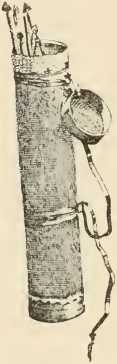
Armed with bow and arrows the
Bushmen laid the whole animal world
under contribution, and defended
themselves from their foes, whether
lion or Kaffir, with equal courage and
Fig. 1G9.—Bushman’s success. In approaching their quarry quiver. (AfterSpan'- ^ wewj practised in all kinds of
cunning. Disguise was a common device; sometimes with a bundle of grass tied on over the head they would glide by fits and starts through the grass so imperceptibly that the feeding herd had no suspicion of their presence. In stalking the wary quagga, which feeds in friendly company with the ostrich, the hunter disguised himself as one of these birds, simulated its gait, stopping every now and again to preen his feathers, or to peck and
1 Livingstone says that in the case of wounds poisoned by the N’gwa, the caterpillar itself mixed with grease was rubbed in as an antidote. Here we seem to have an anticipation of the principle of the Pasteur treatment.
feed, till lie found himself mingling with the herd, and could let % his poisoned arrows without exciting suspicion. Although, under these circumstances, he could have made a heavy bag, he never took more than he realty wanted, for he was a provident hunter, and killed for food, not for sport. For large game the Bushmen combined, together to set traps, digging with great labour carefully concealed pitfalls, or suspending a heavily weighted weapon over the path to the water pools.
The pursuit of large game was the occupation of the men, but there was also a chase of small game, and this, as well as the collection of vegetable food, was the work of the women.
No one who has travelled over the Karoo can have seen without surprise the monstrous ant-hills which disturb the irregularity of the plain : the “ eggs ” of the ants, or more properly termites, known to the white man as Bushman’s rice, were a food they
^ 1-IU. 1/0.—IhelJush-
could fall back upon when other woman’s ’Kii>i or resources failed. Provided with a ^'(Afau-^latzei.) digging stick—that is, a stick pointed at one end and weighted by a perforated stone at the other (Fig. 170)—the women would unearth large quantities of these “ eggs.” When sufficient had been obtained, they were cleaned by sifting away the accompanying sand, and then, with the addition of a little fat, roasted over a fire until they turned a nice brown. Cooked in this way they are said to have been delicious eating.
Locusts were a favourite dish, and the swarms of these great insects which darken the air in their flight1 were looked forward to as bringing a time of plenty. They were not only eaten fresh, but preserved for hard times by drying and pounding up into a powder. This was boiled into a sort of porridge, or mixed with honey and made into a cake : in the latter form it was appreciated even by Europeans. Frogs and serpents were dainty eating: poisonous serpents were decapitated before being cooked ; their flesh has the flavour of chicken.
The vegetable kingdom was ransacked for all that it
O O
could afl'ord, even the seeds of wild grasses were collected and stored for winter use.2 How short a step it seems from this to agriculture ; but to take this step requires qualities that the Bushmen never possessed, and inconsistent with his unconquerable love of a wild life. A kind of bread was made out of the pithy interior of Zamias, or of the root of Testudinarici elephas. In summer, when water is more than usually scarce, the Bushmen satisfy their thirst with the acid juice of melons, which grow plentifully, even in the desert, at that season ; but if water is to be found they may be trusted to find it. In some cases they are driven to obtain it from wet sand, and this they do by means of an ingenious filter-pump ; a hollow reed is wrapped round with a tuft of grass at one end (Fig. 171, b) ; this is inserted into a hole made in the sand (Fig. 171, a) and the water sucked out. But the process is slow and laborious, and it is often with bleeding lips that the
1 I once mistook them for smoke pouring in black clouds from a forest I supposed to be on fire.
2 Since it is the women of primitive hunting tribes who collect and store the seeds, is it not possible that it was also a woman who was the first agriculturist? For an affirmative answer, see Schurz, Ur-(jeschichte der Kvltur, Leipzig, 1900, p. 232, and E. Hahn, Das Alter der Menschlichen Kultur, Heidelberg, 1905, p. 31.
Bushman thus provides for his suffering wife and family. Water was—and perhaps still is—carried in ostrich eggs sometimes elaborately adorned with incised lines, sometimes engraved with figures of animals
|
Fig. 171.—The lower end of the Bushman filter-pump. The end of the reed is supposed to be seen through the grass. (After Fassarge.) |
(giraffes, gnus, zebras, elands) and hunting scenes, or in part of the intestine of a zebra or the paunch of a gnu. It is pleasant to find that these hardy hunters were not unacquainted with cheerful stimulants : they brewed ail
excellent mead from wild honey, and for tobacco they substituted hemp, which is said to be potent smoking (Fig. 172). The honey was obtained by robbing the wild bees, often with the assistance of the bee-cuckoo,
''who was in the habit of betraying the nest, in the well-founded expectation that the Bushman, who always dealt honourably, both with friends and foes, would reward him with a share in the booty. After a good day’s sport they held a feast and spent the rest of the evening in dancing and singing.
The Bushmen carried their love of art into every department of life. AVe have already admired their paintings,1 but, like the Aurignacians, they also engraved animal figures on the rocks, not, however, by incised lines, but by punching holes, so that the resulting; line was “dotted.”2 A ease has been recorded, however, of an antelope graven in relief, and another actually drawn with incised lines,3 and still more recently important discoveries have been made of deeply incised designs, which have been
1 There is a fair amount of literature on the subject. I take this opportunity to give here some additional references :—J. Barrow, op. cit. pp. 193, 269 : G. Fritsch, op. cit. and Buschman Zeichnungen, Zeits. f. Etlin. 187S, X. p. 15 ; A. A. Anderson, op. cit. Vol. I. pi. opposite p. 196, and frontispiece to Vol. II.; Bartels, “ Copien von Felsenzeichnungenen der Buschinanner,” Zeits. f. Ethn. 1892, XXIV. p. 20 ; F. von Luschan, “ Ueber Buschinanner Malerei in deni Drakensberg,” Zeits. f. Ethn. 1908, XL. p. 6G5, pis. ; C. G. Buttner, “Malerei in Damaraland,’’ Zeits. f. Ethn. 1878, X. p. 15 ; A. J. C. Molvnpnx. “ Notes on some Rock Paintings in the Tnli Distrint.” Proc. Rhodesia Sci. Js. 1900, I. pp. 7-9. pis. :~fT*W. Girdler Browu, “ IbjcJj^tiwrrl-ings at JahendaJ’ Proc. Rhodesia Sci. 1903-4, IV. pp. 80-87 ; Franklin WTntt!,' ‘"^Sonie Rock Paintings and Stone Implements, World’s View, Matopos,” Proc. Rhodesia Sci. yIs. 1905, V. ; Schloeman, “ Felsenzeich-nungen der Buschinanner bei Pusompe in Nord Transvaal, etc.,” Zeits. f. Ethn. 1896, XXVIII. p. 220 ; M. Helen Tongue, Bushman Paintings, with a Preface by H. Balfour and Notes by E. D. Bleek, Oxford, 1909 ; O. Moszeik, Die Malereien der Buschinanner in Sud-Africa, Berlin, 1910; J. P. Johnson, Geological and Archaological Notes, Orangia, London, 1910, pp. 70-90 ; S. S. Dornan, op. cit. pp. 439, 445-7.
2 I shall not readily forget the surprise with which I came upon the figure of ail antelope outlined on the surface of a roche montonnie which was glaciated during the upper Carboniferous epoch : this was near Riverton, on the Vaal ; Stow mentions a finely sculptured eland in the same locality.
3 L. Peringuey, “On Rock-Engravings of Animals and the Human Form, etc.,” Trans. South African Phil. Soc. 1906, XVI. p. 401. It may be noted that some of the Aurignacian drawings are })ointilles.
finished by punching out the surface included within the outline, so as to produce a kind of intaglio. One of these (Fig. 173, l) representing an elephant on the march
|
Fk;. 173.—Elephant sculptured in sunk relief, from South Africa.^ (x 1(i about. After Peringuey, and a plaster east.) 2. Foreshortened figure or a rhebok, painted in yellow (oblique lines) and white, (x troni Willow Grove, Cape Colony. After Tongue.) 3. A girafle from South Africa. ( x £ about. After Peringuey.) |
is a perfect triumph of realistic art; every feature is faithfully reproduced, and by the rendering of the limbs, especially by the backward, bend of the off forefoot
and the thrown out hind leg, the swinging gait has been so successfully caught that we seem to see the great animal actually walking. The giraffe (Fig. 173, 3) belongs to the same series. Whether these sculptures were painted or not Dr. Peringuey1 does not tell us, but engravings are known which were certainly completed in that way, just as they were in Altamira and elsewhere.
It has been asserted that the Bushmen painters and the Bushmen sculptors belonged to different branches of
/the race, but this is open to doubt.
Their dress, though scanty, wras well adapted to their roaming habits, and not altogether without its elegances. Around the waist they wore a girdle from which was suspended a scarcely adequate little apron in front and an appendage, known as the jackal’s tail, behind. The woman’s apron was made of threads or strings of beads and sometimes hung down to her feet. A caross or short mantle of springbok’s fur, cut and ornamented in different fashions, was worn over the shoulder. At night when the Bushman curled up in his little nest to sleep this covered him like a blanket. Great care was expended 011 the preparation of the caross ; the skin was first cleaned of all fat and superfluous material by scraping with a flint implement, it was then rendered soft and supple by stretching, rubbing between the hands and trampling with the feet. They had skin or fur caps, mostly worn by the men, but sometimes also by the women,2 which differed in form with the taste of the wearer, but on the whole were not unlike a helmet3 or an Egyptian fez.4 When out walking they wore
1 L. Peringuey, “Rock Engravings of Animals and the Human Figure found in South Africa,’1 op. cit. 1909, Vol. XVIII. pp. 401-419, pis.
2 Barrow, op. cit. vol. i. p. 233. 3 Barrow, lor. cit.
4 Stow, op. cit.
lio-ht leather shoes or sandals. Both sexes adorned
o
themselves with beads made from fragments of ostrich-shell; the shell was broken into little angular pieces, a hole was drilled in each piece with a flint borer, and then the corners were rounded off and the edges smoothed away (Fig. 174). Necklaces of these white beads look well against the warm tint of the skin. A pretty effect was obtained by stringing little discs of dark leather alternately with the white beads. Certain
|
Ft(i. 174.—Stages in the manufacture of bushman’s beads. 1, 1a, ths flint borer ; 2, angular fragment of shell; 3, 4, o, intermediate stages leading to 6, the finished bead. |
districts possessed a reputation for making these beads, which were a regular article of commerce.
For social gatherings they made an elaborate toilet ; the women sprinkled their head and neck with a green powder obtained from copper ore, and dusted glittering scales of mica or threads of asbestos over their hair, which was first dressed with a red ochre pomade. The men painted themselves with red, yellow, or black, in various designs, such as chevrons, diagonal bands, zebralike stripes, etc., after much the same fashion as the Australians ; and they put on their anklets, bearing leather capsules with little pebbles inside—the Bushman bells—which made a rattling noise in the dance. For some dances they wore large ball-shaped rattles also, which were fixed to their shoulders ; these were jerked
at the proper intervals to punctuate the time. The women were fond of perfumes and used to cany a bag of aromatic powder about with them.
In some districts the Bushmen lived in huts (Fig. 175), in others, in caves, which they regarded in a real sense
 |
|
Fig. 175.—Part of a Bushman’s kraal in the Middelveld, showing huts; in the middle of the foreground a hunter returning with a young antelope thrown over his shoulder; he is dressed in a caross, and carries his how and quiver. Two assegais are seen stuck up against the foremost hut, their usual position when not in use. Several of the figures are seen with characteristic hats. (After Burchell.) |
as their home. Dornan, writing of these caves in Basutoland, says they were the rallying points of the various clans, to which, however far they might wander away, they invariably returned, bringing back lively tales of their hunting exploits.1 Stow was informed by
1 S. S. Dornan, “Notes on the Bushmen of Basuto Land,” Trans. S. African Phil. Soc., 1909, XVIII. pp. 437-450.
several old Bushmen that all the great caves, i.e. those inhabited by the head chiefs, were distinguished by paintings, which represented the tribal emblem, such as the eland, hippopotamus, ostrich and other animals.51
Their huts (Fig. 175), light, simple, and portable, were well adapted to a hunter’s mode of life. A few bent sticks formed the framework, which was covered with mats made of reeds laid side by side and neatly sewn together. The whole structure, which was as much a tent as a hut, was hemispherical in shape, about four feet in diameter and only three feet in height, but to compensate for this the ground within was excavated into a kind of nest. Opportunity for adornment was found even here, for the mats were painted with broad stripes of red ochre.
The Bushmen were intensely fond of music,52 and had made greater advances in this art than any of the other races of South Africa; appropriate music and song accompanied each of their numerous dances. Of their musical instruments, which included a reed pipe and drums, especial mention may be made of the four-stringed harp which had been evolved out of the bow, and of a combination of twelve bows which formed a primitive dulcimer.
The dance 53 afforded the Bushman an opportunity for a combination of musical and histrionic powers which was precisely suited to his genius. Hence we find him passionately addicted to this art, which he had developed into a great variety of forms full of easy and graceful movements. Many of the dances might well be termed ballets, the performers, dressed to take the part, mimicked the life and habits of their friends, the animals; thus there was an amusing dance of the baboons, another of the frogs and a very poetical one of the bees. There was also a general masquerade in which each performer represented a different kind of animal. To another class belonged the hunting dances, and those associated with productive rites. One of the latter was a reed or pipe dance, and, to judge from the description, the sound of its fiuting must have been pleasant to the ears of the great god Pan.
According to Burcliell their revelry was well eon-
delight, explaining what they saw, and dwelling upon them as “our paintings,” “our own paintings,” “the paintings of our nation.” They came to a copy of a dance picture, and the old lady at once exclaimed : “ That ! that is a grand dance ! It is the ’Ko-’ku-curra ! ” She said it had gone out of fashion when she was a little girl, but was danced in the days of her grandmother’s grandmother. “I know it!” she exclaimed, “ I know the song ! ” and then swaying to the tune, sang the upper line given below :—
| ||||||||||||||||||
|
’Ke - ’ka - ’ki - ’koo - ’ka - ’ta - 'ta, ’Ke - ’ka - ’ki - ’koo - ’ka - ’ta - ’ta. <s>- _ -s- -e>- _ -s- | ||||||||||||||||||
ducted ; there was 110 rude laughter, 110 drunken jokes
/ttfeir art. Bleek,1 to whom we are indebted for rescuing ymuch of it from oblivion, asserts that it is rich and * varied. What he has recorded makes 6,GOO columns of MSS. and fills 77 quarto volumes. We look forward to Miss Lloyd’s forthcoming work on the subject for a full account of this. Bleek has scarcely published more than the headings, from which we select a few as examples :—Names of the Stars and Constellations ; Prayers to the Sun, Moon and Stars ; Bushman Kites when Canopus and his grandmother Sirius appear ; Myth of the Dawn’s Heart (Jupiter) ; The Origin of Death ; The Lion Jealous of the Voice of the Ostrich 2 ; The Jackal’s Tower ; The Anteater and his Musical Pet; the Lynx ; Bushman Doctor and Sorcerer ; A Primitive Race that Preceded the Bushmen ; Men Turned into Stars, Statues and Trees by the glance of a Maiden ; The Cat’s Song (a poem); The Return Home (a poem). Many hunting stories are included ; of one the headings run as follows:—A man accidentally wounded by another ; the wounded man begs the others to speak gently and not angrily to the one who has shot him ; the dying man’s last speech to his wife ; the widow’s lament, an old man’s speech on the faithfulness of woman and her husband’s trust. Bleek’s material also includes a map of the country inhabited by the Flat Bushmen, drawn by one of them, and genealogies of his Bushman informants ; some of these extend back for five generations, and one includes more than 250 names.
1 W. H. I. Bleek, A Brief Account of the Bushman Folk Lure and other Texts, London, 1875, 20 pp. folio.
2 Livingstone tells us that the ostrich roars so like the lion as to deceive anyone but a native.
nor^ioisy talk.
nor
% folk-lore of the Bushmen is not unworthy of
Great effect is given to the animal stories by making each kind of animal speak its own language ; this is accomplished by systematically transmuting some of the sounds of the Bushman tongue, generally the characteristic clicks, which are changed into more familiar consonants ; thus, in the Tortoise’s language the clicks are turned into labials, in the Ichneumon’s into palatals, dentals and sibilants. The language of the Blue Crane is made by ending the first syllable of almost every word by a double t. Here we may mention, by the way, that Passarge cites one old Bushman who professed to be able to understand the actual language of the baboons.
Some of the Bushmen’s stories have been published in full ; we must content ourselves with a single example ; it was obtained by Mr. J. M. Orpen from the same Qing whom we shall meet with later expounding a mythological picture (p. 295), and it explains how the baboons came to have tails. “ ’Kaang sent Cogaz to cut sticks to make bows. When Cogaz came to the bush the baboons (who then were men) caught him. They called on all the other baboons to gather round, and asked who had sent him there. He told them his father had sent him to cut sticks to make bows. ‘ Ah ! ’ said they, £ your father thinks himself cleverer than we are, he wants the bows to kill us with, so we will kill you.’ Then they killed Cogaz, and tied him up to the top of a tree, and they danced round it, singing ‘ ’Kaang thinks himself clever.’ ’Kaang was asleep at the time, but when he awoke he found out by his magic what had happened, so he wTent to the baboons. When they saw him coming they left off singing ‘ ’Kaang thinks himself clever,’ and sang another song. But a little baboon girl said ‘ Don’t sing it that way, sing the way you were singing before,’ and ’Kaang said ‘ Sing as the little girl wishes.’ So they sang and danced as before. ‘ Ah ! ’ said ’Kaang, ‘ that is the song 1 heard, that is what I wanted, go 011 dancing until I return.’ Then he went and fetched a bag full of pegs, and went behind each one and drove a peg into each one’s back and gave it a crack and sent them off to the mountains to live 011 roots, beetles, and scorpions. That is how the baboons came to have tails and their tails hanor crooked ! ”
O
Our knowledge of the religious beliefs of the Bushmen
O O
is singularly deficient. It could not well be otherwise. For the collection of sound data information must be supplied from a trustworthy source—a Bushman initiated in the religious mysteries of his race, for example—to a trustworthy recipient, that is, a skilled European observer familiar with the Bushman language. But 1 do not know of any published conversation between two such competent persons. With few exceptions the ideas recorded are those of any ordinary uninitiated Bushman taken at hazard. As these people probably differed from one another in spiritual insight as much as we do among ourselves, we shall expect to meet with very miscellaneous and sometimes conflicting views, as in fact we do.
Still there is evidence of various kinds, much of it obtained by Arbousset and Daumas, which shows that the Bushmen as a race were not behind other hunting folk in their feeling for the unseen. They recognised a supreme power, ’Kaang, the Master of all things, who made all things, who sends and refuses the rain, who gives life and takes it away. In the words of the distinguished authors just mentioned, they say : “ On ne le voit point des yeux, mais 011 le connait dans le cceur,”
u
and in their prayers they call upon him saying, “0! ’Kaang, are we not your children ? ”
That they believed in a life after death is shown by their funeral customs. The body of the deceased was painted with red ochre and grease, covered with sweet smelling powder and buried, facing the east, in an oblong grave.1 His hut was east into the grave and consumed with fire, and in some tribes his bow and staff were laid by his side. The grave was then filled up with earth, and generally, but not in all districts, stones were thrown on it by the mourners, and afterwards a stone was contributed by every passer-by till a cairn was raised. The clan shifted its kraal to another place, far away from the grave, because, it is asserted, they were afraid of ghosts ; but this was not the only reason. Bleek in his account of the Bushman folk-lore records the statement, made in the course of a story, that they removed to another place “in order that the children should not be thinking of their father and wanting to cry.”
Livingstone,2 after remarking that in their superstitious rites there was more appearance of worship than among the Bechuanas, adds that at a Bushman’s funeral on the Zouga they addressed the dead and requested him not to be offended, even though they wished to remain still a little longer in this world.
One of their proverbs, so Arbousset and Daumas tell us, was “ Lefan ki boroko,” i.e. Death is only a sleep.
Of course all this is only one side of the picture ;
1 Stow has made a slight slip here. In quoting from Arbousset, he has attributed to the Bushmen some funeral customs which are really those of adjacent Negro tribes ; they are adduced by Arbousset in contrast to those of the Bushmen. Stow has also mistranslated “parfumes” as “embalmed ” In the Kalahari, according to Passarge, the burial is in a round grave and in the contracted position.
" Livingstone, op. cit. p. 165.
there was 110 doubt a good deal of nature worship, the purer beliefs were adulterated with grossly material ideas and equally gross customs disgraced their religious rites. But in this respect the Bushmen are not singular.
It is curious to observe how widely spread is the belief in presentiments. The Bushmen have it ; they say that they feel in their bodies that something is going to happen ; it is a beating of the flesh which tells them things. Those who are stupid do not understand, and disobey these warnings; they get into trouble—a lion eats them or some other misfortune overtakes them.54
None of the African races are distinguished for chastity, and all that can be said for the Bushmen in this matter is that they were not so bad as their neighbours. Passarge remarks that the relations
O O
between the sexes, as he observed them in the Kalahari, might have been much worse ; there was 110 prostitution, for instance, a vice which is common among the Bantus, most open and shameless among the Herero, and widely prevalent among the civilised peoples of Europe.
Marriage was celebrated by a remarkable ceremony.55 The consent of the bride having been obtained and the approval of her parents, who received some kind of present, a day was fixed for the trial of the event : all the neighbours round about were invited to a feast,56 and
when they had all begun to make merry the young man took the opportunity to seize the bride ; this was a signal for her relatives to set upon him with their digging sticks ; they gave him a sound beating and a general fight ensued. If the young man could manage to keep a tight hold through all this the issue was decided; he was a married man. This is perhaps connected with the fact that the husband was obliged to marry outside his own clan.57 Polygamy existed, but was not much practised.
A birth was celebrated by a feast, dances and song, as also was the name-giving day.
Boys were admitted to the status of men after a course of training and an initiatory ceremony. Like the Australians, the Bushmen perforated the septum of the nose, wearing a quill for a nose peg, and it is said that the act of perforation was one of the initiatory rites.
We may recur for a moment to the Bushman's pnintinp-s in order to point out a fact of considerable importance in connexion with the cave, paintings of Europe^ We are told58 on the authority of the Bushmen themselves that it was not any man of a tribe who was competent to make a painting : it was only those who were specially gifted, and when an artist had adorned the walls of a eave with his polychromes no one would dare to interfere with them so long as he was alive, nor indeed so long as his memory lasted. It was only when his name had passed into oblivion that a new aspirant for fame would venture to make fresh drawings over the old ones. In some caves as many as five distinct series of paintings are to be seen one over the other.
As regards the interpretation of the paintings, Stow strongly maintained that they are all simply aesthetic or historical, and if a mythical meaning attached to any of them, this, he thought, must have been added as an
~ 7 ' O '
afterthought. Dr. Hahn is, if possible, even more explicit: he was well acquainted with the tribes in the Orange district, and of these one, the Annin, was at the time he wrote still given to rock painting. The old people, he tells us, men and women, teach their children, and they exercise their art for the pure pleasure of representation. The paintings, he adds, have nothing to do with the religious customs of the Bushmen.59
There can indeed be little doubt that some, such as the famous cattle raid, for instance (Fig. 152), are chiefly historical; others again, such as the representations of animals, seem to be pure works of art, and nothing has been elicited from the Bushmen which would suggest that they are in any way connected with sympathetic magic. In no case do any of them appear to have been concealed from women and the uninitiated.
On the other hand, there are others, certainly of a very different character, which I cannot help regarding as truly mythical. Stow himself has given a clear description of one at least. In order to understand this, we may first point out that among the Bushmen dances there was one, the most famous, indeed, of all, which was directly ordained by Tvaang himself—who was the superior person in a trinity of gods—and it was danced in his honour. This was the Mo’koma or dance of blood, so-called because it often happened that in its delirious performance one or other of the dancers would fall to the ground with blood streaming from his nose.
O O
It is interesting to observe that the women who gathered
O O
round to revive this victim of the god used to place two reeds over his back in the form of a cross, which was a common Bushman symbol, and an initiated man conjured from him a foreign body, the pretended cause of his complaint.60 By excessive indulgence in this dance some men ruined their health, and were then spoken of as “ spoilt ” by the Mo’koma. Such sinners were punished by ’Kaang, who had them carried off to a mysterious place situated under water, where they were transformed into beasts and otherwise chastised. We can now perceive how singularly to the point is the discovery made by Stow in the Malutis, near the source of one of the tributaries of the Eland’s river, where he found a picture, painted on a rock shelter, which represented this very myth in detail. On one side are the women engaged in the dance, and near at hand three satyr-like demons, one of whom is bearing away two miserable wretches to their doom ; on the other side the sinners are seen in their place of torment; they are already transformed into beasts, at least as far as their heads, and are securely pinioned with two stout sticks. One of them ’Kaang has seized, and is holding him in a very painful position while administering a sound thrashing with a heavy “ kibi or digging stick.
The mythological meaning is not always so patent as in this instance, and can only be interpreted by the initiated. Thus Mr. J. Orpen had a copy of one painting which several old Bushmen to whom he showed it described as two hunters disguised with the heads of rheboks chasing a jackal, but one of the initiated, Qing
byname, recognised in the two hunters the mythological personages, Hagwe and Canate. “ They are all under water,” he added, “ and those strokes are things growing
’ 000
under water. They are people spoilt by the Mo’koma dance because their noses bleed.”
We cannot regard the next picture (Fig. 176) without wishing that Qing were here to interpret
|
Fi<;. 176.—Mythical Bushman painting, from the Biggardsberg. The human figures are painted in brown, red, and yellow, the insects in blue with graduated tints. (After Prozesky.) |
it, but we can plainly perceive, even unaided, that it must illustrate some myth.1 The four strange-looking monsters with toothed arms appear to be part men, part insects ; possibly men disguised as insects for a religious dance; and the particular insect which they suggest to me is the Mantis. My friend and colleague, Prof. Poulton, whose advice I sought? 011 this point, also thinks there is a good deal of Mantis feeling about them. But the Mantis was regarded
O O
1 The original occurs near Konigsberg, on the slopes of the Biggardsberg, a range of mountains running out from the Drakensberg ; a copy in watercolour was made by Herr Prozesky. and exhibited by Herr Schloeinann at a meeting of the Anthropological and Ethnographical Society of Berlin, See Zeits. f. Eihn. 189G, XXXVIII. p. 909.
by the Bushmen as a living symbol of the great god ’Kaang ; it forms a centre of a whole cycle of folk-lore, and, still more important from M. Reinach’s point of view, it was appealed to for success in hunting. Most apposite is the story M. Arbousset tells us of a father’s dying speech to his son. It runs thus :—“ My son, when thou goest to the chase, seek with care N’go [the name for a Mantis and also a caddis-worm] and ask food from him for thyself and thy children. Mark after thy prayer if he move his head, describing an elbow, and that very evening thou shalt bring to thy mouth a portion of game, which thou shalt hold between thy teeth, and shalt cut it with thy knife, with thine arm bent, describing an elbow, like our 1STgo.” 61
It seems difficult to believe, but it is asserted that all62 the Bushmen dances were religious. “They are to us what prayers are to you,” is a saying attributed to one old hunter. If so, all dance pictures may be regarded as mythological, as well as the animal-headed figures (Fig. 177), which, save for their agility, recall the Egyptian god Anubis.
Let us now pass in review the stone and bone implements of the Bushmen, comparing them at the same time with the Palaeolithic implements of Europe.
Most of the stone implements which I collected myself at Riverton 011 the Vaal are extremely rough and uninstructive, but Mr. J. Johnson, who lias investigated several prehistoric settlements in Orangia, has found a large number which present a characteristic form, and Stow has described some which were in actual use by the Bushmen in his time. The more important are the following :—(l) A disciform scraper, described as thick, flat, rudely circular, and from 2b—3 inches in width. It was held between the finger and thumb, and
|
Fnj. 177.—Animal-headed men in dancing postures, from youth Africa. (After Moszeik.) |
used for dressing skins. The description would apply to some scrapers figured by Johnson,1 which are not dissimilar to Mousterian forms, such as occur in the Lower Aurignacian of Europe.2 (2) A spoke-shave, nearly fiat with a deep semicircular notch, used for rounding and cleaning bows, the handles and shafts of clubs,-spears, and harpoons. I have not succeeded in finding any illustrations of this. (3) Long, thin flakes, trimmed at one or both ends, which closely resemble
1 J. P. Johnson, op. cit. p. G2.
2 L. Bardon and J. Bouyssonie, “ Station pr£historique de la Couniba del Bouitou, pres Brive, Correze,” Bull. Sue. sri. hist, et arch, delu Correze, 1907-8, pp. 54.
Solutrian and Magdalenian forms (Fig. 178, a, d).1
(4) Scraper-planes (grattoir-rabot), which are not unlike the keeled scraper of Aurignacian age (Fig. 178, e, e').
(5) Minute Hakes, some resembling Solutrian and others Tardenoisian forms (Fig. 178, b, c, f). (6) Arrowheads (Fig. 178, g, g'), which, allowing for the fact that they are chipped out of a different stone (Lydian stone, jasper, or chert), are remarkably similar to the “ pointes a peduncle” of the Solutrian.2 (7) Grooved sandstone
|
Fit;. 178.—Bushman stone implements from Orangia. ( x about |. After Johnson.) |
cylinders, about inches in diameter, and 3 inches in height, with several deep longitudinal grooves down the sides, used for rubbing down bone awls and arrowheads. These find their nearest parallel in the Magdalenian. (8) Perforated stones (’tikoe) used for weighting the ’kibi or digging-stick. These were made with infinite pains out of a sandstone or hard igneous rock; the perforation was ground out day by day with Lydian stone and water. (9) Stone mortars, about six inches
1 L. Barclon and J. Bouyssonie, “ Station prehistorique de Chateau de Bassaler, pres Brive, Correze,” Bull. S<>c. sci. hist, et arch, de lit Correze, 1908, pp. 19.
2 Pardon and Bouyssonie, loc, cit,
in diameter and eight inches high ; these were worked
O O’
into perfectly regular shapes, and the hollow interior was well finished and smooth. The labour this involved must have been truly appalling.
The bone implements include (l) an awl of bone or ivory, about four inches long, one-fifth to one-sixth of an inch thick, and tapering to a point at each end. All the sewing of the Bushmen was done with this ; needles
O 7
were as unknown to them as to the Aurignacians ; they are first met with on the horizon of the Upper Solutrian. (2) Arrow heads ; these, which have been already described, are not unlike some Aurignacian points. (3) A bone harpoon with long, sharp barbed points was used for fishing. This was a highly prized possession, ranking with the ’tikoe and poison stone. Barbed harpoons are not known in Europe till the Magdalenian age. (4) A pipe for smoking ; this was a tubular bone about three or four inches long. (5) A bone whistle, also a tubular bone. Such bones are not uncommon in the Magdalenian.
We must not omit to mention that the Bushmen made a coarse kind of pottery, sometimes adorned with incised lines; similar pottery is said to have been found in the Magdalenian deposits of Belgium.
The arrow straightener, which is rather widely distributed in Aurignacian deposits (Castlemeule, p. 220, Cro Magnon, Solutre, and Ruth, as well as in Belgium), was not known to the Bushmen ; reeds such as they used for shafts do not require straightening, nor, if they did, could they be straightened by mechanical means. The possession of the arrow straightener by the Aurignacians shows that those hunters made their shafts of wood.
If we except the ’tikoe and the stone mortars, the Bushmen implements, speaking generally, are Upper
Palaeolithic in character, and some are Aurignacian. The " common use of bone excludes the Mousterian, while the possession of barbed harpoons and other implements of an advanced type may be fairly attributed to the inventive faculties of the race. These cannot have lain idle throughout the long interval which has elapsed since the close of the Aurignacian age.
A certain amount of government had been established among the Bushmen; there were head chiefs to the tribes and sub-chiefs to the families or clans ; the hunting-grounds of each family were strictly delimited, and the boundaries were faithfully observed. It is said, as we have already pointed out, that the head chiefs had their residence in great caves, and that the paintings in these were the emblazonment of the symbol of the tribe.
All that we learn about the Bushmen impresses us with their great intellectual ability. Johnston mentions one individual he met, who conversed fluently in Dutch, spoke more English than many Boers, and was thoroughly conversant with Hottentot, Ochi-herrero, Ochi-mpo, and several Bantu dialects.1 They were distinguished for their hospitality to strangers, and for the unselfish way in which they divided their food. They loved their country and showed an unfailing devotion to their chiefs ; they possessed all the noblest of the primitive virtues, and, not least, unflinching bravery and unquenchable love of freedom. It was this last which came to be accounted to them as their greatest crime. They found it impossible to become slaves to strange masters in their own land. Equally impossible was it for a hunting race to maintain its existence in proximity to an encroaching agricultural people of European blood. A terrible war of extermination was waged against them
1 Johnston, “Tribes of the Congo,” Mem. Anthr. Inst. 1884, XIII.
by the Boers.1 The stories that are told of this war are shocking to our humanity ; and we cannot refuse a tribute of admiration to these brave people, who in almost every instance preferred death to surrender. Almost the only exception recorded is that of a chief who, surrounded by foes, replied to repeated calls to yield by arrows from his bow; at length, as these ran short, he accepted quarter and delivered himself up, whereupon his brains were immediately blown out. The last to be killed in this war was one of the painters. Upon his body there was found a leathern belt with twelve little horns strung to it, each containing a different pigment.2
We have spoken of the Bushmen in the past tense, for they are practically extinct; a miserable remnant of inferior character still lingers 011 in the Kalahari desert, but even this is slowly dwindling away under the terrible hardships of an unfavourable environment,
As we have seen, the Bushmen when we first knew them inhabited the southernmost part of Africa, while the Aurignacians occupied in the remote past at least a part of Europe. If then the ^ European Aurignacians^ or some tribes of them, were the parent stock of the Bushmen, they must have traversed the whole length of^iOncaT before 'arriving at the Cape; and Stow, who possessed an unrivalled knowledge of the Bushmen, was led by independent investigation to conclude_that they must have migrated from the north southwards ; he has even gone so far as to indicate their route. One branch of the race kept_more to the westward side
1 “ The extermination of the Bushman was for a long time regarded by the Cape Government as a matter of State policy.” W. H. Tooke, “ Science in South Africa,” 1905, p. 98.
2 Here we are reminded of the “ paint-tubes,’’ of the Aurignacians, p. 232.
of the continent in their journey south, the other kept more to the east (Fig. 179). Stow asserted that the western branch were the painters, the eastern the sculptors or engravers, and that where they cameTiTi coiitact'the two"artiTwe're'intermingled. precisely as in 'Aurignacian Europe.
Whether the sculptors and painters were as sharply separated as Stow supposed may be open to question,
|
Fig. 179. — The routes taken by the Bushmen in their migrations from the Equator southwards to the Cape of Good Hope. (After Stow.) |
but that the original home of both lay somewhere in the North is extremely probable; all the evidence which has since come to light points plainly in that direction. Rude signs painted in red ochre have recently been found by Koch 1 on the right side of the YictoriaTNyaiiza south of the Kagera river, i.e. in the region where Stow’s lines representing the Bushmen’s migrations commence on the map (Fig. 179). But rock engravings have long been known much further north than this; in the Wadi Tele slight, near Murzuk, for instance, 25° north of the
1 R. Koch, “ Anthropologische Beobachtungen gelegentlich einer Expedition an den Victoria Nyanza,” Zeits. f. Ethn. 1908, XI. p. 4G7.
Victoria Nyanza, deeply incised outlines of animals were discovered by Barth63 in 1850; one striking picture extending along the foot of a cliff represents a dense crowd of cattle in very various attitudes, all moving in one direction. Barth gives a sketch of this, but remarks that it does but scant justice to the original, which is “really beautiful.” Another showing a bull and two bull-headed men armed with bow and arrow is singularly Bushman-like in feeling and execution. | As MoszeiTT rightly remarks, an unprejudiced^person can scarcely doubt that this is the work of the Bushmen.64
A little earlier than Barth, Felix Jacquot published an account of incised drawings which he observed at Tiut and Mogh’ar in the south of Oran.65
A great number .of, additional discoveries have been made more recently in northern Africa ; south of Murzuk incised drawings are known in Tibesti and the reoion
o o
of the northern Tuaregs (Adger),66 and north of it they extend through Algeria into Morocco, from Constantine by Ain Sefra to Figig.67 Some of these drawings represent extinct animals such as Bubcihis antiquus (Fig. 180) or animals 110 longer inhabiting these regions, such as the ostrich, elephant, and rhinoceros. Neolithic implements have been found at the foot of the engraved rocks.
Ancient petroglyphs also occur in Egypt, as for instance in the Wadi Hammanat between Edfu and Silsilis.1
It would thus appear that mural drawings, paintings or engravings, having many features in common, may be traced from the Dordogne across the Pyrenees into Spam, and beyond the Mediterranean into Morocco, Algeria, Oran, and Egypt, over the Sahara, past the Victoria Nyanza, and thence 011 through’ Rhodesia, the
|
Fig. ISO.—Deeply incised drawings of Bubalu* antiqims from the Col d’Er Richa, A tin, Southern Oran. Reproduced from a photograph which is slightly distorted, owing to its being taken at too short a range. (After Flamand, UAnthr.) |
Transvaal, and Orangia, to the southernmost extremity of Africa.
If, as their unity in subject and treatment suggests, these are all the work of the Bushmen or related tribes, then they afford precisely the kind of evidence which our hypothesis demands, and some of the Aurignacian people have really, as we supposed, passed in ajdow migration across the whole of the broad territory which intervenes between Dordogne and the Cape. I hat the movement was towards the South is shown by tlie^fact
1 G. B. M. Flamand, op. cit.
that the drawings become increasingly younger as we proceed in that direction. [11 France they arc of Upper Palreolitliic age, in'the North of Africa Neolithic, and in the South tlijjy are recent. From this again it follows that the migration must have occupied a long interval oFTnne" during which the earth experienced more than one change of climate, and some of the animals which the artists took a special pleasure in depicting, such as the mammoth and the ancient Bubalus, became extinct.
Wg owe our knowledge of this great migration to a fortunate accident : had the passion for art which possessed the Bushmen been less strong or less enduring, it would probably have remained unsuspected to all time. It would be strange indeed if this were the sole migration of its kind, the chances are that it is but one among others, some of which may not be beyond our power to discover.
As we glance back over this inquiry our eyes naturally turn to the scene in the cavern of Altamira. and rest there with pleasure on the little Senorita de Sautuola and her wonderful “Toros” which started us on our long and adventurous investigation.
And last a word of farewell to the Bushmen. The more we know of these wonderful little people the more we learn to admire and like them. To many solid virtues— untiring energy, boundless patience, and fertile invention, steadfast courage, devoted loyalty, and family affection—they added a native refinement of manners and a rare {esthetic sense. We may learn from them •how far the finer excellences of life may be attained in the hunting stage. I11 their golden age, before the coming of civilised man, they enjoyed their life to the full, glad with the gladness of primeval creatures.
' O O -
The story of their later choys, their extermination, and the cruel manner of it, is a tale of horror on which we do not care to dwell. They haunt no more the sunlit veldt, their hunting is over, their nation'is destroyed; but they leave behind an imperishable memory, they have immortalised themselves in their art.
THE SOLUTRIAN AGE
During this period the fabrication of flint implements attained a perfection which has evoked the admiration of all archaeologists. Some of the best work recalls that of the Neolithic epoch, and has never been excelled except by the knives of the late pre-historic period in
The art reached its culmination in the Upper Solutrian; deterioration then set in and continued till a fresh climax was reached after the Paleolithic epoch had come to an end. The earliest examples of the Lower Solutrian are comparatively primitive arrow-heads (Fig. 181, 7), which already possess, however, a well-developed tang (fieche d peduncle) and thus mark an advance in this method of attaching the head of the arrow to the shaft. These are immediately succeeded by the beautiful implements (Fig. 181, 1, 2) known from the shape of their outlines as laurel-leaf and willovv-leaf points (pointes en feuille de lauvicv et de saule) ; they are evenly flat and remarkably thin, so thin in some cases as to be translucent; but the character which especially distinguishes them is the beauty of the secondary flaking (Solutrian retouch). In this process thin scales were split off with great regularity, leaving long, nearly
parallel, furrows which run from the edge of the implement up towards the middle ; both sides have been dressed in this way. Some of the finest examples, which appear to have been buried in a “ cachette,” were discovered in making a canal near Volgu (Saone-et-Loire). The unusual size of these—one is as much as 0'35 metre in length—and extreme thinness has led to the suggestion that they were votive offerings not intended for common use, and it is asserted in confirmation that one of them was painted with red ochre.
The larger forms of the leaf-like points, some of which are not unlike the broad-bladed assegais of Africa, were used as spear-heads; the smaller as arrow-heads.
The suggestion that some new method of flaking had been introduced in Mousterian times makes itself still more strongly felt in the case of the Solutrian retouch. The method of flaking was certainly not that used for the rougher sort of implements.
It was probably the result not of blows but of pressure. It is difficult to understand otherwise how such delicate laminae can have been produced. Travellers have from time to time brought home accounts of the employment of such a method by existing races; thus Krause in describing the Fuegians, who are very expert in the dressing of flint, remarks that the fine flaking is produced by pressure skilfully applied by means of a piece of bone—an old harpoon deprived of its point often serving this purpose. The Eskimos of Alaska, who employ the same process, make use of a piece of reindeer’s horn mounted in a handle of fossil ivory. But no existing tribe is able to obtain quite the same perfection of retouch as was possessed by the Solutrians of Palaeolithic Europe. The work of some modern forgers in our own country sometimes attains a high degree of
Ft<;. 1S1.—Solutrian flint implements. 1. Tlie largest known complete Solntrian point, pointe en fenille de lanrier, from Volgu, Rignv-sur-Arroux (Saone-et-Loire). (x J about.) '2. Pointe en feuille <le saule. (x §.) 3. Small pointed flake, (irottes des Baousse-Rousses. (x £.) 4. Pointe a cran, Orotte d" Kgli.se, St Martin d'Exrideuil, Dordogne, (x f about.) Borer, Grotte d’Eglise. (x £.) (i. Double-pointed borer, Grotte d’Eglise. (x f about.) 7. Tanged arrowdiead, La,Font-Robert, Correze. (x f about.) S. Double scraper, Grotte d’Eglise. ( x |.) (Xo. 7 after Bardon and Bouyssonie, the rest after G. and A. de Mortillet.)
30‘J
merit, but it does not approach the Solutrian ; indeed these practitioners, when shown good examples of the laurel-leaf point, have admitted their inability to make even a colourable imitation.
The leaf-like points are found in both the Lower and Upper Solutrian, but another characteristic form—the shouldered point (pointe a cran)—is restricted to the Upper stage. This (Fig. 181, 4) is often spoken of as “ typique ” to distinguish it from the less developed Aurignacian shouldered point. It is dressed on one side only, and its margin is sometimes coarsely serrated. The shoulder is almost always on the right hand (the implement being placed 011 its Hat face with the point forwards).
Besides these especially characteristic forms there are others which belong to the general class of scrapers, drills and burins (Fig. 181, 3, 5. 6, 8), as well as minute flakes, the precise purpose of which is unknown.
Bone and ivory continued in use throughout the period: arrow-straighteners, smoothers and simple spear-points were occasionally made of these materials, and, as we have already seen, the earliest bone needles are met with on the Upper Solutrian horizon. A single instance is known of engraving on bone. Evidently a good deal of painti 11 g was earried on, for lumps of raw pigment, ochre, and graphite, are frequently met with in the Solutrian hearths.
The horse was one of the most abundant animals of the age, but the fauna and flora as a whole show that the dim a t e_was_n 0 t_ao_geniaL as in Aurignacian times ; the eoldy which was afterwards to dominate the Magdalenian age, was already beginning to make itself felt.
MAGDALENIAN MAN
In caves where the succession of deposits is complete a comparatively thin layer of loam, often not more than twenty to thirty inches in ..thickness, and sometimes not even that, is all that separates the Magdalenian stage from the underlying Solutrian ; yet the change in the general character—of the industrial art is complete.. The flint implements are less elaborated, simpler in style, and often lacking in finish ; the elegant Solutrian laurel-leaf points have disappeared, and we meet instead with long thin flakes, like those of the Australian aborigines (p. 181), and splinters which have been converted by a minimum amount of dressing1 into scrapers, gravers, drills and other simple tools (Fig. 182).
1 The marginal dressing of Paleolithic flints has been minutely studied of late, with the result that it is now often possible to determine the epoch of an implement by observation of its edge alone (see Bardon and Bouyssonic, “ Outils Readies par percussion,” Her. de Vficole d'Anthr. 11)0(3, xvi. p. 170 ; ib. “La Grotte de la Font Robert,” Bull. Soc. sci.%hi.st., et(trrheolixjiijup de la Currfce, 1908; ib. “La Coumba-del-Boui'tou,” Bull. Soc. sci. de Corrhe, 1907-8). R. R. Schmidt, “Entwicklung der palaolithischen Steintechnik,” Mmmus, 1910, I, Erganzungsband, p. 98, gives the following summary :—Chdlemi, the retouches are coarse, broad, conchoidal, leaving strongly marked concavities. Acheulean, the retouches are also conchoidal, but narrower, longer and finer. In the Lower Monstrrinn. they are similar to the Upper Acheulean. Upper Miius'eriun, “stepped” retouch, short, scaly retouches following one behind the other, and becoming smaller as they approach the edge. Auritjnaciun (i) “channelled ” retouch ; strong, regular furrows extending over the whole margin of the flake, (iij “Aurignacian” retouch ; the
311
It is not to these Hints, however, that we must look for the distinctive character of the Magdalenian industry ; they still played an important part, not directly as weapons of the chase, but rather as the implements by which those-^yeapons were made.
The new kind of material which had previously come into use—bone, reindeer’s horn, and mammoth’s ivory— possessing very different properties from flint, and requiring a different kind of workmanship, effected a revolution in the arts. The arms it furnished to the hunter increased in the number and complication of their forms, and new kinds of implements were devised which added to the comforts of daily life. The stimulus of discovery led to rapid progress in the new industry, and the deposits in the caves reveal three stages in its development, succeeding one another in a definite order from the simpler to the more complex: thus as the characteristic of the first stage we have the simple point (Fig. 183), of the second the harpoon with a single row of barbs, and of the third the harpoon with two rows of barbs, one on each side (Fig. 184).
The simple forms of arrow-head and spear-head which came in with the first stage, but persisted throughout the remainder of the period, are cylindrical rods of various dimensions, terminating at one end in a conical point, and at the other in a base for attachment to the shaft. The base is fashioned in several different ways : very commonly by slicing off the head obliquely to its length, so as to afford a surface for making a simple splice with the shaft (Fig. 183, 1,8); sometimes,
scraping end of a flake is rounded by fan-like retouches. Solutrian, “ scaly ” retouches, line, thin scales are flaked oil-from the whole surface. MiOfdulenkm, the edge is rarely dressed over its whole extent; a “ nibbling ” retouch which grows smaller as the age draws towards its close.
though almost exclusively in deposits of the first stage, it is excavated by a wedge-shaped fissure (Fig. 183, 3),

Fn:. 182.—Magdalenian flint implements (all x i). a, b, end scrapers; c, 11, awls; r, scraper ; J, <j, pen-knife flakes with saw-like base ; h, burin or graver ; i, k, /, denticulated flakes ; m, parrot's beak burin ; n, burin ; o, lateral burin, it, c, if, i, n, From Laugeric Basse ; h, ;/, k, from La Madeleine ; e, from Cro Magnon ; f, /, from Les Eyzies ; h, from fior^e d’Enfer; m, from the Abri de Souey, Dordogne; o, from the (-Jrntte de Xoailles, Correzc. (All after Rel. Aquit, except a, after Cirod et Massenat ; h, m, n, after (t. anil A. de Mortillet. and o, after Banlon and Bouyssonie.)
evidently intended to fit on to a shaft with a correspondingly wedge-shaped extremity; in general style this recalls the Aurignacian point, from which it is distinguished by the greater robustness of its bifid extremity ; more generally this last relation is reversed and the base forms a solid wedge, which was probably inserted into a slit at the end of the shaft (Fig. 183, 9, 10). In a few rare examples the wedge is converted into a tongue by which a shouldered joint is produced, but the shoulders are always round, never square ; there is 110 better joint, so far as security is concerned, than the square shoulder : it is the kind exclusively adopted by the Eskimo and some other hunting tribes at the present day, but it was not invented in Masjdalenian times. The union of the head with the shaft was no doubt secured by threads of sinew tightly bound round the joint. Finally then* are some simple points with a base which truncates the head transversely (Fig. 183, 6,7) and some with a pointed base (Fig. 183, 2); perhaps with a view to providing a loose joint, so that the head might readily break off in the wound, its connexion with the shaft being maintained by a loose cord.
Both arrow-heads and spear-heads, especially the latter, are usually adorned with some simple incised design, such as a series of transverse lines, zigzags, or scroll work. These, as Lord Avebury has pointed out in the case of Eskimo weapons, served no doubt as a means of identification. Such marks of ownership are commonly met with on the arrows of existing wild races ; they provide a useful arbiter in the settlement of disputes, such as arise from time to time in battle or the chase. In the illustration (Fig. 22&f6iYlthe right), taken from a drawing made by an Eskimo, two Eskimo hunters are represented as quarrelling over the carcase of a walrus which one of them has slain ; iu their anger
Fid. 183.—Magdalenian spear dieads andjirrow-heads. 1. In ivoiy, from the Grotte ile la Garenne, Saint Marcel. (After Breuil, L'Anthr. x j eirea.)
2. In reindeer horn, from Laugerie Basse, Reliij. Aquitanaj. ( x i.)
3. From Laugerie Basse. (Aftor (!irod and xMassenat. x £.) 4 and .'>. From the cave of Alaszycka, near Oicuw, Poland. (After Ossowski. x I) (j and 7. From the Freudental cave, Sehatfhausen. (After Karsten. x about h.) 8. From Brassenipouy. (After Piette and de la Porterie, L'Anthr. ” x j.) 9 and 10. From Salp6triere. (After Cazalis de Fondouce. x TV)
they seem to have forgotten that the arrow bears the owner’s mark. There are other characters of a different
Fir,. 184.—Barbed harpoons from the Middle (a, b, c, d) and Upper (e, f) Magdalenian stages. A, from the Grotte du Roc du Courbet, Bruniquel (After Cartailhac, U Anthr. xj.) b, from San Marcel. (After Breuil, UAuthr. x 4}.) 0, from Bruniquel. (After Cartailhac, U Anthr. x ^.) d, from Salpetriere. (After Cazalis de Fondouce. x -|.) e, from Kesserloch, near Thayngen. (After Merck. x f.) F, from Bruniquel. (After Cartailhac, UAuthr. x |.)
kind (Fig. 186) inscribed on weapons or other bone objects, which have been interpreted by Piette as some
kind of script. It is possible that these also are ownership marks. We must be careful, however, not to push this explanation too far. for it is now known that the marks on the weapons of some existing hunting tribes, as for instance the Eskimo, are often intended to indi-
Fir:. 1S6. — Problematical characters, supposed by Piette to be primitive writing. From Roche-I) e r t i e r, Vilhonneur, Charente. (After Piette, & Anthr. 1905. p. !)).
|
Fir;. 1S3.—Harpoon heads with perforations for attaching a thong. From Castillo, Sant a 11 d e r. (After Hermilio Alcalde del Rio.) |
cate not ownership but the totem to which the owner belongs (Fig. 1ST).1
Some of the simple points are scored with a deep longitudinal groove, sometimes called the blood-chanuel ; it has been suggested that this may have been intended to carry poison. In this connexion it
1 E. W. Nelson, “The Eskimo about Bering Strait,” Hep. Bureau of Am. Ethnology, 189'J, Pt. 1, p. 324.
may be mentioned that some of the interior tribes of British North America make use of poisoned arrow-heads. The poisons are of various kinds, that obtained from the fangs of the rattlesnakes being the most commonly used and the most deadly.1
The simple point presented itself almost ready-made as one of the prongs of the reindeer’s horn ; the harpoons of the succeeding stages required more elaborate workmanship. The form with uniserial barbs often ends below in a conical point with a flange on one side only (Fig. 191, 3, 4), and in some cases two or three of these heads may have been bound together at the end of the shaft to form a bident or trident for spearing fish. In some well-made examples from Castillo, in Santander, a
Fig. 187.—Simple forms of the raven totem in use among the Eskimo of Bering Strait. (After E. W. Nelson.)
perforation exists near the base—no doubt intended for a connecting thoug (Fig. 185).
The harpoons with biserial barbs take a great variety of forms, and near the base frequently swell out into an annular ridge, or two opposed lobes, before terminating in a blunt cone (Fig. 184, a). This, again, is suggestive of a loose union with the shaft, and in one instance the upper angles, where the lobes spring from the head, are deeply incised as though to afford a notch for a connecting thong. The double-barbed harpoons of the Azilian stage, which succeeds the Magdalenian, are perforated with a fairly large hole, obviously intended for the passage of such a thong.
1 C. Hill Tout, British North America, p. 132 : London, 1907.
No'bows have been discovered in any Magdalenian deposits ; this weapon, if it existed, as it almost certainly did, was in all probability made of wood. Some of the simple bone-points are of such comparatively small size that they could not have served for spears, and can only be interpreted as arrow-heads.
Whatever doubts may be entertained as to the existence of the bow. there can be none as to the ££ propulseur ” or spear-thrower, an instrument still in use among
several wild hunting tribes, including some who at the same time are also in possession of the bow. The spear-thrower reduced to its simplest terms is a stick with a recurved tooth at one end ; the spear is laid parallel with the stick, its butt-end resting against the tooth. It is differently held by different races; the Eskimo rest it between the root of the forefinger and thumb, the ends of these digits holding the spear (Fig. 188). By a sweeping movement of the wrist and forearm the spear is discharged, and as the fingers close over the handle of the throwing-stiek this is swept forwards witli great force and rapidity, following and accelerating the spear in its flight. Several Magdalenian spear-throwers have been discovered, chiefly in the caves of Dordogne ;
as many as thirty-four examples are known from the Middle Magdalenian of Laugerie Basse. They are carved in one piece out of bone or ivory, and adorned with engravings or finely sculptured after some animal form. One of the finest specimens is that represented in Fig. 189—a spirited study of the forepart of an ibex. In its skilful rendering, its vigour and truth, this is a masterpiece of art : to put it to common use would to our eyes seem nothing less than a desecration.
m
y i! I-b3
A solid ivory cylinder (25 cm. long and 7 cm. thick), the purpose of which is problematical, was found in the lciss at Predmost in Moravia, from a supposed Solutrian horizon. It closely resembles in form the diminutive ivory bolas which are used by the Eskimo to catch birds, but it is of much greater size, as large indeed as the weight for a “ grandfather’s clock ” and of much the same shape.
\
\
Fig. 189.—Throwing stick in i vorv, from the Magdalenian of Mas d’Azil. (x After
Piette.)
There are several objects among the Magdalenian bone implements to which it is difficult to assign a use. One of the most interesting of these is the baton de commandement, as it is termed by De Mortillet (Fig. 190). In its simplest form this is a rod of reindeer’s horn, perforated with one or more cylindrical holes; very commonly it consists of a part of the stem of an antler bearing-one of the tines or the base of a tine, and the hole
|
Fir;. 190.—The Magdalenian baton de commandemtnt and an Eskimo’s arrow-straightener. a, r, e, from Laugerie Basse; D, from La Madeleine. (a, d, after A. de Mortillet. x A; c, E, after Breuil, L’Anthr. x ^ about ; B, Eskimo arrow-straightener in walrus ivory, after Boyd Dawkins, x i). |
is drilled through the expanded region at the angle of branching. Sometimes it is carved into a simple symmetrical form devoid of ornament, at others it
Y
assumes a more elaborate character, and is adorned with incised designs. In several instances the extremity just beyond the perforation is sculptured to represent two heads adossee (Fig. 190, a), a motive not infrequently met with in primitive art. In one instance, on the other hand, the two heads, in this case of mammoth, are opposed face to face.
De Mortillet’s explanation of the bdton de commandc-ment is implied in its name, translated “ sceptre ” by some English writers. One of the commonest forms (Fig. 190, d) bears some resemblance to the club carried by some North American chiefs, and known among them as a j)og-a-magan. but this always lacks the characteristic perforations. By other authors it has been variously interpreted as a tent-peg, a drum-stick, a magic rod, a trophy of the chase, or part of a horse’s bridle ; but perhaps the strangest suggestion of all is due to Dr. Schoetensack,1 who imagines that it was used as a rude kind of fibula. This view has been hailed by Dr. Klaatsch2 as a “ glucklicher gedanke,” and it seems to be widely accepted in Germany. That a people who had achieved such a mastery over the carving of bone and ivory as the Magdalenians. and who showed so keen a sense of the appropriate in art, should have fastened their garments by such a clumsy device seems at least unlikely, and expert hunters would scarcely choose to start on the chase with a piece of bone about a foot and a half long dangling round their necks. The
1 O. Schoetensack, “ A quoi servaient les ‘ batons de commandement,’ ” L’Anthr. Vol. XII, p. 140, pi iii. 1901.
2 H. Ivlaatsch, Weltall unci Menscheit, edited by H. Kraemer, Vol. II, Berlin, no date, p. 276. Prof. Engerrand (G. Engerrand, Six learns tie Prehistorique, Brussels, 1905, p. 145) states that the Eskimo still use similar objects for the same purpose. This, however, is not the case. An innocent “ suggestio falsi” conveyed by Dr. Schoetensack’s illustrations is, no doubt, responsible for this error.
Magdalenians were quite capable of making respectable buckles or fibulae, but they probably fastened their dress in quite another fashion. A more plausible explanation, as it seems to me, is that proposed by Prof. Boyd Dawkins,1 who has compared the baton with the Eskimo’s arrow-straighteuer. For some reason this view has not been very favourably received by anthropologists cither at home or abroad,2 possibly—though reasons are seldom given—because most of the Eskimo arrow-straighteners exhibited in our museums have been brought from Greenland or other regions where this
& o
instrument lias obtained its most perfect form and development. Such examples are generallj7 of comparatively small size, skilfully carved out of ivory, and especially distinguished by the form and other characters of the perforation intended for the insertion of the arrow. This is invariably lozenge-shaped (Fig. 190, b), and, as Air. H. Balfour points out with just insistence, it passes obliquely through the implement. Both the form and direction of the perforation ensure a good grip of the arrow-shaft, and distribute it in such a manner as to minimise the chances of bruising the shaft during the operation of straightening. In the Magdalenian implement, on the other hand, the hole is always circular or cylindrical, and takes a straight course, at right angles to the two faces. This difference, which impairs to some extent the usefulness of the Magdalenian implement, seemed to me at one time to offer a fatal objection to the identification suggested by Prof. Dawkins 3; but it now appears that the Greenland form, with which we
1 \V. Boyd Dawkins, Cave Huntiny, London, 1874, p. 355.
2 See M. Hoernes, Der Diluviale Mensch in Europn, Brunswick, 1903, p. 72.
3 Prof. Dawkins (lac. cit.) attributes the difference largely to friction due to use. I am afraid this explanation is not supported by the facts.
Y 2
are most familiar, is not universal among the Eskimo. Boas has figured an example from Baffin Land, in which the hole is cylindrical, and apparently takes a direct and not an oblique course. Between this and the Magdalenian batons there is 110 essential difference; both are arrow-straighteners.1 There are some other Magdalenian implements (Fig. 191, a, b) perforated by several holes which I should have regarded as problematical, but for
|
C B Fig. 191.—A. and b. Magdalenian shaft-straighteners. G. Eskimo sliaft-straighteuer. a. from La Madeleine. (After Reliq. Aquit.) B. from La Madeleine. (After A. de Mortillet.) e. from Baffin Land. (After Boas. All x |.) |
the fact that Boas also describes a piece of bone, similarly perforated, as an arrow-straightener, and expressly mentions that it is provided with several holes of various diameters in adaptation to the various thicknesses of the arrow-shafts2 (Fig. 191 c).
Although the Greenland arrow-straightener is a much
1 Or more strictly “shaft” straighteners, for in many cases the holes are too large for arrows though well adapted to lances. See antea, p. 220.
- Franz Boas, “The Eskimos of Baffin Land and Hudson Bay,” Bull. Amer, Mus. Nat. Hist. Vol. XV. p. 84, fig. 117, New York, 1901 ; W. J. Sollas, Nature, Vol. 74, p. 372, fig., 190G.
superior instrument to tlie Magdalenian, yet a remarkable resemblance may sometimes be traced in their decorative form, the heads adossee already referred to as a motive in Magdalenian art being a frequent feature in the Eskimo examples (Fig. 190, b). In both cases also the handle of the straightener is frequently incised with line engravings representing animal forms.
|
Fie;. 192. —Bone implements from the ^Magdalenian of Kent’s Hole, Torquay. 1, Awl : 2, pin or taa-poo-ta; 3 and 4, fragments of harpoons with nniserial barbs ; 5, part of a harpoon with biserial barbs ; 6, a broken needle, (x ft. After Sir John Evans.) |
As connected with the chase, we may mention the bone pins not uncommonly met with in Magdalenian deposits (Fig. 192, 2). These, though inappropriately thick, are supposed to have served for dress fasteners ; but it is extremely unlikely that a people, who were evidently adepts in the art of sewing, would show so great a disregard for valuable skin garments as to drive such
O O
rude pegs as these “ pins ” through them. We shall find a more probable explanation by reference to the Eskimo, who possess similar pins (Fig. 193, 2, 3), which they call “ taa-poo-ta,” and use for skewering together the sides of the wounds inflicted in killing seals or other large animals, with the object of securing the
 |
|
Fig. 193.—Bone implements used by the Eskimo in East Greenland. 1, a set of taa-poo-tas carried in a leather case or quiver ; 2, the central taa-poo-ta of the set, which partly by reason of its larger head helps to keep the rest in place ; 3, one of the other taa-poo-tas ; 4, part of a buckle. These with other implements are all carried attached by leathern thongs to a leathern bracelet. (After Sollas.) |
blood, not a drop of which is willingly lost.1 The Algonkian Indians, who live inland, next to the Eskimo, have the same custom. Occasionally the Eskimo make use of a bone plug instead of the “ taa-poo-ta ”; it is inserted in the wound as a kind of stopper (Fig. 194, 2).2
1 W. J. Sollas, “ On some Eskimo Bone Implements from the East Coast of Greenland,” Journ. Anthi'. Inst. Vol. IX. pi. vii. 1880.
2 F. Boas, loc. cit.
• An ivory peg figured by Piette from Brassempouy, with the remark “ use unknown,” may perhaps have served the same purpose (Fig. 194, l).1
Whistles made from the phalange of a reindeer, such as are in use among North American Indian tribes, have been found in Magdalenian deposits of several eaves (Fig. 197, i).
The Magdalenians were evidently fishermen as well as hunters. Some of the barbed harpoons were doubtless used for spearing fish, but the hook and line were
|
Fig. 194.—1. Ivory peg from Brassempouy. (x b. After Piette, UAnthr.) 2. Wooden peg used by the Eskimo to stop the wounds made by their spears, (x After Boas.) |
not unknown ; some curious little bone implements with prong-like barbs (Fig. 195, 1, 2, -3) have been interpreted by the Abbe Breuil as fish-hooks (Fig. 195, 4). Small rods of bone sharply pointed at each end (Fig. 197, b, e) also served the same purpose ; similar rods, which are known as “ gorges,” are still in use amongst the Eskimo and other tribes at the present day. The gorge when
1 Piette, L’Anthrop. Vol. VI. p. 135, tig. 6.
swallowed witli the bait enters the fish lengthwise, but when pulled upon afterwards by the line it turns round
|
Fig. 19.5.—Magdalenian bone implements, supposed to be fish-hooks. 1, from Foutarnaud, Gironde, x nearly ^ ; 2 and 3, from Bruniquel, x § ; 4, supposed mode of attachment. (After Breuil, L'Anthr.) |
Fig. 196.—A perforated stone, probably used to load a digging stick, from Salpetriere (after Cazalis de Fondouee, x i). That the Magdalenian women contributed the vegetables to the famify meals is suggested by the discovery at Salpetriere of a perforated stone very similar in size and shape to those used by the Bushmen and most other hunting tribes to give weight to their digging sticks. Many other stones excavated on one or both sides,1 but not perforated, have been found in Magdalenian deposits elsewhere, and it is possible that some of these are unfinished ring stones, abandoned by their owners in a time of panic.
and lying athwart the gullet holds its victim as firmly as a hook.
1 See Reliquice Aquitunicie, pi. A.XIII.
A variety of evidence leads to the conclusion that the clothes of the Magdalenian people were made from the skins of animals killed in the chase ; the reindeer probably furnished some of the warmest and most resistant to the weather. That these, after dressing and trimming, were sewn together is suggested by the
Fic. 197.—Magdalenian implements, all but h in bone or ivory; a, arrowhead ; b and e, gorges ; c, a bodkin ; </, /, </, needles, >/ with a broken eye ; h, a grooved piece of sandstone for rubbing down bone needles ; i, perforated phalange of a reindeer used as a whistle ; a to e from Uareime, x after Breuil ;/ and g, from Dordogne ; A, from Massat, Ariege, after Rel. Aijuit. x ii ; i, from Bruniquel, after Be Mortillet, x
abundant bone needles which are found strewn through Magdalenian deposits (Figs. 192, G; 197, cl, j, g\ 198, l). The needles are remarkably well made, straight and slender, with sharp points and round or elongated"^ eyes.
Their variety in size—the le to 72 mm.—seems to show that
the
ranging; from 37
o O
seamstress was particular as to the fineness of her work. Iu making a needle the first step was to obtain splinters of bone from a reindeer’s shoulder-blade, or to cut strips out of the cannon-bone of a horse or deer; these were then scraped into shape with a flint flake, rubbed
|
m | |
|
mj | |
|
to?. | |
|
If |
f iji'W s |
|
\J\ | |
|
m |
|
Fig. 19S.—Implements from the caves at Creswell Crags. 1, bone needle; 2, bone awl made from the tibia of a hare ; 3, notched bone ; 4, flint burin ; 5, part of figure of a horse engraved on the smoothed surface of a rib. 1—3, From Church Hole Cave ; 4, 5, from Robin Hood Cave. (All nat. size. From Sir John Evans, after Boyd Dawkins.) |
smooth and pointed by a grooved piece of sandstone (Fig. 197, h), and finally drilled by means of a delicately chipped flint awl. The awl was no doubt mounted in some manner, probably by binding it with sinew on to a rod of wood or bone. In drilling holes for shaft-straighteners a large flint borer was necessary, and the
question arises whether any accessory apparatus was used, such as the bow drill, so common among many primitive people at the present day. The Eskimo use an ivory bow drill, and if a similar implement had been
5
Fio. 199.—Magclalenian implements from the mammoth cave of Wiorzchovie, Poland. 1, Handle in reindeer horn for attachment to a cord—similar handles are in use among the Eskimos and the natives of Vancouver Island ; 2, an ivory plate pitted and perforated ; 3 and 4, ivory pendants ; 5, mammoth rib with a handle carved at one end, probably used as a snow-seraper. (1—i, x | ; 5, x i. After Count J. Zawisza.)1
known to the Magdalenian men we might expect to find examples preserved in the cave deposits ; none, however, have so far been identified. The bow is not the essential
1 Count J. Zawisza, “ La Caverne du Mammouth en Pologne,” Mem. St><\ Anthr. Paris, 1873, Vol. I. p. 439, pis.
part of the bow drill, but merely a mechanical refinement, ensuring that the bow string is maintained in uniform tension. The string, twisted round the borer, may be employed alone, its ends being held one in each hand and pulled alternately in opposite directions. This simple method of obtaining rotation, which still survives among various wild tribes, may have been used by the Magdalenians ; though it is by no means impossible that they had already invented the complete bow drill. Indeed, among the numerous ivory rods of the Magdalenians, there are some, to which as yet no purpose has been ascribed, that closely resemble the Eskimo drill-bow, as for instance the fish-like rod shown in Fig. 200, d. In style and artistic motive this is thoroughly Eskimo (cf. Fig. 200, e to h). It is perforated at the tail end by an elongated hole, but there is no second perforation ; this, however, is also the case with some Eskimo drill-bows. On the other hand, similar forms, destitute of a hole, are also used by the Eskimos as sinew twisters for bow strings, or as chisels for working in wood or splitting walrus hides, or again as handles for bags. The rectangular rod shown in Fig. 200, a, b, c, has been described, no doubt correctly, as a Magdalenian chisel ; it is certainly far more like a chisel than a drill-bow.
Domestic utensils are not numerous. The most important }Tet discovered, and its importance is great, is a shallow bowl, made out of a pebble of fine close-grained sandstone, which was found in the cave of La Mouthe, Dordogne.68 It lay in a Magdalenian deposit, which was separated by a layer of stalagmite from the overlying
Neolithic stratum. It is oval iu outline (Fig. 201) and produced at one side into a kind of shelf or handle ; the base is engraved with a rough sketch of the head of an
O O
a
Fic. 200.—Magdalenian and Eskimo implements in bone and ivor}'. a, b, c, An ivory chisel seen from two faces, a, I), and one side, r, from Saint Marcel (after Breuil, x £) ; (/, an ivory rod with a fishdike head, from Mas d’Azil (after Piettu,’ x J); e, Eskimo sinevv-twister in Pitt-Rivers collection, Oxford ( x h) \ f, Eskimo chisel for working wood, from Ikogmut, Bering Strait (after Nelson, x \) ; <j, Kskimo bow-drill, from Norton Sound (after Hoffman, x A) ; h, Eskimo rod for fastening a bag, from Agiukchugumut, Bering Strait (after Nelson, x ^).
ibex. It lias been interpreted as a lamp, and it is certainly not unlike some of the stone lamps used by the Eskimo to warm and light their winter houses. It has evidently been used, for at the bottom of the bowl there still remains some carbonaceous matter. Some of this was submitted to M. Berthelot for chemical analysis and he reported that it much resembles the
|
Riviere, x ; B, an Eskimo stone lamp for comparison, from Kadiak Island (after Hough,1 x ^). |
residue left by the combustion of auimal fat, such as §uet or lard.2
AVe have already made a passing allusion to the fact that the mural paintings which date from Aurignacian times are generally found in remote recesses of the caves, far from the entrance, where the light of the sun never reaches. Various explanations have been offered for the problem which thus arises ; artificial illumination
1 W. Hough, “The Lamp of the Eskimo,” Ann. Rep. Smithsonian Institute, 1896 (1898), pp. 1027-1057.
2 Berthelot, G. R. Ac. Sci. 1901.
seemed the most likely, but was met by the objection that 110 signs of smoke were to be seen 011 the walls of the caves. The discovery of lamps, for others have been found since the one discovered at La Mouthe, completely disposes of this difficulty, for 110 smoke is given off by the Eskimo lamps when they are properly tended (see p. 3GO). The ibex 011 the bottom of the lamp of La Mouthe resembles in style an ibex which is engraved on the wall of the cave ; the suspicion that the mural decorations of the caves did not cease with the Aurignacian age seems therefore not to have been without foundation.
Another inference may be suggested by these lamps. If they illuminated the walls of the caves sufficiently well for the artists to do their work they must have emitted a considerable amount of heat; the primary purpose of the Eskimo’s lamp seems to be the production of heat (see p. 3G0); thus the caves may have been converted into comparatively comfortable winter quarters.
|
A |
Fig. 202.—A, An ivory pendant from an Fskimo chatelaine preserved in the Pitt-Rivers Museum, Oxford (nat. size): B, a similar object, but broken, from Kulna, Moravia. ( x f. After Hoernes.)
Personal ornaments have been found in great variety. In addition to the teeth of bear, horse, and reindeer, sea-shells, and even fossils, all perforated for suspension, we encounter pendants of various forms carved out of bone 01* ivory, some of which are of especial interest 011 account of their precise resemblance to similar ornaments in use among the Eskimo, who attach them to needle-cases, housewife bags, and sometimes as tassels to their dress. Long, thin bone or ivory rods also occur, very carefully shaped and bearing incised designs ; some of
them closely resemble in form and ornament the hairpins still in use among the Eskimo. A small broken ornament with little pit-like markings (Fig. 202, b), found in the Magdalenian of Ivulna,1 Moravia, recalls some objects of unknown use which the Eskimo women carry attached to their “ housewives ” (Fig. 202, a).
^ The art of the period is most fully expressed in sculpture and line engraving. At the same time it
Fig. 203.—Ivory carvings by Palaeolithic men and the Eskimo. n, a tube carved in the form of a woman, by the Eskimo of the Lower Yukon, Bering Strait (after Nelson); b, the Venus impudica of the Aurignacian in Langerie-Basse ; c, a belt fastener, supposed to represent a tish, Eskimo of Nunivak Island, Bering Strait (after Nelson) ; d, a pendant in form of a beetle, Eskimo of Baffin land (after Boas) ; t, a pendant representing a “ lady-bird,” from the Magdalenian of Laugerie-Basse ; /', part of an ear-ring, Eskimo, from Nulukhtnlogumut, Bering Strait (after Nelson). All x except cl, which is x nearly |).
seems to be generally assumed that some of the later paintings on the walls of eaves already referred to really belong to the Magdalenian age, and as we have just seen with some reason. The line engravings, sometimes deeply cut, sometimes faintly scratched in, are frequently met with on the sides of bone implements, more rarely on stones ; towards the close of the
1 J. Knies, Gasopis ranzejniho Spolken v Olomnci, taf. xiv.
period the designs become conventional and geometric, but the earlier drawings, which are fortunately the most numerous, are faithful delineations of the contemporary animals; one of the earliest discovered is the famous mammoth (Fig. 204) from the rock-slielter of La Madeleine, which has always been regarded with especial interest, not only as an evidently faithful portrait of an extinct animal drawn from life, but as confirming in an unexpected manner the conclusion obtained from other evidence that Palaeolithic man was
familiar with this animal in the living state. x None of the characteristic features of the mammoth have escaped the artist’s observation : the profile of the head, the great curved tusks and swinging trunk, the coating of long hair, the mane, the little eye and large, half-opened mouth, and the peculiar gait indicated by the position of the kneeless hind-legs have nil been rendered with convincing truth—so much so that we must apologise to the artist on adding that the fidelity of his sketch is confirmed by independent evidence, afforded by the complete and well-preserved specimens of the mammoth found in the frozen soil of Siberia.
z
The reindeer is a favourite subject, and has provoked some of the cleverest sketches. A famous masterpiece is the well-known “Reindeer grazing, of Thayngen” (Fig. 205), which was found in the cave of Kesslerloch, near Schaffhausen, Switzerland ; another the “ Reindeer running, of St. Marcel ” (Fig. 206, a) ; and a third the male reindeer following the female (Fig. 207). The horse,
|
Fig. 205.—The reindeer grazing, from the Kesslerloch, near Thayngen, Switzerland, engraved on a shaft-straightener. (Original size. After Merck.) |
supposed to be Przevalsky’s species, is frequently represented, and its frisky colt is drawn in characteristic attitudes (Fig. 210, 4). Several studies are known of the bison, and one in particular from Laugerie Basse (Fig. 208, 1) is of special interest, since it represents, behind a grazing bull, unconscious of impending evil, a Magdalenian hunter, crawling on the ground with a spear in his right hand which he is about to
-pIG ■)(,(;_v. The running reindeer, engraved on hornblende sehist, from
Saint Marcel, (x i. From Breuil, L’Anthr.) B. Deer69 and salmon incised on a piece of horn from Lorthet, Hautes Pyrenees. (After Piette, L'Anthr. 1894, Vol. V. p.*144, fig. 15.) c. The stag (Cervus elaphus), on bone, from Lorthet. (After Piette.)
throw. The human figure is not well drawn, so that no trustworthy conclusion can be deduced from it; it shows a large, powerful lower jaw with an angular chin, and a curiously peaked roof to the skull; a hatching of simple lines represents the hair of the head, and since similar lines are distributed over the legs and body it has been conjectured that these parts of the body also were hairy. Sketches of several other naked human figures are known—as, for instance, the femme au rcune from
Laueerie Basse, which again shows indications of a
O 7 0 ^
growth of hair over the thighs and abdomen (Fig. 208, 4). A broken arrow-straightener from La Madeleine bears a sketch of a standing human figure, evidently naked : it is diagrammatic, but faithful, and shows a complete absence of any tendency to stcatopygy (Fig. 208. 2). The profile of a man-like form found at Mas d Azil is distinguished by such an extraordinary projecting face that Piette thought it might represent an anthropomorphic ape ; it has a projecting muzzle not unlike that which we may attribute to Neandertal man, but is without ail)7 other features ot resemblance (Fig. 208, 3). A human face with very oblique eyes (Fig. 209) cut 011
Fkj. 20S.—]. Man stalking a bison, on reindeer horn, from Laugerie Basse. (After A. de Mortillet. x about A.) 2. Man carrying a stick, 011 a fragment of a baton, from La Madeleine. (About original size.) 3. Apelike man, 011 bone, from Mas d'Azil. (x 3. After Piette.) 4. Femme an rerme, on ivory, from Laugerie Basse, (x £. After Piette.)
a piece of reindeer’s liorn found in the cave of Roche-bertier recalls the faces which figure on the doorposts of some of the houses of the North American Indians. Of the remaining animal forms which find representation we may mention the ibex (Fig. 210, 5), Saiga antelope (Fig. 210, 3), seals (Fig. 210, 8), bear (Fig. 210, 2), woolly rhinoceros (Fig. 210, 6), wolf (Fig. 210, 9), chamois (Fig. 210, 4), a goose (Fig. 210, 1), a swan (Fig. 210, 7), trout, pike, and salmon. An admirable drawing of salmon, in various attitudes, lazily disporting themselves in the water, is reproduced in the illustration (Fig. 206, b). Drawings such as this are rare; other instances are the reindeer grazing and the following reindeer. These are not merely studies of isolated animals, but genuine pictures distinguished by an attempt at composition. Perhaps we should include in the same category the interesting sketch of wild horses (Fig. 211) galloping in troops, as wild horses do, and following their leader. There seem to be seventeen horses in one of the troops of the figures, and nineteen in the other. Przevalsky’s wild horse has been observed in troops of from five to fifteen (all mares), each led by a single stallion.
The sculptors in bone and ivory afford some of the finest examples of Magdalenian art; the bone dagger from Laugerie Basse, with its life-like rendering of the reindeer, artistically adapted to form the handle, is a famous example (Fig. 212, a). The same cave has furnished several other daggers ; one has the figure of a mammoth for the hilt (Fig. 212, b), another that of
|
Fig. 209.—Man’s head carved on reindeer’s horn, from Grotte de Rocheberthier, Cha-rente. (x After A. de Mortillet.) |
Fic. 210.—1. Goose on reindeer horn, from Gourdan (nearly original size). 2. Bear on a pebble, from Gonrdan. 3. Saiga antelope on a stone, from Gourdan. 4. A colt on bone, from Lorthet. 5. Chamois on bone, from Isard. G. Head of woolly rhinoeeros on stalagmite, from Gourdan. 7. Swan on a pebble, from Gourdan. S. Seal on bone, from Gourdan. 9. Wolf on stone, from Gourdan. (All after Piette, L Anthr.)
343
some great carnivore, Some of the sculptured figures which have been regarded as the handles of daggers are possibly not of this nature ; the Abbe Breuil believes that they were all intended simply and solely as images of the animals they represent, and he is inclined to think that magic influence was attributed to them: there is no doubt a considerable amount of truth in this view, and it may very well apply to the sculptured mammoth found in the cave of Bruniquel already referred to (Fig. 212, b), but scarcely to the reindeer-hilted dagger of Laugerie Basse. As another instance of an animal form carved without any apparent ulterior
Fx,;. 211._Two Troops of Horses, each with its leader, engraved on a slab of
stone, from Le Ohaffaud (Vienne). (After Cartailhac, VAnthr.).
purpose may be mentioned the head of a musk ox, found in the Kesslerloch, near Thayngen, Switzerland (Fig. 212, d). Most of the sculpture, however, is decorative ; as additional instances we may cite a pendant carved with the figure of a Saiga antelope, and the ibex which is sculptured in so masterly a manner on the spear-thrower mentioned on p. 320 (Fig. 189). The adossed heads of bison at the extremity of an arrow-straightener may also be recalled here. \|
The objects shown in Fig. 213 present special points of interest. The drawings in the two upper figures (Fig. 213, 1, 2) occur on opposite sides of a stone
pendant, and this association is in itself extremely suggestive. The first drawing represents an animal running at a gallop, and the second if—as we have a

Fit;. 212.—A. Dagger of reindeer horn, from Laugerie Basse. ( x about After Beliq. Aquit.) The whole po.se of the carved reindeer inevitably suggests an artistic adaptation for use as a dagger-handle. n. Mammoth carved out of reindeer's horn, from Bruniipiel. (x After A. de .Mortillet.) c. Horse's head in bone, from Saint Marcel (About original size. After Breuil, L Anthr.) n Head of nuisk ox in bone, from the Kesslerlocli. (Original size. After Merck.)
right to assume—related to it, some kind of vehicle, which can be 110 other than a sledge. That this is its
true nature has already been suggested by Sir Arthur Evans,1 and a careful examination will, I think, leave but little room for doubt 011 this point. The animal is not a dog, but some kind of deer, and on comparing it with actual galloping reindeer as represented by Ivennan,2 the resemblance is found to be so close that it is difficult to detect any difference; the sketches might almost be superposed Euclid fashion. But in this same drawing of Kennan’s the reindeer are shown drawing a sledge, which in its essential characters agrees with the supposed sledge of our illustration ;
|
Fig. 213.—Various Magdalenian relics. 1, 2, a stone pendant on one side (1) a reindeer (?) galloping, on the other (2) a sledge (?), from Saint Marcel, Indre (after Reinach, x f); 3,4, a bone scored with tally (?) markings, from La Grotte du Pape, Brassempouy (after Piette, x \) ; 5, a churinga or bull-roarer, in ivory, from Saint Marcel, Indre (after Breuil, x f). |
o .
the two longitudinal pieces
(Fig. 213, 2), rising upwards as they extend forwards, correspond with the runners, and the transverse curved bars with bent wooden rods arched upwards, which form the seat of the modem sledge.
1 Citecl by Breuil, L'Anthr. 1902, XIII. p. 152.
2 George Ivennan, Tent-life in Siberia, New lork and London, 1910, plate entitled “A vace of wandering Korak reindeer teams, lacing p. 212.
During a, recent visit to the Museum at Bergen, Norway, I observed a rude sledge from King William Land which might almost have served for the illustration (Fig. 213, 2) presumed to represent a Magdalenian sledge. It was made of unhewn drift
O O
wood and looked like a large clumsy ladder. Piette has figured some other Magdalenian ladder-like forms and
O o
interpreted them as signs used in primitive writing; they may very well have been intended for sledges.
There are differences iu detail in the representations of the two sledges, Magdalenian and modern, but not more than can be accounted Tor by differences in artistic rendering. We may therefore conclude with good reason that the Magdalenians had already invented the sledge, and learnt to harness the reindeer.
The hollow bone scored with transverse markings (Fig. 213, 3, 4) appears to be a kind of tally and recalls some of the Australian message sticks. The marks on the left of Fig. 213, 3, look as if they were intended to indicate tens, and on counting the lines on the right hand side these will be found to amount to forty in all, or four tens corresponding with the four divisions on the left; at the same time it must be admitted that the correspondence is not exact in detail, nine, ten, or eleven smaller lines occupying the spaces of the larger divisions.
The last figure (Fig. 213, 5) has been interpreted as a bull-roarer,1 an instrument of magic2 (p. 198), still widely disseminated among primitive races, including the Australians, Bushmen, and the Eskimo.
The engra vings and carved figures illustrate in a remarkable manner the natural history of the Magdalenian
1 A. P>. Cook, “ Les g.alets points du Mas d’Azil/’ L’Anthr. 190.'!, XIV. n. <>55.
2 A. C. Had don, The Study of Man, London, 1898, p. 277.
age ; and their evidence is in complete harmony with that derived from a study of the associated bones. The fauna includes among others the following : Reindeer, stag (Cervus clap Inis), the great Irish deer (Cerms megaceros), bison, horse, ass, musk-ox (now confined to Arctic North America), Saiga antelope (now confined to the steppes of Russia), glutton (now distributed over lands bordering the Arctic Ocean), Arctic hare (Alpine and Arctic regions); piping hare (Lagomys piisillus, an inhabitant of the Asiatic steppes), lemming (restricted to the northern parts of Europe. It is a colder fauna than that of the Aurignacian or Solutrian; the horse has diminished in numbers ; the reindeer increased, so much so indeed that this concluding phase of the Upper Palaeolithic well deserves the name of the “ reindeer age.” The species of the tundra which disappeared, or almost disappeared, during the steppe climate of the Aurignacian and Solutrian have returned. Europe is again subjected to the rigours of a sub-Arctic climate. This recurrence of cold conditions corresponds probably to one of the minor glacial episodes which interrupted the recession of the ice in the post-Glacial period.
At an early period in the study of Paleolithic remains observers were led by the presence of the cold-loving species of the tundra to look to the Arctic regions for the surviving representatives of reindeer men. Primer Bey was one of the first to identify the .Magdalenian,s with the Mongolians, though on somewhat insufficient grounds. He was followed by Hamy,1 who asserted that it is solely among Arctic people, Lapps, Eskimos, and Chukchis, that we find the same customs, weapons, and implements as those of the Magdalenian age. These races, he remarks, continue down to our own days, in
1 E. T. Hciiny, Precis ile Paleuntuloijie Ilumnine. Paris, 1870, p. Sfifi.
the eircumpolar regions, the age of the reindeer as it existed in France, Belgium, and Switzerland.
A similar view was subsequently expressed by Dupont,1 who pointed to the Eskimo as the one race which makes so close an approach to the Magdalenian in the character of its art, implements, and mode of life, that we may fairly say the age of the reindeer still continues in the Arctic regions. A little later the same opinion found an ardent supporter in Prof. Boyd Dawkins,2 who suggested that the Magdalenian had followed the reindeer as these had followed the melting ice sheets in their retreat to the north. This is a conclusion, however, which has been strongly contested, especially of late years. Laloy remarks : “ Cette theorie est absolument coutredite par les faits ”3; Steensby, the latest writer 011 the origin of the Eskimo, dismisses it as fantastic and impossible.4 M. Joseph Decheletted in his valuable manual dismisses it in a few words : “ C’est en vain qu’011 a note certains traits d’analogie de l’art et de l’industrie . . . telles analogies s’expliquent aisement par la parite des conditions de la vie matdrielle.”
For my own part, I hardly think the facts can be so simply explained. To take but a single instance. We have already seen how three races remote from one another in space (North America 11 Indians, Bushmen, and Australians) all possess the same curious custom of mutilating the fingers. It is scarcely likely that so
1 M. E. Dupont, L'Homme pendant les "ye* de In pierre, Brussels, 187—. p. 211.
2 W. Boyd Dawkins, Care Huntiwj, London, 1874, p. et seq.
3 Laloy, L’Anthr. 181)8, Vol. IX., p. r>8G. This author is mistaken in sserting that in Greenland decoration is confined to lines and points. _
4 11. P. Steensby, Om I'Jskimokultin-ens (>prutddsp, Copenhagen, 1D05, pp. 1-21!). This work contains a very full bibliography.
5 J. Drchelette, Manuel d'Anheohnjie 1‘rehistoriqup, tic. Paris, 11)08, strange a proceeding was evolved in response to the environment. The motives alleged arc various, but probably the idea of sacrifice is the most fundamental. It would be not a little remarkable, however, if this idea found independent expression in the same extraordinary fashion in three several instances, (i cannot help thinking that it is far more likely we have here a case of borrowing from a common source ; and we have seen that the custom once prevailed in Southern France, where, as we allege, the ancestors or ancestral relatives of these races were at one time to be found,' The view which M. Dechelette sustains entirely ignores the evidence derived from skeletal remains. In face of such conflicting judgements it becomes necessary to examine this question in some detail. If we can find an existing race which may fairly be regarded as the lineal descendants of the Magdalenians, we shall have connected two dissevered ends in human history, thus linking together by a single explanation the fate of one race and the origin of another ; but the very consciousness of our desire for continuity must warn us against 1 too facile an acceptance of testimony.
THE ESKIMO
As a useful preliminary to our inquiry we may begin with a brief sketch of the habits aucl mode of life of the inhabitants of the North American tundra. The belt of barren land which is known as the tundra borders the Arctic Oeean both in the Old World and the New : it supports a scanty vegetation of mosses and lichens, together with a few trees, such as the Arctic, willow, „ dwarf bireli, and two species of e6nifers, which are chiefly found in th& neighbourhood'of lakes and watercourses. Towards the interior the tundra is succeeded by a forest zone characterised by pines and other conifers, but including patches of willow, poplar, and birch. Beyond the forest follows the great prairie or steppe. The men who inhabit these regions are the Red Indians1 and the Eskimo,2 both alike members of the Leiotriclii,
1 A pedantic objection has been raised to the use of this name oil the ground that it is applied to a people who are neither Indians, nor red : “red,” however, is a term with a very wide meaning, and there is a good historic reason for “ Indian ” ; the nomenclature is consecrated by usage, and cannot lead to any serious misconception.
2 As in the case of many a Scottish clan, the Eskimo owe their name to their enemies, in their case, the adjacent Indians: it means “eaters of raw flesh,” though as a matter of fact the Eskimo generally cook their food, unless prevented by necessity. Their own name for themselves is lnnuit—i.e. men.
the great group of straight-haired men. The Eskimo occupy the Arctic coast from Greenland to Alaska, and even beyond, extending into the Aleutian Islands and the extreme north-east of Asia, as far as Ivolyuchin Bay1 (Fig. 214). They number, all told, according to Ivurl Hassert’s estimate made in 1891, about 40,000 individuals. The Chukchi and Kamchadals, characterised b)T similar habits and mode of life, but belonging to
|
Fir;. 214.—Distribution, past and present, of the Eskimo. Past distribution shown by dots, present by black wash. (After Steensby.) |
a different race, are found in Kamtchatka and the north-east extremity of Siberia.
Wherever they occur the Eskimo are distinguished by a remarkable uniformity in bodily characters, habits, implements, language, and mode of life. Yet they have no national unity, and completely realise the anarchic ideal of government; they are without chiefs, and even the cc angakok ” or medicinc-man possesses far less authority or influence than his nearest homologue, the
1 W. II. Dali, Jmmi. E. Qpo.jr. Son. Vol. III. p. 5(J8, 1881.
Fn; 21.).—Portraits of Polar Kskinio. 1. A man named Uvdloriark, about 35 years of age, dressed in tunic, trousers, and boots, but without gloves ; 2. A man named MasaitsiaU, about 55 years old, a great “ angakok.” 3. A woman, lviajuk, about 50 years old, full face. 4. The same in profile. The l’olar Eskimo inhabit North-West Greenland ; they are the most northern people on the globe. (After Stcensbv.)
Asiatic shaman. The only differentiation of labour is that between men’s work and women's work.
Some fifty dialects have been distinguished in their language, but the most unlike of these, i.e. the dialect spoken 011 the east coast of Greenland and that 011 the Asiatic side of Bering Strait, do not differ more than, say, English and German. Thalbitzer,1 the latest writer 011 the subject, remarks that the Eskimo language, so far as it is known, stands apart from all others. No one has yet succeeded in discovering any language, either in Asia 01* among the American Indians, which might possibly have been originally related to it.
Their physical characters bear the same testimony, and stamp them as a race apart; their resemblance to the Mongolians, though marked in many respects, is no greater than might be expected to exist between two races which are both included within the Leiotrichi.
The Eskimo (Fig. 215) are of short stature, the mean height of the Greenlanders being 1621 mm. Their hair is absolutely black, coarse, and straight like a horse’s mane. Their skin is reddish-brown in colour; smooth and full to the touch, like a negro’s. Their eyes are dark brown ; the orbit is wide and high. The face is long and orthognathous ; the nose both long and narrow: it is indeed the most leptorhine as yet observed. The head is long, high, and wall-sided, with a pent-roof-like summit. The cranial capacity is great; according to j Duckworth, 1550 c.c., thus surpassing some of the most I civilised peoples of Europe.2
1 W. Thalbitzer, A Phonetic Study of the Eskimo Language, Mecklelelsei 011) Gr0nland, Hefte 31, Copenhagen, 1904.
2 Bnerly, however, from an examination of seventeen .skulls found in Greenland, obtained an average of only lo57 c.c. J. Bnerly, Journ.
The Indians, who succeed the Eskimo towards the interior, occupy a broad belt of wood and tundra stretching right across the continent; the}' are divided
O O *•
into two great races—the Algonkian on the east and the Athapascan on the west. In mode of life there is a considerable amount of resemblance between the Eskimo and these northern Indians ; and some of the Algonkians possess veiy similar bodily characters, except as regards stature, the Algonkians being a tall people. They are also less dolichocephalic, though towards the east they make a close approach to the Eskimo in this respect.1
The other animals which inhabit the tundra and the pine woods are the fox, wolf, bear, and marten ; squirrels, hare, beaver, and beaver-rat ; the musk ox (Fig. 69), which is restricted to the tundra, and never enters the woods (Fig. 21G); the mountain sheep, which is found in the Rocky Mountains the elk or moose and the reindeer. There are also abundant
Anthr. Inst. 190G, Vol. XXXVI. p. 120. For an account of the brain see Chudzinski, " Trois encephales des Esquimaux,” Bull. S<>c. d’Anthr., l'<i,ris, 1881, ser. 3, Vol. IV. p. 312, and A. Hrdlicka, “An Eskimo Brain,” Am. Anthr. 1901, p. 454.
1 The taxonomic position of the American races may be indicated by the following attempt at classification. The Leiotrichi include two groups, one characterised by finer and the other by coarser hair (Deniker, “ Essai d’une Classification des Races Humaines,” Hull. S<>c. d’Anthr. 1889). We will distinguish them as the Leptoconne and the Pachyconuc. The Pacliycoime may be subdivided into the Mongoloids, with a small and depressed nose, and the Americans, with a Luge and salient nose. The Americans then fall into the following groups :
Dolichocephalic ; long face ; short stature . . Eskimo Mesaticocephalic ; ,, ,, . . Fuegian, Botocado
Brachyeephalic ; nose aquiline ; tall or medium
height..........Redskins (the Eastern
Algonkians are dolichocephalic)
Brachyceplialic ; nose straight ( tall . . . Patagonian
or upturned \ short . . South American Indians.
A A 2
|
Fi«i. 216.—(After Steensby.) |
water-fowl, and the waters swarm with fish, especially salmon, sturgeon, pike, and the white fish (Coregonus albus). The last-named, much esteemed for its fine flavour, contributes largely to the sustenance of the Indians during the winter; it is the chief food of the Ojibways (Algonkian), who call it the “reindeer of the water.”
The passage of the sun across the equator sets a great part of this animal world in motion. The reindeer, 011 which the very existence of man depends in these inhospitable regions of the north, leaves the forest belt at about the end of May and travels northward over the tundra 111 search of fresh vegetation. It marches in herds numbering many thousands of individuals, reaches the margin of the Arctic Ocean just before the winter ice breaks up, and finds a passage over this to the islands lying off the coast, which furnish its most northerly feeding-grounds. There, isolated from the continent after the disappearance of the ice by the open sea, it enjoys the short Arctic summer, and fares well, growing sleek and fat, till on the approach of winter it turns south again, crosses the sea as soon as the surface is covered with fresh ice, and regains its home in the woods. In these annual oscillatory migrations it' is exposed to continual danger : wolves are never very far off; from the woods through the tundra the Indian follows the herds as far as the limits set by the Eskimo occupation, or if farther at his own peril ; beyond this limit the hunt is continued by the Eskimo himself. There is 110 close time for the reindeer, but it is more particularly during the return journey, when the animal is in good condition, and accompanied by its newly-foaled young, that its flesh is sought. In the case of the reindeer both Eskimo and Indian pursue the same methods of capture : it is waylaid at spots where its trail crosses a river, or it is driven by noise and alarms in the direction of convergent stone fences, which extend for great distances, and lead to a lake or watercourse, where the hunter waits concealed in his bircli-bark canoe or his kayak, ready to dispatch victim after victim with his spear. By this latter method, when the plot is well arranged and the herd not too large, not a single animal will escape. The reindeer flesh is the favourite meat of Indian and Eskimo alike : every part of the animal is eaten, even the contents of the stomach ; the blood is boiled, and makes a rich brown soup, greatly esteemed as a dainty ; sometimes the halfdigested vegetable food from the stomach is mixed with the blood before boiling—a welcome addition in a region where plants edible by man are scarce or altogether absent. The marrow is extracted from the bones, which are then pounded small and the fat boiled out.
The autumn hunting affords a rich store of reindeer meat, which is dried and set aside as provision for the winter. The mode of curing, at least among the Indians, is as follows : The flesh is first cut in thin slices and dried in the sun, or over the smoke of a slow fire. It is then pounded between stones, and finally a quantity of melted fat—about one-third of its bulk—is poured over it, The result is the well-known pemmican. If carefully protected from damp it will keep good for several years. The horns of the animal are used to make fishing-spears and fish-hooks, ice-chisels, and other implements. The skin is carefully dressed, cut into shape, and made up into winter clothing. A shinbone, split longitudinally, is used as a scraper to remove superfluous hair and fat. The undressed hide furnishes a substitute for rope. It is cut into long strips of various thicknesses and twisted into thongs for deer-snares, bow-strings, net-lines, fishing-nets, and snow-shoes. The tendon of the dorsal muscle is split up into fine threads for sewing. During the absence of the reindeer—i.e. for about eight or nine months of the year—the Indians of the tundra live chiefly on white fish, which is caught by hook or net: in winter, when all the lakes and waterways are thickly frozen over, the nets or hooks are introduced through holes broken in the ice.
The Eskimo hunter, while possessing much in common with the Indian, is distinguished by greater aptitude and by special methods of his owrn. He represents the triumph of human adaptation to the changing conditions of a rigorous climate; by the variety and ingenuity of his implements, weapons, and devices he has brought the art of hunting to its very highest state of differentiation, and in the exercise of this art he stands supreme among all the hunting races of the world.
In summer (July to September), when the sea isopen, he lives along the coast, dwelling in tents made of reindeer skin or seal’s skin, and hunts the seal with harpoon and bladder from his kayak, using a spear-thrower to hurl the harpoon. In some localities, as at Point Barrow, he also goes a-whaling at this season. The whales migrate towards the north at the beginning of summer, and return about the end of August, moving southwards to the Mackenzie : on the return journey they are attacked from umiaks (large skin-covered boats), containing as many as twelve men, all armed with harpoons. When a whale appears, as many harpoons as possible are cast into it, and endeavours are made to drive it towards the shallow water off the shore. The whale is valued not only for its flesh and blubber, but for a variety of useful purposes : threads of “ whalebone ” are used for making nets, its jaws serve as runners for sleclges, and when wood is scarce its ribs are used for rafters or tent-poles. Fishing is also carried on in the inland waters, chiefly by children, women, and old men : the fish are taken by hooks, nets, and barbed spears or harpoons. In dangerous places, such as rapids or whirlpools, the sport requires great skill and nerve, and is undertaken by able-bodied hunters. Birds are shot with a fowling spear, or captured by a kind of miniature bolas : their eggs are collected by the children.
In autumn (August and September), when the reindeer are on the homeward road, the best hunting of the year begins, and a heavy tax is levied oil these animals, to provide not only for present eating, but also a sufficient store for the winter season. Salmon fishing is also actively pursued, and large quantities of these fish are preserved for future use.
At the beginning of winter (October), the Eskimo go into their winter house, a solidly constructed dwelling capable of containing several families. It is sometimes built of stones, sometimes of timber, and in each case thickly covered over with a layer of earth. The wooden house is ingeniously designed, with a skeleton of upright pillars and transverse balks, to which the boards forming the walls and roof are affixed. The timber is furnished by driftwood found on the coast: in some localities this driftwood is so scarce that it may take three or even five years to collect as much as will build a single house or provide the framework of a boat. It is said that these winter houses are the best that could be devised, under the circumstances, to meet the rigours of an Arctic climate. They are entered by a long covered passage, aiid warmed by blubber lamps : these (Fig. 217) are simple variously shaped bowls of soapstone, sandstone, or other rock, in which blubber, usually obtained from the seal, is burnt. The houses arc so proof against cold that, with these lamps, a temperature of 20° 0. is maintained. Speaking of the Greenland houses, which are built of stone, Hans Egede remarks : “ I cannot forbear taking Notice, that though in one of these Houses there be ten or twenty Train-Lamps, one does not perceive the Steam or Smoak thereof to fill these small Cottages : The Reason, I imagine, is the Care they take in trimming those Lamps—viz. they take dry Moss, rubbed very small, which they lay 011 one Side of the Lamp, which, being lighted, burns softly,
|
Fig. 217. —Eskimo lamp, n, Flame from the moss; b, melted blubber ; c, lumps of blubber ; <1, e, dish to cateh drippings from the fat. (After Steensby.) |
and does not cause any Smoak, if they do not lay it 011 too thick, or in Lumps. This Fire gives such a Heat, that it not only serves to boil their Victuals, but also heats their Rooms to that Degree, that it is as hot as a Bagnio. But for those who are not used to this Way of firing, the Smell is very disagreeable, as well by the Number of Burning Lamps, all fed with Train-Oil, as on account of divers Sorts of raw Meat, Fishes and Fat, which they heap up in their Habitations : but especially their Urine-Tubs smell .most insufferably, and strikes one, that is not accustomed to it, to the very Heart.” 1 O11 entering into winter quarters the Eskimo begins to reward himself for the labours of the year : reindeer 1 Hans Egede, A description of Greenland, London, 1745, p. 117.
meat, seal’s blubber, and dried salmon furnish forth a long succession of Gargantuan feasts, which continue as long as the provisions last. When they give out—and in good times this will not be till the darkest days are
past—hunting must perforce begin again. By this time the ground has long been frozen hard ; rivers, lakes, and the sea are covered with a continuous sheet of smooth winter ice. Hares may now be trapped ; the musk-ox, which never leaves the tundra, is an easy prey, but never eaten, except as a last resort; the Arctic bear may be engaged in fight, and this calls for all the skill and
o o o 7
courage shared by the two men who undertake the combat, But the main food of many Eskimo tribes, both now and all through the greater part of the year, is provided by the seal. There are four kinds of seal in the Arctic Ocean, and two of them extend northwards beyond the Arctic Circle, as far as Grinnell Land. One or other species is fairly plentiful up to lat. GO0 N. ; its, favourite haunts are deep fjords, covered for nine months of the year with smooth ice. It makes holes in the ice in order to obtain air to breathe, and in summer it crawls up through larger holes 011 to the ice to bask in the sun. In spring it feeds its young in a hole under the snow, and when the snow has melted away it returns to the ice. The walrus, which affords a favourite food, is far less widely distributed. It is most dainty in its choice of a dwelling-place ; the sea must not be too deep, the bottom must be covered with abundant shellfish, and certain relations must exist between the sea-currents and the ice.
In late winter and spring, the Eskimo, for the most part, leave the land and spread in small groups over the ice, travelling by dog-sledges along the coast, and never remaining very long in one place. They live at
this time in snow houses, warmed by blubber lamps, and hunt seals, chiefly by the “ maupak ” method—that is, the hunter sits down by the side of an air-hole and waits till a seal comes up to breathe, when he dispatches it with a harpoon : as the year advances, the “ arpok ” method is also used, the seal in this case being killed as it lies basking at midday in the sun.
The dress of the Eskimo, which is much the same for the women as the men, consists of short trousers and a tunic ending above in a hood to cover the head (Fig. 215). The trousers are sometimes continued downwards into stocking feet. Of boots, which arc well made, they have a great variety, to be worn according to the weather. Shoes with very ingeniously contrived soles are made for walking on the ice. Fur gloves or mittens are also worn. An overall for use in wet weather is made from the intestines of the seal. The intestine is thoroughly cleaned, inflated with air, and hung up to dry. It is then carefully flattened and rolled up tight, like a spool of ribbon. When required for use it is slit up longitudinally, and makes a strip about three to five inches wide. The margin is pared, alid several strips are sewn together into the desired form. These overalls are extremely light, not above six or seven ounces in weight. The transparency of the seal’s gut renders it useful for other purposes : it makes an excellent substitute for glass as a window-pane.
The Eskimo-wear their dress only when outjofLdaors^ in their houses they go stark naked, and the first hospitality offered to a visitor is an invitation to strip.
Notwithstanding the hardships of the struggle which the Eskimo wage with reluctant Nature for their existence, they were at one time by 110 means a miserable
race; they made themselves comfortable in a frozen region where other men would have perished, took a healthy enjoyment in life, and were distinguished by many estimable domestic and social qualities. The intrusion of the white man has brought with it its usual evil blight—poverty, sickness, selfishness, and loss of self-respect. It would be beyond our province to give instances, but one case where a different result might have been expected may be cited from Rink. He writes : —
“ On approaching these places [Ny Herrnhut and Lichtenfels] the visitor, 011 being told that each of them contains about a hundred natives and two or three missionary families, will be at a loss to make out where the former have their abodes. The mission lodges are pretty spacious, and for Greenland even stately in appearance. The stranger will probably be surprised on being informed that these buildings are only inhabited by missionaries, because he discovers nothing like human dwellings anywhere else. Then his attention will be called to something resembling dunghills scattered over low rocks and partly overgrown with grass, and he will be surprised to learn that the native population live in these dens.”1 At one time these people had good winter houses.
The number of Eskimo is diminishing, especially in Greenland, and if the race should become extinct, the country will remain uninhabited, for white men alone could not live there.
Detailed descriptions of the implements, weapons, and miscellaneous possessions of the Eskimo may be found in the Annual Reports of the Bureau of Ethnology, published in Washington : a brief enumeration will
1 H. Rink, Danish Greenland, London, 1877, p. 181.
suffice for our purpose. The kayak, umiak, salmon-fork, bird spear, spear-thrower, bow (Fig. 218) and m arrow, bird bolas, and skin tent
IS are chiefly used in summer ;
dog sledges, harpoons (Fig. 219), spears, winter houses, and blubber lamps during the winter; besides these there are bow drills, arrow straighteners, needles and needle-cases (Fig. 220), bone pins, tool-bags with bone handles, buckles, belt
218 —The Eskimo Fig- 219.—1. A snow scraper. 2 and 3. Harpoon bow "" (After Ratzel.) head of ivory with a flint point. (After Boas.)
fasteners, snow picks, hair combs, and a vast variety of other miscellaneous objects (Fig. 221).
The adjacent Indians possess the birch-bark canoe in
two forms, a larger corresponding to the Eskimo’s umiak, and a smaller corresponding to the kayak, which is sometimes covered in for as much as three-quarters of its length ; snow shoes, sledges for travelling over snow, drawn by women assisted by dogs, the bow and arrow,
u spear-thrower, ice-chisel, S fish-hooks, nets, and fish-ing-spears : to ensure their recovery the arrows are sometimes attached
Fio. 220.—Wooden needle-eases,1 Baffin Fio. 221.—An ornament for the Land Eskimo. To one of them a hair with pendants of reinpair of thimbles is linked over an deers’ teeth. Baffin Land ivory bar. (After Boas.) Eskimo. (After Boas.)
by a long thread to the bow, and a line held at one end in the hand is sometimes attached to the fishing-spear. In some cases, indeed, as among the Ojibways and Shoshones, a rudimentary harpoon
1 In King William Land the Eskimo use a hollow long bone as a needle-case ; a similar needle-case still containing its needles has been found in a Magdalenian deposit.
(Fig. 222) was at one time in use. provided with a point which became detached from its immediate union with the shaft 011 entering its victim, a connexion however being still secured by a long intervening line. The Eskimo harpoon (Fig. 219) is a further development of the same device : it is distinguished from all others by the introduction of an additional movable segment between the detachable point and the shaft (not shown in the illustration). The intermediate piece is articulated with the shaft by a ball-and-socket joint, and held in position by two stout thongs of reindeer hide which pass through holes drilled in it and the shaft.
If now we turn to the Magdalenian implements, we must admit that a large number of those most characteristic of the Eskimo are not to be found among them. The sledge, the kayak, and the fully developed harpoon are all missing, and since in each of these bone or ivory occurs as an essential part, thev should have left some trace of ^
? . . Fic. i2±1—A rudinient-
their existence, had the Magdalemans ary harpoon used inpossessed them. This argument does i;1ei.Al^anb’ (Aftel not apply, however, to the bireli-bark canoe and wooden sledge of the inhabitants of Eastern Siberia or of the Athapascans and Algon-kians of North America, for, as we have seen, wood is a perishable material. There is indeed good reason, as we have already shown, for supposing that the Magda-lenians made use of a wooden sledge (Fig. 213, 1, 2).
The sledge, the kayak, and the harpoon of the Eskimo are all highly specialised instruments, and we
should scarcely expect to find the remote ancestors of the race in full possession of the completely developed Eskimo culture as it now exists.
When we examine the various kinds of objects which are common to the Eskimo and Magdalen ians, we cannot fail to remark a surprising amount of resemblance between them in detail. There is 110 essential difference between the more primitive Eskimo arrow-straighteners and those of the Magdalenians ; the bone arrow-heads are often strikingly similar, and this similarity extends to those used by the Indians, especially as regards the character of the ownership marks; the bone hairpins of the Magdalenians may be matched among those of the Eskimo, and the lobate ivory pendants, sometimes heart-shaped, which both races possess, are almost identical in size and form. These are used by the Eskimo as ornamental appendages to fur bags, “ housewives,” or clothing. Other little pendants of unknown use among the Eskimo (Fig. 202) resemble the Magdalenian in every respect, and this is a very important fact. It is resemblance in trivial detail which impresses us quite as much, if not more, than resemblance in general design. The snow scrapers (Fig. 219), if we are correct in our interpretations of the Magdalenian implement shown in Fig. 198, are similar in both races.
|
Fig. 223. — An ivory smoother used by the Eskimo of Point F r a a k 1 i 11, W e s t Georgia. (Pitt-Rivers Coll., Oxford. x b.) |
The ivory “lissoir” or smoother of the Eskimo (Fig. 223) is represented in the Magdalenian industry, but it also occurs earlier in Aurignacian deposits.
Not much stress can be laid on the bone needles, for
these are of almost world-wide distribution, but the bone pins or taa-poo-tas seem to be more characteristic. The barbed bone spear-head of the Magdalenian more closely resembles that of the Eskimo than of any other people; that in use among the Fuegians is simpler and ruder in form ; but it is by no means certain that the Fuegians should be omitted from this comparison.
The spear-thrower is common to the Magdalenians, Eskimo. Indians, and many other races, including the Australians, and thus does not count for much ; nor should we omit to point out that the form of the Magdalenian implement is very different from that of the Eskimo. .
The sculpture of figures in the round presents many remarkable analogies, the reindeer, mammoth, and muskox of the Magdalenians finding parallels in the whales, seals, and bears of the Eskimo, though, qii the ground of art, superiority must be allowed to the more ancient race. The same is true of the line-engravings, with which both adorned their implements. The Magdalenian sketches are always the more realistic, the Eskimo the more conventional. There is also a difference in motive. The Magdalenian artist was an artist for pure love of art—he took pleasure in the graceful form and attitudes of the reindeer and delighted in representing it; the Eskimo, 011 the other hand, is more interested in storytelling, his drawings show a strong tendency towards picture writing, and almost achieve it (Fig. 224). The difference will be perceived at a glance on comparing the figure of a feeding reindeer from the Kesslerloch (Fig. 205), with the drawings engraved 011 an Eskimo
* arrow-straightener preserved in the British Museum. (Fig. 190, b). I11 the one our admiration is aroused by the truthful outline and artistic feeling of the sketch ;
B B
in the other our pleasure is less aesthetic, but perhaps more intellectual : we are impressed by the skill with which the animals arc generalised—the detail is as sparing as in Egyptian hieroglyphs and the symbolisa-tion is just as correct—but our chief interest is in the event which the drawing records. In the one case the object of the drawing is a reindeer, in the other, a reindeer hunt. The hunters, disguised with reindeer horns, are stalking the unsuspecting herd. This difference is essentially similar to that which we have already observed in the case of Solutrian and Bushman art,
Fig. 224.—Drawings on Eskimo bow-drills. Oil the left a man gathering berries, in the middle two boys playing football, on the right hunters quarrelling over possession of game.
though the Bushmen have retained to a greater degree
o o o
a love of realistic representation.
We should perhaps scarcely have expected this order of development, though now that it is suggested good reasons can be found for it.
Children often display a remarkable aptitude for rough portraiture ; the illustration (Fig. 225) records the spontaneous efforts of an untaught English girl at the age of seven or eight. They are admitted by their victims to be excellent caricatures, but the artist showed no signs of unusual ability with her pencil in later years. A stage of imitative art may thus occur in the childhood both of the individual and the race.
On a general review of the facts it would appear that, allowing for the long interval which separates the Magdalenian from the Eskimo in time, there is a sufficient degree of similarity between tlie products of their industry and art to furnish a prima-facie case in favour of an alliance by culture. The evidence is indeed very strong, though not perhaps by itself convincing ; and if, proceeding a step further, we begin to speculate on the consanguinity of the two races, we are met with geographical difficulties, not to mention others, which
|
Fid. 2'2.3.—Photographs of portraits drawn by an untaught girl seven or eight years of age. |
are amply sufficient to justify those who maintain a sceptical attitude. /-
There still remains, however, one class of evidence to which as yet we have made 110 allusion : it is that relating to the bodily characteristics of Magdalenian man. Such of his skeletal remains as are preserved in our museums were, until recently, surprisingly few ; many more, 110 doubt, have been encountered by explorers of caves, but unfortunately many of these persons were more intent 011 enriching their collections with “ curiosities ” than on scientific investigation, and we have to deplore, in consequence, the loss of
b n 2
much precious material, which has been ruthlessly destroyed because it was not fitted to adorn a cabinet. Of late years, however, the systematic excavation of the caves at Mentone under the generous patronage of the Prince of Monaco has put us in possession of several well-preserved skeletons, so that our knowledge of one part of the Magdalenian population of Europe has now been placed on a secure basis.
The material at our disposal indicates the contemporaneous existence of two distinct races, one represented by the giants of Mentone, the Cro Magnon race ; and the other by a man of comparatively low stature, whose skeleton was found at Chancelade.
The Cro Magnon race was recognised as Mongoloid
CD O O
by Primer Bey,70 but it presents several very remarkable characters which do not find any close analogy among any existing people. Skeletons belonging to it were first discovered in 1868, in making a cutting for a
’ 00
railway line from Limoges to A gen at Cro Magnon (whence the name), near Les Eyzies, in the valley of the Vezere; additional discoveries have since been made from time to time, the most recent being afforded by the grottes de Grimaldi, which have yielded six additional skeletons.71 These were found under circumstances which show that the Cro Magnon people buried their dead ; some were interred over a hearth, others in a grave, or in a rudimentary tomb, made by placing stones on edge for the walls, and roofing over with slabs. The corpse was buried, possibly dressed in the clothes, and certainly adorned with the ornaments, which had been worn during life; these include perforated shells of Nassa neritea, perforated teeth of deer,
vertebras of fish such as salmon, and carved pendants, representing together the remains of a necklace or collar. The perforated shells are sometimes found 011 the skull, and seem to have been sewn on to a cap. Flint implements of Magdalenian type are also found in the burial place.
The bodily characters presented by all the skeletons are of a very uniform kind. The stature ranged from 1750 mm. to 1890 mm., with a mean of from j 1820 to 1870 mm. (6 ft. to G ft, 3 in.). The 1
|
Fra. 226.—Skull of the old man of Cro Magnon. |
cranial capacity is very great, ranging from 1590 to 1715 c.c. The head (Fig. 226) is dolichocephalic, and1 thus not in harmony with the face, which is broad and! short (index from G3‘2 to G3'4); the glabella and brow ridges are well marked, the orbits rectangular and very deficient in height (index from Gl*4 to GG'7); the nose is depressed at the root, but rises rapidly, and is long and narrow, or leptorhine (index from 45'9 to 5G'9).
A race distinguished by tall stature, a short face and depressed orbits was certainly not Eskimo, nor does it
appear to be represented among the Athapascans or Algonkians, whether living or fossil.
The Cro Magnou was the first discovered of the two races, and for a long time afforded the only evidence we possessed as to the physical characters of Magdalenian man. Our know]edge of the Chanceladc race is based
O
Fia. 227.—Tlie Magdalenian skull of Chancelade (a, ij), and a recent Eskimo skull (c, d). (Both x £ about, a, is, After Testnt ; c, D. from a specimen in the University Museum, Oxford.)
on a single skeleton found 011 October 10, 1888. It lay buried in the deposits of a rock shelter 011 the left bank of a rivulet called the Beauronne, 7 kilometres north-west of Perigueux, in the commune of Chancelade. The remains of a rich Pleistocene fauna, flint implements of Magdalenian type, as well as implements of bone and reindeer’s horn, were found associated with it. It rested on a rocky floor at a depth of l'G4 metres from the surface of the soil; overlying it were first a hearth and associated debris, 37 cm. thick ; then a sterile layer, 32 cm. thick; next another hearth and debris, 40 cm. thick ; and finally a superficial layer of cave earth, 53 cm. thick.
We owe a masterly anatomical study of the skeleton to Dr. Testut, who states that it represents a man of low
|
face is obvious. |
stature, only 1500 mm. in height with a large skull (capacity 1700 c.c.) having the characteristic Eskimo form (Fig. 227): a comparison which is borne out by every feature in detail; it is wall-sided, with a pent-like roof, and dolichocephalic, with an index (72'02) almost the same as that of the Eskimo (mean value 7172); the face is remarkable for its length, and there is a close correspondence in the relation between the length and the breadth, or the facial index, which amounts to 72*8 in the Chancelade and 72*2 in the Eskimo skull; the nose also is long and narrow, its index (42-5) agreeing closely with that of the Eskimo (42*62) ; the orbit is wide and high, just as in the Eskimo, its index being 86-97, and that of the Eskimo 87*8 ; the palate is fairly long in comparison with its breadth, with an index of 67*9, that of the Eskimo being 68 *4 ; finally the naso-malar angle of Flower, which measures the recession of the face behind the orbits, is very large, attaining the value of 145 : in this respect also it makes a nearer approach to the Eskimo, with a value of 144, than to any other known race.
The evidenee could scarcely be more definite ; the osteological characters of the Eskimo, which are of a very special kind, are repeated by the Chancelade skeleton so completely as to leave no reasonable doubt , that it represents the remains of a veritable Eskimo, who lived in southern France during the Magdalenian age.72
In North America, as we have seen, a tall Indian race immediately succeeds the Eskimo towards the interior; and in Europe a tall Cr6 Magnon race was associated with the short Chancelade people. If we have rightly identified the two short races one with the other, we shall next be tempted to suppose that some close bond of blood may have existed between the two tall ones. There are,' indeed, some characters which they possess in common, the Algonkians, in the eastern part of the continent, having long heads, like the Cro Magnon men, and this in itself appears to be a remarkable tact, when we consider the rare occurrence of dolichocephaly among the Leiotrichi. The short faces and depressed orbits of the Cro Magnon men mark them off, however, as a distinct race.
The Magdalenian culture extended (Fig. *229) east from Altamira, through France, Switzerland, Germany, Bohemia, Moravia, and as far as Russian Poland (Fig. 199), and it has been traced northwards to Belgium (Fig. 230), Kent’s Hole in Devon
|
Fig. 229. |
(Fig. 192) and Creswell Crags in Derbyshire (Fig. 198).1 Future discoveries alone can inform us as to the relative distribution of the two races, who probably shared this territory between them, but it is safe to suppose that the Chancelade race occupied the more northern stations, though all that is certainly known is its occurrence in southern France. The question next arises as to how the existing Eskimo acquired their present distribution.
1 It is unknown in Italy and the greater part of Spain.
The Magdalenians are the latest completely Palaeolithic race which inhabited Europe : their successors 011 this soil, apart from the Azilians, were the Neolithic folk, who brought with them a pastoral or agricultural mode of life. It is highly probable that these Neolithic folk were already in existence, previous to their entiance into the Magdalenian area, and if so, the time was almost
O
certain to arrive when by a natural increase in numbers they would begin to exert a pressure 011 adjacent tribes. The chase is extravagant in the demands it makes upon territory ; possibly a thousand farmers could exist on the
land which would only support a single hunter. Thus, from the very nature of their industry the Neolithic people could scarcely fail to grow strong numerically, and consequently capable of forcing their way into fertile regions in face of whatever resistance the hunters might oppose. Simul-
|
Fig. 230.—Upper Paleolithic stations in Belgium ; Goyet is typically Magdalenian. |
taneously with this pressure from behind, an attraction may well have arisen in front, for (towards the close of the Magdalenian age a steady amelioration of climate was in progress which especially affected the temperate zone ; as a consequence the sub-arctic fauna which supplied the Magdalenian hunters with so large a part of their food, especially that important member of it, the reindeer, so highly esteemed by Indian and Eskimo alike, was shifting its limits towards the north .J In this connexion we may recall the fact that Magdalenian stations are known to occur well within the limits of the greatest extension of the ancient ice, as, for instance, at several localities in Switzerland,
and at Cresswell Crags in England. The cold fauna, represented by fossil remains of the reindeer, musk-ox, and walrus, is found in North America as far south as southern New Jersey, or in the adjoining region to the south and west ; and it seems to be confined to superficial gravels, a fact which points to a comparatively late immigration. Possibly it was followed or accompanied by Magdalenian man.
Ingress to the North American continent might take place over Bering Strait and the Aleutian Islands, or across the Icelandic bridge. At first sight the latter route appears most promising. It is doubtful, however, whether at this time it was still standing; it had possibly ceased to be intact during Miocene times, and is generally supposed to have completely broken down before .their close. Besides this, no relics of Magdalenian man have been discovered on those remnants of the bridge which still stand above water, nor on the neighbouring shores. . Scotland has yielded none,73 and the earliest human remains found in Scandinavia date from the Neolithic period. The more probable route would therefore appear to have lain over Bering Strait \ or the Aleutian Isles.74
A general consideration of all the facts might, then, lead 11s to some such hypothesis as the following. Durino’ the Magdalenian ages two races of dolicho-
OO O
cephalic Leiotrichi, differing greatly in stature, extended from western Europe to the east, across the entire breadth of Asia, occupying a zone which included much of the tundra and the steppes. They possessed a common Magdalenian culture, and resembled in their mode of life the Algonkians and Athapascans of the tundra as they existed before the advent of the white man, feeding 011 reindeer and the mammoth, horse and bison, together with various kinds of fish.
The taller, and probably more powerful, race held possession of the more favoured regions in the south, where the climate was less rigorous and game more abundant; the shorter race, hemmed in by its tall relations in the south and the ocean or the ice in the north, had to make the best of its inhospitable surroundings, and developed, thanks to its great intelligence, a special mode of life. No doubt other Leiotrichous races, but distinguished by broad heads, were in simultaneous existence in the more southern parts of Asia.
As the climate became warmer, the pressure of the
the fauna of the mammoth are widely distributed ; associated with the mammoth itself are Elephas coliimbi, the musk ox, reindeer, ahorse (Equus major), an elk (Alces americamts) and a bison (Bison crassicomix). Along the Arctic coast, east of Point Barrow, their bones, scattered through a frozen clay, are so common that the Eskimo make use of them for implements ; the mammoth ivory in particular is carved into household utensils.—(W. H. Dali, Bull. U. S. Geol. Surv. 1892, No. 84, p. 2G6, and Stanley-Brown, “Notes on the Pribyloff Islands,” Bull. Am. Geol. Soc. 1892, IV. pp. 490-500.) Dr. Scharff, who contends that the Icelandic bridge between Europe and North America was still standing at the very close of the Pliocene times, does not go so far as to assert that it lasted into the Magdalenian age.—(R. F. Scharff, “ On the Evidence of a former Land-bridge between Northern Europe and North America,” Proc. Roy. Irish. Ac. 1909, Vol. XVIII. sect. B, pp. 3-28.) rapidly increasing Neolithic people began to make itself felt, acting probably from a region somewhere between the Carpathians and India. A movement of the Leiotrichi was thus set up towards the north ; but as there was 110 room for expansion in that direction, it was diverted towards the only egress possible, and an outflow took place into America over Bering Strait or the Aleutian Islands. The primitive Eskimo, already accustomed to a boreal life, extended along the coast. The primitive Algonkians, following close upon their heels, occupied the southern margin of the tundra, and extended east as far as the Atlantic Ocean. The broader-headed Athapascans came next, and gradually acquired possession of the western half of the southern tundra, The Eskimo were rigidly confined to the coastal regions, but there was nothing to arrest the
O ' O
progress of the primitive Red Indians towards the south —everything, indeed, seemed to invite them in that direction. No geographical barriers rise across the path, and game of all kinds was abundant, so that in no very long time the primitive Indians may have populated both the American continents throughout their whole length, from north to south. It is interesting to observe in this connexion that at the southern extremity of South America we still find a dolichocephalic Leiotrichous race, the Fuegians, who, though very inferior to the Eskimo in all re'spects, yet present some very striking resemblances to them in bodily structure, implements, and mode of life.
The subsequent differentiation of the original Red Indian races—i.e. the primitive Algonkians and Athapascans—may have given rise to all the existing races of both the American continents, except along the western coast, where the occasional stranding of vessels
from the cast of Asia or the islands of the Pacific may have added a foreign element.
That the Algonkian and Athapascan races once occupied a far larger area than they do now, or rather did before the invasion of modern Europeans, is shown not only by fossil remains found outside the present boundaries, but by circumscribed areas still inhabited by them, which are isolated from the main body of their race by alien tribes.
Recurring for a moment to the Eskimo, we may mention that Steensby,1 as the result of a veiy interesting investigation, is led to conclude that the origin of the full)7 developed Eskimo culture must have occurred somewhere near the region of Coronation Gulf, where the conditions are peculiarly favourable for an “ emancipation from forest life” and an adaptation to the environment provided by the Arctic coast. This view would not be wholly inconsistent with that which we have just sketched out; but it rests on resemblances between the implements and mode of life of the Eskimo and Indians which are susceptible of a different explanation.
If the views we have expressed in this and preceding chapters are well founded, it would appear that the sur-I viving races which represent the vanished Palaeolithic ' hunters have succeeded one another over Europe in the order of their intelligence : each has yielded in turn to a more highly developed and more highly gifted form of man. From what is now the focus of civilisation they have one by one been expelled and driven to the uttermost parts of the earth : the Mousterians | survive in the remotely related Australians at the Antipodes, the Solutrians are represented by the Bushmen ' of the southern extremity of Africa, the Magdalenians
1 H. P. Steensby, Om Esldmokulturens Oprimlelse, Copenhagen, 1005. ^
by the Eskimo 011 the frozen margin of the North American continent and as well, perhaps, by the Red Indians. It is a singular fact, when considered in connexion with the claims sometimes asserted in favour of the dolichocephalic skull, that in each of these ancient races, marked by so many primitive characters, a longhead is distinctive. Perhaps this also is to be numbered among the primitive characters ?
What part is to be assigned to justice in the government of human affairs ? So far as the facts are clear they teach in no equivocal terms that there is no right which is not founded 011 might. Justice belongs to the strong, and has been meted out to each race according to its strength ; each has received as much justice as it deserved. What perhaps is most impressive in each of the cases we have discussed is this, that the dispossession by a new-comer of a race already in occupation of the soil has marked an upward step in the intellectual progress of mankind. It is not priority of occupation, but the power to utilise, which establishes a claim to the land. Hence it is a duty which every race owes to itself, and to the human family as well, to cultivate by every possible means its own strength : directly it falls behind in the regard it pays to this duty, whether in art or science, in breeding or organisation for self-defence, it incurs a penalty which Natural Selection, the stern but beneficent tyrant of the organic world, will assuredly exact, and that speedily, to the full.
THE AZILIANS
This chapter will be a short one, and I would gladly have omitted it altogether, but it is impossible to conclude without some reference to the Azilians, the last of the ancient hunting tribes. They take their name from the cave of Mas d’Azil, where the relies of their industry, including the remarkable painted pebbles already alluded to (p. 78), are found in the fourth layer (d) of the following series of deposits.
A. Blackish clay, with Gallic pottery, and Gallo-
Roman pins.......0-2—0'4 metre.
B. Blackish clay, Bronze Age above, Neolithic
below
C. Layer crowded with snails’ shells (Ilelix
0-1-0-G
nemoralis), Arisian......
D. Azilian, red loam, remains of hearths,
0-15-0-5
recent fauna . . .
|
! 1-24 . 0-3 . 1'5 G. Loam, sterile.......1'5 H. Magdalenian, black loam, reindeer . . 0'83 I. Gravel, sterile (7 "4 metres above the river |
E. Loam, sterile . . .
F. Black loam, with reindeer
The river Arise flows past the mouth of the cave, and the cave loam was no doubt deposited by this river in times of flood.
Judged by their implements, which are rudely chipped flints and harpoons made of stag’s horn, the Azilians
should be included with the Paleolithic hunters, but they belong to a later geological period, when the ice sheets had melted away, when richly wooded landscapes replaced the monotonous tundra and steppes, when the reindeer and the fauna of the reindeer had migrated to the north, and the existing fauna, characterised by the stag (Cervus elaphus), had taken possession of the soil. It was the time of sheep, cattle, horses, and pigs, all, however, as yet in the wild state, for the Azilians had not discovered the secret of domestication. Little heaps of corn and other vegetable products which occur associated with their implements have been supposed to indicate that the Azilians practised a primitive agriculture, but a more probable explanation is given by Prof. Breuil, who considers that this material has been introduced by rats and, perhaps, other rodents.
The characteristic Azilian implement is the harpoon (Fig. 231) ; it consists of reindeer horn and is coarsely made, broad and Hat, with two rows of barbs, and a perforation near the base to take the line by which it was attached loosely to the shaft. These harpoons have been found, not only at Mas d’Azil, but at several places in the south of France,1 and as far north as Oban in Scotland.2
A deposit which lies above the Magdalenian at Ofnet, in AViirttemberg has been referred to the Azilian by Dr. R. R. Schmidt.3 It is remarkable for the great number
1 Azilian remains have been found at Tourasse (Hte. Garonne), Mont-fort (Arriege) with painted pebbles, Lourdes (Htes. Pyrenees), Reilhac (Lot), Gourdan (Gard), Laugerie Basse, and La Madeleine (Dordogne).
2 J. Anderson, “Notice of a Cave recently discovered at Oban,” Proc. Soc. Antiq. of Scotland, 1895, Yol. XXIX. p. 211 ; W. J. L. Abbott, ‘‘The New Oban Cave,’' Nat. Sci. 1895, Yol. YI. p. 330; M. Boule, “Les Cavernes d’Oban,” L’Anthr. 1890, Yol. VII. p. 319.
3 R. R. Schmidt. “ Die vorgeschichtlichen Kulturen der Ofnet,” Ber.. d. Nat.-tciss. Ver. f. Schivuben u. Neuburg, 1908, pp. 87-107, in particular pp. 99-103.
C C
\
of human skulls which were found arranged in groups, like eggs in a uest, aud buried in red ochre. One nest contained 27 skulls, all orientated in the same direction, looking towards the setting sun. No other bones of the
o , o
skeleton, except a few vertebrae of the neck, were found with them. The presumption is that after death the
|
l 3 Fig. 231.—Azilian harpoons. 1 and 2. From Oban. (After Anderson.) 3. From the Grotte de Reilhac (Lot). (After Boule.) 4. From Mas d’Azil. (After Piette. All x ) |
body was decapitated, the head preserved, and the rest of the body consumed on a funeral pyre. Strings of perforated shells and deer’s teeth, worn during life as necklaces or chaplets, were found buried with the skulls. On the skull of a little child hundreds of shells lay close together, placed there, no doubt, by some sad, affectionate hand.
No Azilian harpoons nor painted pebbles were associated with the skulls, but the little geometric Hints known as Tardenoisian, which belong to the same age as the Azilian, were plentiful enough.
Through the kindness of Baron von Huene I was able
O
to examine these skulls in the Geological Museum at Tiibingen, and satisfied myself of the absence of any close affinities with skulls of Magdalenian age. They are now in course of description by Hofrat Dr. Schliz, who states, in a preliminary report communicated to Dr. Schmidt, that they seem to indicate a people related to the Neolithic pile-dwellers; there is evidence of a mixture of types, some with affinities to the Mediterranean races, and some to the short-headed Northern races (Homo alpinus).
At Oban the Azilian deposits were found in a sea cave which yielded the following succession :—
A superficial layer of black earth.
. 2 ft. 3 in. to 3 ft. . 1 ft. G in.
. 4 ft.
Upper shell bed......
Pebbly gravel....._ •
Lower shell beds, a lenticular intercalation Pebbly gravel......
Rocky floor.
The shell-beds, which resemble one another in all essential respects, are true kitchen middens, composed of the shells of edible molluscs, such as oysters, limpets, whelks, periwinkles, cockles, razor-shells, and scallops, all of the largest size, as well as the big claws of crabs, the bones of large sea fish, and of mammals such as the red deer, the roe deer, goat, pig, badger, otter, dog, and cat. They contain also the remains of hearths, ashes, and charcoal, numerous Hint implements, hammer stones and scrapers, bone pins, awls and smoothers, in addition to the characteristic harpoons,
0 c 2
of wliicli seven specimens were found. Some human bones occurred at the surface of the ground as well as in the shell beds ; there were two skulls of great cranial capacity (1715 c.c.), which Sir William Turner1 compares with those of the British long barrows ; unfortunately, these were among the specimens found at the surface, so that their age is uncertain ; there were also some long bones—a femur, displaying that flattening of the shaft which is known as platymery, and a tibia, also with a flattened shaft or platycnemie. This flattening of the shafts of the femur and tibia has been attributed to the habit of squatting cross-legged, but Sir William Turner thinks that it is due to strenuous muscular exercise, as in hunting, walking over rough ground, or climbing steep hills. The height of the adult man represented by the femur is estimated as 1G54 mm. —
____ ve opens upon a raised beach about 30 feet
above the present sea level, and at the time it was occupied by man it was just out of reach of the waves, except during unusually high tides, when the pebbly gravel was washed in. Since then the land has risen nearly 30 feet, carrying the cave with it. This is a point of considerable interest, for the 20 to 25 feet beaches of Scotland and Ireland have long been known to contain rough stone implements which are usually regarded as Neolithic.2 At Glasgow, which is partly built on a raised terrace belonging to this group, no fewer than eighteen canoes have been obtained.3
Successive raised beaches border here and there the coast of Scotland ; not to mention those at higher levels,
1 Sir William Turner, “Human and Animal Remains found in Caves at Oban,” Proc. Soc. Antiq. of Scotland, 1895, Vol. XXIX. pp. 410-438.
2 G. V. Du Noyer, “On Worked Flints from Carrickfergus and Larne,” Quart. Journ. Geol. Soc., 1868, Vol. XXIV. p. 495.
3 Archibald Oeikie, Th». Scnimj of Scotland, London, 18(55, p. 324.
there is one at 100 feet, another at 50 feet, and 011 this it is said some of the valley glaciers of the Great Ice Age have left remnants of their moraines;1 these were formed during pauses in a long-continued elevation that accompanied the dwindling of the ice. "Whether any 20 or 25 feet beach belongs to this series is unknown, but the elevation continued till the land stood a little higher than it does now, and peat and forest growth covered wide stretches of boulder clay right down to the edge of the sea. Then the land began to sink, shell-bearing clays were deposited over the peat, and 011 these, as the land once more came to rest, coarser sands and gravels were laid down. This occurred when the land stood from 20 to 25 feet lower than it does at present, then elevation once more set in, and continued till the existing level was attained. According to Air. Lloyd Praeger, all the 20 feet raised beaches of Ireland belong to this last episode, and there is every probability that the sliell-beds of Oban with their Azilian harpoons are of the same age. As a result of an exhaustive investigation of the shells contained in these beaches and the underlying clays, Mr. Praeger concludes that the climate of the time was warmer than at present. A similar result has been obtained by Prof. Blogger from his investigations of southern Norway, where rude flint implements (tranchets) not far removed from the Azilian in date are found in association with raised deposits (Tapes beds) which correspond to the clays underlying the 20 to 25 feet beaches of Scotland and Ireland, though in consistence with the more ample movements of Scandinavia they occur at a higher level (G9 to 70 metres).2 The
1 Sir A. Cieikie, Text hook of Geoloyy, London, 1893, p. 1044.
2 W. C. Brdgger, Senylnrude <><j postyhtevdp, nia/fornndrinijer i Kris-tianiafeltd, Kristiani.a, 1900-1901’ p. 440 and p. 705 ; also titmndliniens beliyijenhed under steiudderen i det sydi/wtltye Norye, Kristiania, 1905, p. 87 et seq. and p. 305, molluscan fauna of these beds indicates, according to Br</)gger, a climate as much as 2° C. warmer than the present.
We have evidently still much to learn about the Azilians; that they were rude hunters and fishermen, unacquainted with agriculture, seems clear, but it is by 110 means certain that they represent the highest culture of the time. They have an important bearing on the questions discussed at the close of the last chapter, but in the present state of our knowledge little would he gained by pushing this inquiry further.
CHRONOLOGY
The last and most difficult part of our task now awaits us, and we must endeavour to assign each of the ancient hunting stages its place on the recognised scale of time.
It would be comparatively easy to construct a consistent scheme if we could only persuade ourselves to disregard a few inconvenient facts, but in making an impartial survey we become increasingly impressed with the conflicting nature of the evidence, and end by confessing that our results are largely provisional, open to question, and certain to be modified with the progress of discovery.
Even the doctrine of interglacial episodes, which seemed at one time to have been firmly established, has again been seriously questioned by experienced observers.
The Hotting breccia at the time I visited it seemed to afford incontrovertible evidence in favour of this hypothesis ; nothing could be clearer than the fact that the breccia rests on one boulder clay and is covered by another; this, indeed, is disputed by 110 one. But now we learn from Prof. von Lepsius that the breccia
391
is not a single undivided deposit; it is said to consist of two members, one older, distinguished by its white tint, the other more recent, reddish in colour. According to Prof. Lepsius it is the younger only which lies between the boulder clays, and it is the older only which contains the fossil flora. To this a Pliocene age is assigned. On the whole I am not inclined to accept this explanation, it does not appear to be in accord with the facts ; in the section from which he obtained his fine collection of plants Von Wettstein describes red breccia as intercalated with’ the white,75 and Penck has described the white breccia as resting on the red. That the red breccia is unfossiliferous is only what its colour might lead us to expect, for the iron rust or ferric hydrate to which this colour is due is extremely destructive of organic remains. For the present, therefore, we may, I think, accept Penck’s inference as sound.
The age of the loss is still an open question. Penck affirms that the younger loss passes under the moraines of the fourth glacial episode and thus is at least as old as the period of the fourth advance. Others regard it as more recent and refer it to the period of the fourth retreat, as we have also done in a previous statement made, perhaps, too positively (p. 212).
In this part of our inquiry we will change the order of our procedure, and instead of advancing from the past towards the present, we will begin with the present and trace our steps backwards into the past. Let our scale of time begin with the year 1911 a.d., or, for greater convenience, 2000 a.d. ; as our reckoning will be in thousands of years so small a difference will not be of any consequence.
As we journey backwards we shall have already passed the whole of English history since the Conquest before reaching the beginning of the first thousand years; another thousand takes us to the birth of Christ; as we approach the beginning of the third millennium we have left the whole history of Rome behind ; in the fourth we witness the introduction of bronze into Egypt; in the fifth bronze disappears, copper replaces it, and before
Meiers -300
O
+300 -600 900 1200:
1500
S IV Glacial retreat IV Genial ep.sode
Fig. 232.—Chronological scale from 20(10 a.d. taken as the origin down to the last glacial episode. T, Scale of time ; the unit is 1000 years. S, Scale of the snow-line, measured above and below 0, which represents the existing level of the snow-line. (The plus and minus signs should exchange places.)
we reach the beginning of this millennium the age of metals is at an end, and the Neolithic epoch reigns in its stead. The middle of the sixth millennium is marked by the rise of the first Egyptian dynasty, and a little earlier King Sargon was reigning in Mesopotamia, while our Neolithic predecessors in Europe were beginning to found their pile-dwellings in the lakes. On entering the seventh millennium we find ourselves among peoples of a ruder culture, some, like the recent Fuegians,
leading a miserable life near the margin of the sea and leaving behind those great shell mounds or kitchen middens which testify to their poverty-stricken existence ; a little earlier, perhaps, the Azilian hunters had wandered as far north as the coasts of Scotland.
During this period of 7000 years the climate, so far as we know anything of it, seems to have maintained a general uniformity, though in the early days of the Neolithic epoch signs are not wanting of a slightly warmer temperature than now exists, to the extent, possibly, of one or two degrees Centigrade.1 The present is the latest, but perhaps not the last, of the genial episodes of the Great Ice Age.
From this point—the beginning of the seventh millennium—we look backwards over the last glacial * episode. The curve of temperature descends in a valleylike depression, the bottom of which corresponds with the period of intense glaciation. The curve given in the diagram (Fig. 232), though it corresponds with changes of temperature, is intended to represent movements of the snow-line, as these have been determined by Penck.
A reference to it will show that during the maximum of the last glaciation the snow-line lay about 1200 metres nearer the sea-level than it does at present. The ascending slope of the curve traces the ascent of the snow-line and the consequent dwindling of the glaciers during a time that we may define as the period of retreat; the descending slope similarly traces the descent of the snowline and the growth of the glaciers during a time that
1 Ii. L. Praeger, “Report on the Raised P>eaches of the North-east of Ireland, with special reference to their Fauna,” Proc. Hoy. Irish Acad.
IS 90, Vol. IV. pp. 30-54 ; Gunnar Andersson, “ The Climate of Sweden in the Late-Quaternary Period,” Srerujes (reol. Undersbknings Arsbok, 1909, p. SS ; Gerard de Geer, “A Thermograpliical Record of the Late-Quaternary Climate,” Postgbtzirde Klimarerihidcr'ungen, Stockholm, 1910, p. 309.
we may define as the period of advance. Thus every complete oscillation of climate in the Glacial epoch includes (l) a genial episode, (2) a period of advance, (3) a glacial episode, and (4) a period of retreat. Since there were four oscillations we may distinguish each of these intervals as first, second, third, and fourth, or, as a difference of opinion exists as to the precise number of the oscillations, and we are chiefly concerned with those which we have termed the third and fourth, we may substitute for these numerical terms some others outside the range of controversy, such as last and penultimate.
The last retreat of the glaciers did not proceed at a constaut rate, nor, indeed, was it continuous ; Penck has shown that it experienced at least four interruptions, each of which has left its record in well-marked terminal moraines. These four stages of arrest are indicated on the curve by the letters a, /3, y, S.
The duration of the last period of retreat has provided a favourite subject for speculation, but it is only within the last few years that a sound basis has been provided for research. Some of the earlier results seem, however, to make a close approach to the truth. A. Heim, basing his estimate on the present rate of growth of the little delta now being deposited in the lake of Lucerne by the Muotta, arrives at a period of 16,000 years. It is possible, however, as Penck maintains, that this does not measure the whole time occupied by the retreat of the ice but only that part of it which lies above the stationary stage /?, and it is more than possible that the growth of the delta has not proceeded at a uniform rate.
The more exact method to which we look for the ultimate solution of this problem is that devised by Baron de Geer; space will not permit us to explain this in detail, but the principle is simple enough ; it consists in actually counting the number of layers of sediment which the melting ice deposited in.the sea during its retreat. There is good reason to believe that each of these layers was set free by the melting of the ice in summer and, consequently, their total number corresponds to the total number of summers included in the period of retreat. De Geer has so far succeeded in counting the number of layers which cover the south of Sweden from the southern coast of Scania to a point near the watershed where the ice had almost entirely dwindled away; their number is 5000, and this, therefore, is the number of years which elapsed during the recession of the ice in Sweden. If we now add to it the 7000 years already found for the duration of the succeeding and still existing genial period we obtain 12,000 as the number of years which separates our time from that when the receding front of the ice had already attained the southern coast of Scania. But, as we have already seen, the margin of the ancient ice lay far beyond the limits of Scandinavia (Fig. 6); at one time it extended due south of Scania to a little beyond Dresden. But this was during the third glacial episode; during the last or fourth, with which alone we are now concerned, its boundary, according to Br^gger, crossed Jutland and the Baltic provinces, being marked by a terminal moraine known as the Baltic ridge. The distance between this and the southern coast of Scania is about half that which the ice traversed in its retreat over Sweden, and it is necessary, therefore, to know how long the ice took in withdrawing from this region if we are to determine the true value of the whole period of retreat. But here our data fail us; De Geer’s method has not yet been applied to Jutland or the Baltic provinces, and all that we can do is to make a more or less plausible guess.
It might be supposed that if the ice took 5000 years to accomplish its retreat over Sweden it would only require half that time for a distance half as great. But this assumes that the rate of retreat was uniform, while we already know from De Geer’s observations that it was very far from being so ; in the neighbourhood of Stockholm it was five times as fast as in southern Scania, and north of Stockholm it was even faster. Perhaps we shall not be far from the truth if we assign a period of 5000 instead of 2500 years for this part of the retreat, but this it may be well to repeat is nothing more than a guess. Accepting it provisionally, we arrive at a total of 10,000 years for the full period of retreat, or of 17,000 years for the interval which separates our time from the close of the last glacial episode.
The Magdalenian age lies admittedly within the period of retreat; Penck would place it at or close to the stage of arrest /3, and Nuescli has estimated its age, reckoning from the present time, as 24,000 years, a result which is almost certainly in excess. The stage /3 may have corresponded with the time when the margin of the ice had reached Scania ; Br^gger correlates it with the outermost moraine (known as the Ra) in the neighbourhood of Christiania, and if so the age of the Magdalenian, at least in part, would be 12,000 years, or just half Nuesch’s estimate.
During the Aurignacian and Solutrian ages the climate, though genial at first, seems afterwards to have steadily deteriorated; this is certainly what a general consideration of the fauna would suggest, and thus these ages may be assigned to the last period of advance. The Solutrian need not have been separated by any wide interval from the Magdalenian; it is true
the last glacial episode seems to intervene, but it is by
110 means certain that during this episode Europe, outside the region covered by the ice, was uninhabitable or uninhabited. It probably afforded a far more hospitable soil than that narrow strip of land between the frozen sea and the inland ice which is now occupied by the Greenland Eskimo.
Opinions differ upon the age of the Aurignacian and Solutrian. Prof. Boule1 would place them in the same period of retreat as the Magdalenian ; and leaving these we approach a very vortex of controversy. Where are we to put the Mousterian ? Judging from M. Commont s observations (Fig. 65), it would seem to have been a very long period, and speaking generally the mammalia associated with it, both in caves and fluviatile deposits, belong to the cold fauna, As at Sirgenstein, so in several other caves, the period closes with an accumulation of the bones of Arctic rodents. The general evidence would therefore lead us to place the Mousterian in the same period of advance as the Aurignacian and Solutrian. Prof. Boule, however, makes it coincide with the last glacial episode, while Prof. Penck,2 on the other hand, carries it much further back, placing its commencement in the third period of retreat and its later stages in the third genial episode. No doubt there are many facts, otherwise difficult to explain, which may be urged in support of this bold innovation. Thus, as we have already seen, several localities are known where Mousterian implements are found in association with the warm fauna, as, for instance, at Krapina, where Neandertal man, admittedly Mousterian, is found along with
1 M. Boule, “Observations sur un silex taille du Jura et sur la Chronologie de M. Penck,” L’Anthr. 1908, Vol. XIX. pp. 1-13.
2 A. Penck, “ Das Alter des Menschenge.schlectes,” Zeits. f. Ethn. 1908, Vol. XL. pp. 390-497, and Penck and Bruckner, op. cit. Vol. III. p. 1172.
Rhinoceros Merckii, or again at Mentone, where Mous-terian implements are associated with Elephas antitjuus. The terrace of the Saone at Yillefranche is cited by Penck as another instance, disputed, however, by Boule, and still more striking evidence is afforded by the cave of Wildkirehli on the Santis.1 This cave opens on the side of the Ebenalp (1684 m. = 5526 ft.) at a height of 1500 m. (5005 ft.) ; it contains Moiisterian implements mingled with bones of the cave bear, cave lion, cape leopard, wolf, ibex, chamois, and stag. The reindeer is absent, and the fauna may as fairly be called “ warm ” as “ cold.” The bones of the cave bear are especially numerous ; according to Herr Baehler they must represent about 1000 individuals. Evidently this was a favourite hunting place, with abundant game and forests near at hand. Not, however, during the last glacial episode, when the Ebenalp was surrounded by a sea of ice and probably covered with eternal snow ; a genial climate, as Prof. Penck contends, seems much more probable.
AVe shall now be able to appreciate the extreme difficulty of the position. If we put the Moiisterian in the third genial episode, what becomes of the Chellean ? There is a general agreement that this must also be referred to a genial episode. But it cannot share a place with the Moiisterian ; if the Mousteriaii takes the third genial episode it will drive the Chellean into the preceding or second genial episode. Thus the Mous-terian cannot be discussed alone, and we must now proceed to consider the position of the earlier Paleolithic stages.
1 E. Baehler, “Die prahistorische Kulturstiitte in tier Wildkirchli-ebcnalphohle, ” Verh. d. Schicakrr Natnrf. Iras, in St. Gnllen, 1‘JOfi, and Penck and Bnickner, Ivc. cit.
Iii this country we have long been familiar with the fact that the men of the valley gravels belong to an epoch much later than the Chalky boulder clay. This was established by Prestwich more than half a century ago, when he described the famous section at Hoxne,
O 7
where John Frere had discovered Palaeolithic implements in 1797.2 They were so numerous at that time that they were sometimes used to mend an adjacent road ; this is referred to by Frere, who remarks :—“ The manner in which the Hint implements lay would lead to the persuasion that it was a place of their manufacture and not of their accidental deposit.” Prestwich showed that the implements, which are Acheulean bouchers, occur above a series of lacustrine beds which occupy a hollow in the boulder clay, and his observations have since been abundantly confirmed by the explorations of Mr. Clement Reid, made on behalf of a Committee appointed by the British Association.3 By means of borings and trial
|
Fig. 233.—Section at Hoxne. a, Boulder clay ; b, lacustrine clay ; c, lignite ; cl, black loam with Arctic plants ; e, loam ; s, sand. Acheulean bouchers occur in e and s. Scale 200 feet to 1 inch. (After Clement Reid.) |
pits Reid established the following succession (Fig. 233) :—At the base is Chalky boulder clay (a), resting on glacial sands; a hollow in this is filled with (b) lacustrine beds, 20 feet in thickness, (c) a layer of lignite with remains of a temperate flora, (d) lacustrine beds 20 feet in thickness, containing an Arctic or sub-Arctic
1 J. Prestwich, op. cit. Phil. Trans., 1SG9, Vol. CL. p. 305.
2 John Frere, Arcliceolotjia, 1800, Vol. XIII. p. 20(5.
3 “The Relation of Paleolithic Man to the Glacial Epoch, Report of the Committee, drawn up by Clement Reid,” Rep. Brit. ^ssoc. 1896, Liverpool, pp. 400-415.
flora, and finally, (e) the implement-bearing briek-earth and gravel. Representing this 111 a vertical column we have :—-
Acheulean industry.
Cold climate (Betula ntnvi, Sulix polar in).
Temperate climate (.\lnus ijlutinosa, liosa caninn).
Glacial climate (Clialky boulder elaj').
80011 after the publication of Prestwich’s first paper, additional evidence was obtained at another famous locality, the Biddcnham gravel pits, which were visited in 18G1 by Prestwich, Evans, and Lyell in company. The section given by Prestwich (Fig. '234) shows at a
|
Fig. ‘234.—Section across the vallej’ of the Ouse, two miles WNW. of Bedford. 3, Cornbrash : 2, Oxford c-lay ; 1, boulder elay, rising to 90 feet above the Ouse ; d, river gravel with Aeheulean implements, mammoth, and Hydrobia mnrrjinatn ; c, reeent river gravel ; a, recent alluvium of the Ouse. (After Prestwieh.)1 |
glance that the valley of the Ouse must have been cut out through the boulder clay before the implement-bearing gravel had been deposited. My own acquaintance with this subject dates from a visit made to this locality in 1868, and I have always regarded the evidence it affords as definite and conclusive.
The age of the Chalky boulder clay thus becomcs a question of capital importance. It is said to be the most recent glacial deposit in Norfolk, but it is probably not the most recent in the British Isles ; the Hessle boulder clay or the Purple boulder clay may very well be younger, and we might fairly correlate the Chalky boulder clay with the moraines of the third glacial episode in the Alps. This is also the opinion of Prof. Boule, who lono1 a^o suo'orested as a result of an exhaustive survey
O O OO J
of the facts that the Lower Paleolithic deposits are later than the third and earlier than the fourth glacial episode.
But we must be careful to discriminate between the various stages of the Lower Paleolithic epoch. The argument, so far as it has gone, has proved nothing with respect to this period as a whole ; all that lias been shown is that certainly some part, perhaps the whole, of the Aeheulean age is later than the Chalky boulder clay. There can be no doubt about this. And I think it is equally certain that the Aeheulean, as a whole, or in part, can be shown to be later than the third glacial episode in France. Thus Prof. Boule has pointed out that Aeheulean bouchers occur overlying the moraines of the third glacial episode, but not those of the fourth. He cites the fact that M. Tardy found one of these bouchers on the right bank of the Ain, above alluvium which overlies the undisturbed moraine of the great Rhone glacier, and that in 1908 M. Lebrun found another near Conliesfe,1 5 kilometres south-east of Lons-le-Saunier, i.e. in a region occupied by the ice during its greatest extension, or in the third glacial episode. The implement found by M. Lebrun was a small one, only three inches in length, and might have belonged to the first stage of the Mousterian.
Almost equally cogent evidence is afforded by the basin of the Garonne, north of the Pyrenees. Four terraces can be traced along the course of this river, and they have been correlated by Obermaier,1 with the four terraces of the Eastern Alps. The lowest is about 15 metres above the alluvial plain, and ends towards the mountains in a moraine ; the next is 55 metres above the plain, and contains quartzite implements of Aeheulean type; the remaining terraces, which stand higher still, have not afforded any traces of human industry. It would thus appear that Aeheulean man inhabited the south of France during, or after, the third glacial episode. The contemporary fauna as shown by fossils was areto-alpine (mammoth, woolly rhinoceros, and reindeer). Penck has endeavoured to weaken this conclusion by an attempt to show that the 55 metres terrace is on the horizon of the second, and not the third of the East Alpine terraces, but after a visit to this region, 1 cannot help thinking that Obermaier’s explanation is correct.
If, however, the Aeheulean is subsequent to the third glacial episode in England and the greater part of France, and contemporary with it in the Garonne, then the only place left for the Chellean, with its warm fauna, is in the second genial episode ; 110 doubt at the very end of that episode, or precisely where Penck has placed it, the Mousterian, or that part of it which is associated with a warm fauna, then falls naturally into place in the third genial episode. Thus we arrive at the scheme shown in the diagram (Fig. 235).
I think this fairly represents the conclusions which follow from an impartial review of the evidence, but I am by no means so sure of its truth. The argument is beset at almost every step by too many uncertainties, and we may have long to wait before the fortunate discovery is macle which will furnish us with the key to this problem. For the present we may content ourselves with the reflection that the relative order in which the Palaeolithic stages succeed one another in Europe has been definitely ascertained, and some fixed points have been determined in relation to river terraces and glacial deposits, while the characters of the successive races
|
Cbellean Acheulean Mousterian Magdalenian |
|
Fig. 23.j.—Chronological scale. T. Scale of time ; the unit is 1000 years. S. Scale of the snow-line. (The positive and negative signs should change places.) |
which have occupied the soil have been revealed in unexpected detail.
In casting a retrospective glance over our results we shall recognise as one of the most salient facts the progressive nature of the human race. This is immediately obvious in the practical arts of life; even in the Lower Palaeolithic epoch each successive stage brings with it some improvement in the fabrication of its rude stone implements. Later on, as a use is discovered for other kinds of material, new methods are devised and the workman becomes continually exercised to greater skill.
Still more remarkable is the wonderful unfolding of the inner life. Even at a comparatively early stage man is found expressing his sympathy with the living world around him in works of art, many of them astonishing in their absence of convention and their faithful rendering of beautiful forms. The bits of life which the artist has felt, which have fastened on his memory, and which he delights to recall with brush or burin—the boar making its fierce charge, the mare tending her playful colt, the reindeer grazing by a quiet pool—these also appeal to us. We look across the ages and we recognise in these hunters a reflexion of ourselves.
In addition we discover the sympathy of man for man. We stand by the open grave and look upon the last gifts wh'ich the mourners in an innocent superstition have provided for the spirit’s adventurous journey in another world. Here we are made aware of a faith in the unknown and the quickening of immortal hopes.
Thus all through the dimly discerned history of ancestral man the facts bear witness to the unfolding of a progressive being.
But according to Prof. Boule, the primitive hunter, who already entertained the expectation of another life, was endowed with a brain which still retained many of the original characters of the ape. The brain of modern man has been purified of these.
If this be so, then it would seem probable that the progress recorded by the works of man’s hand was accompanied by modifications in the structure of' his brain.
Here we are face to face with that mystery of mysteries, the problem of evolution, for which 110 ingenuity, however great, has yet furnished a solution. Natural selection, that idol of the Victorian era, may accomplish much, but it creates nothing.
In the matters of invention, discover}7, the attainment of skill, we have some experience of the inner nature of the process ; it involves the mind, with its powers of observation, reflexion, and imagination, and it is accompanied by a sense of effort. When the effort is slight and the result appears disproportionately great, we speak of it as inspiration, and this is another mystery.
If these experiences within ourselves correspond with a progressive modification of the substance of the brain, as M. Boule’s observations might suggest, then it would seem possible that the fundamental cause in the whole process of evolution is in reality an affair of the mind.
AYe know very little of the powers of the mind, on this subject we are scarcely more advanced than were the ancient hunters in their knowledge of the latent potency of matter.
The material universe natural science has already subjected in no small degree to her sway; her next great triumphs will follow from the experimental investigation of the inner world.